The 5 essential phases of penetration testing

Modern organizations depend on complex digital systems that are increasingly targeted by advanced cyberattacks. As a result, security teams need a clear, proactive way to identify and fix weaknesses before they’re exploited.
Penetration testing provides that framework. By simulating real-world attacks in a controlled environment, it helps uncover vulnerabilities, verify existing security controls, and guide practical improvements to an organization’s defenses.
This guide explains the five core phases of a penetration test, outlines key industry methodologies, and examines how newer practices, such as continuous testing and AI-assisted analysis, are shaping the future of cybersecurity testing and resilience.
What is penetration testing?
Penetration testing, often referred to as ethical hacking, is a proactive security assessment where ethical hackers simulate cyberattacks to identify exploitable weaknesses in systems, applications, or networks. The goal is to expose vulnerabilities before real attackers do. This process helps organizations:
Discover misconfigurations, insecure code, or weak authentication mechanisms.
Evaluate how well their existing security controls hold up under attack.
Strengthen incident response and risk management strategies.
Ultimately, penetration testing provides an objective look at your organization’s security health. By replicating real-world attack vectors, it helps prioritize critical fixes and guide smarter investments in cybersecurity.
Why is penetration testing important?
Before diving into the penetration testing phases, it’s crucial to understand why this process is indispensable.
Here are the core reasons every organization should conduct regular penetration tests, especially those handling sensitive data:
Proactive risk identification: Detect vulnerabilities before adversaries exploit them.
Regulatory compliance: Meet requirements for frameworks like ISO 27001, PCI DSS, HIPAA, and GDPR.
Improved security posture: Uncover blind spots in your defense strategy and verify existing controls.
Business continuity: Reduce downtime and data loss risks by addressing high-impact vulnerabilities early.
Customer trust: Demonstrate a visible commitment to data protection and cyber resilience.
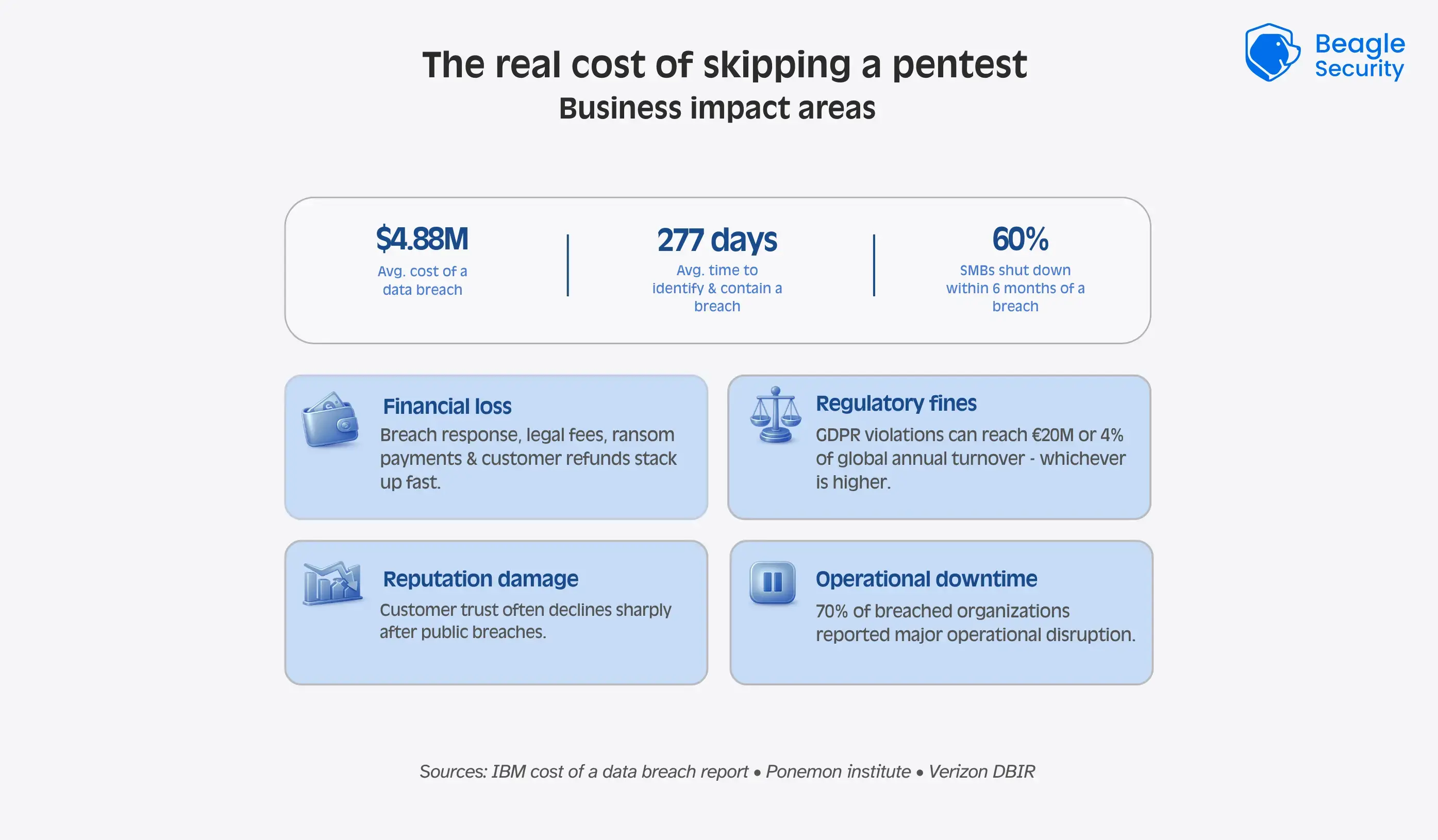
In short, penetration testing isn’t just about compliance, it’s about confidence. The insights gained from each phase help transform your security from reactive to resilient.
Essential 5 phases of penetration testing
Every penetration testing engagement follows a structured and methodical process. While tools and tactics may vary depending on the scope, the core five phases of penetration testing remain consistent across frameworks and methodologies.
Let’s break them down in detail.
1. Reconnaissance
The reconnaissance phase, also known as information gathering, is the foundation of every penetration test.
At this stage, testers collect as much information as possible about the target system, organization, and infrastructure. The goal is to map out the environment and identify potential entry points without actually engaging or exploiting the target yet.
Key activities include:
Passive reconnaissance: Gathering publicly available data such as domain information, employee details, IP ranges, and open-source intelligence (OSINT).
Active reconnaissance: Using controlled techniques like ping sweeps, DNS queries, or port scanning to identify live hosts and services.
Outcome:
The reconnaissance phase helps testers create a detailed profile of the target environment. This intelligence guides the next stages of testing and determines the most efficient attack vectors to explore.
2. Scanning and discovery
Once enough information is gathered, the next penetration testing phase involves scanning and discovery. Here, testers move from observation to interaction, probing the target system to uncover live hosts, open ports, and active services.
Key activities include:
Network scanning: Identifying connected systems, open ports, and accessible services.
Application mapping: Detecting technologies in use (frameworks, CMS, web servers).
Service enumeration: Collecting detailed information about identified services, versions, and potential vulnerabilities.
Popular tools like Nmap, Nessus, or Nikto are often used during this phase.
Outcome:
A clear understanding of the system’s attack surface. The data collected here helps narrow down potential vulnerabilities to be tested in the next phase.
3. Vulnerability assessment
In this third penetration testing phase, the focus shifts from discovery to analysis. Testers identify, classify, and prioritize vulnerabilities found in the target environment.
Key activities include:
Running automated vulnerability scanners to detect known issues.
Manual verification of results to eliminate false positives.
Risk ranking of vulnerabilities based on severity, impact, and exploitability.
Outcome:
A prioritized list of vulnerabilities is ready for deeper exploitation. This phase bridges the gap between raw data collection and actionable security insights.
4. Exploitation
This is the most critical and high-impact phase of penetration testing where ethical hackers actively exploit discovered vulnerabilities to determine their real-world risk.
Unlike vulnerability scanning, exploitation simulates how an attacker could gain unauthorized access, escalate privileges, or move laterally across systems.
Key activities include:
Launching controlled exploits against validated vulnerabilities.
Gaining system access through misconfigurations or weak credentials.
Privilege escalation to access sensitive data or admin-level functions.
Pivoting to other systems within the network.
Ethical hackers follow strict guidelines to ensure testing remains safe and controlled, without disrupting business operations.
Outcome:
A realistic assessment of how far a real attacker could go and what data or systems are at risk. The exploitation phase provides proof of concept for vulnerabilities, making remediation efforts more targeted and urgent.
5. Reporting and remediation
The final penetration testing phase is where technical findings are translated into actionable insights. The reporting and remediation phase provides decision-makers with a clear, prioritized roadmap for strengthening security defenses.
Key components of the report include:
Executive summary: High-level overview of risks and business impact.
Detailed technical findings: Vulnerabilities discovered, severity levels, and evidence of exploitation.
Recommendations: Step-by-step remediation guidance.
Validation plan: Guidance for re-testing and verifying fixes.
Outcome:
The organization receives a comprehensive report that bridges technical details with business relevance. This phase empowers teams to take immediate, informed action turning vulnerabilities into opportunities for stronger resilience.
Penetration testing methodologies
To ensure consistency, reliability, and repeatability, penetration tests often align with recognized methodologies. These frameworks define standardized penetration testing phases and procedures, ensuring that assessments are comprehensive, reproducible, and defensible.
Here are four of the most widely recognized and respected methodologies in the industry:
1. OWASP testing guide
The OWASP Testing Guide is one of the most widely adopted frameworks for conducting web application penetration testing. Developed by the Open Web Application Security Project (OWASP), this guide provides a detailed, community-driven roadmap for identifying and mitigating vulnerabilities in web applications.
It emphasizes testing against the OWASP Top 10, a list of the most critical web application security risks such as injection flaws, cross-site scripting (XSS), insecure deserialization, and security misconfigurations.
The OWASP methodology follows a structured approach that aligns closely with the standard penetration testing phases, beginning with reconnaissance and ending with reporting. Each stage includes clear testing objectives, recommended tools, and validation techniques.
This framework is particularly valuable for organizations developing or maintaining web applications, APIs, or SaaS products.
2. NIST SP 800-115
The NIST Special Publication 800-115, titled “Technical Guide to Information Security Testing and Assessment,” is a U.S. government-backed framework that defines a structured and formalized approach to penetration testing and related security assessments.
Developed by the National Institute of Standards and Technology (NIST), this guide breaks down the testing lifecycle into distinct phases: planning, execution, post-testing activities, and reporting. These stages align with the penetration testing phases discussed earlier, emphasizing thorough documentation, repeatable processes, and measurable results.
NIST SP 800-115 is especially beneficial for organizations operating in regulated sectors such as government, finance, and healthcare. It provides guidance not just on how to conduct tests, but also on how to plan, scope, and manage them in compliance with broader information security programs (such as NIST Cybersecurity Framework or FISMA).
3. PTES (Penetration Testing Execution Standard)
The Penetration Testing Execution Standard (PTES) was created by a group of leading cybersecurity professionals to bring uniformity and clarity to penetration testing engagements worldwide. It defines a detailed, end-to-end structure covering seven distinct penetration testing phases, from pre-engagement interactions to post-exploitation and reporting.
These seven phases are:
Pre-engagement interactions – Defining scope, rules of engagement, and objectives.
Intelligence gathering – Collecting data about the target.
Threat modeling – Identifying and prioritizing attack paths.
Vulnerability analysis – Discovering potential weaknesses.
Exploitation – Attempting to compromise systems.
Post-exploitation – Assessing impact and persistence.
Reporting – Documenting and communicating results.
PTES balances technical depth with practical application, providing both executive-level guidance and technical specifics. It’s often seen as the gold standard for professional and consulting firms conducting client-focused penetration tests.
4. OSSTMM (Open Source Security Testing Methodology Manual)
The Open Source Security Testing Methodology Manual (OSSTMM), developed by the Institute for Security and Open Methodologies (ISECOM), provides a highly analytical and quantitative framework for evaluating operational security. Unlike other methodologies that focus primarily on technical vulnerabilities, OSSTMM takes a measurable, scientific approach to assessing how well an organization’s controls actually protect its assets.
OSSTMM divides testing into five channels: Human, Physical, Wireless, Telecommunications, and Data Networks. Each channel represents a potential attack surface and is evaluated for visibility, trust, and control metrics. The outcome is a Security Test Audit Report (STAR) that provides measurable insights into how secure, operational, and resilient each system is.
This methodology is particularly useful for enterprises seeking a quantitative measure of their security posture, not just a qualitative vulnerability list. It provides an excellent foundation for comparing different systems or validating compliance with internal security standards.
Extended modern penetration testing phases
Cyber threats and development practices are evolving rapidly, and so is penetration testing. Beyond the traditional five phases, modern security teams are extending their approach to include continuous validation and automation.
Continuous penetration testing (DevSecOps integration)
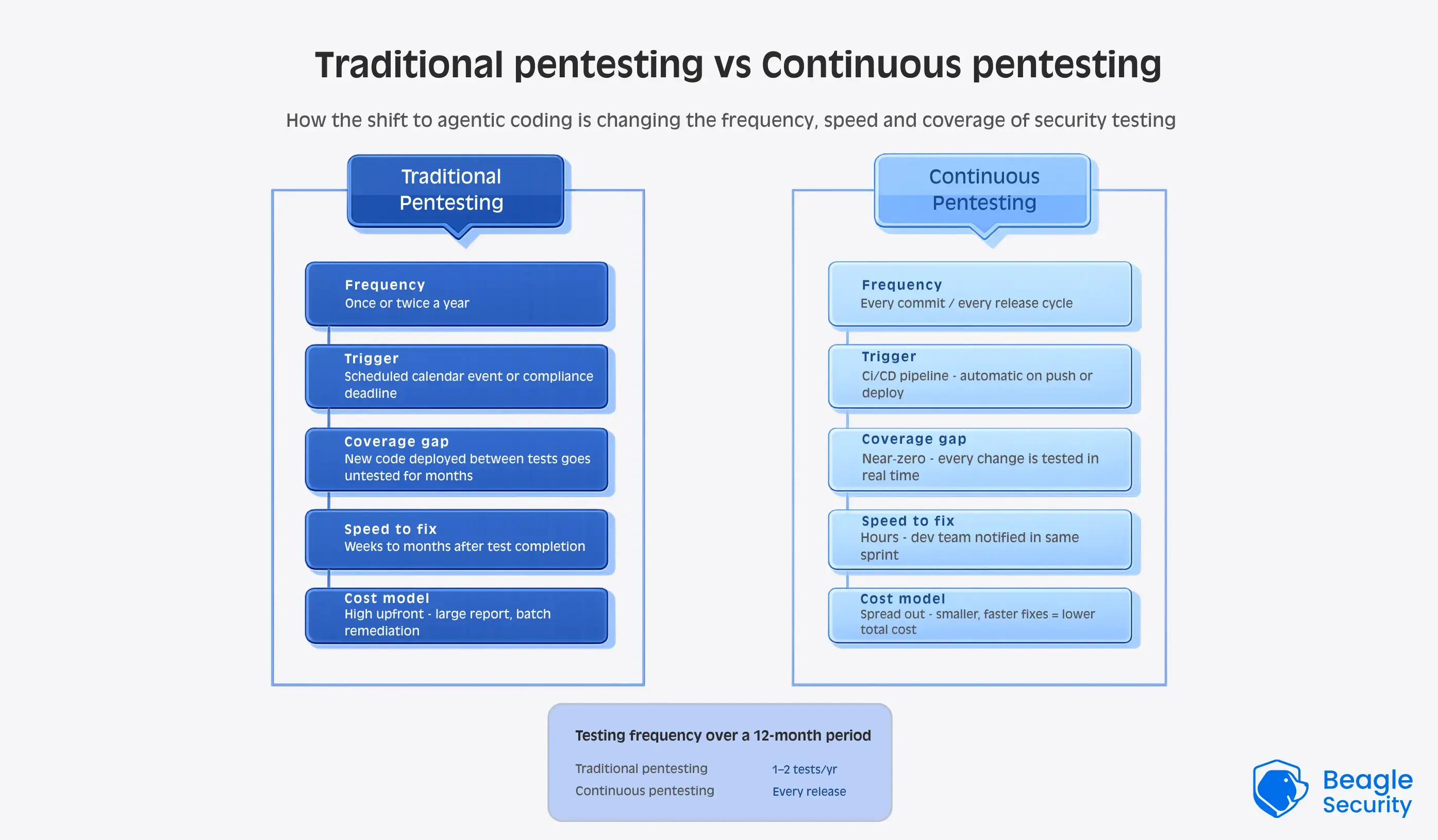
In agile and DevSecOps environments, traditional annual tests aren’t enough. Continuous penetration testing integrates testing into the software development lifecycle (SDLC), allowing organizations to:
Detect vulnerabilities earlier in the development process.
Automate scans during every release cycle.
Maintain real-time visibility into security posture.
This approach shifts penetration testing from a point-in-time activity to an ongoing security assurance practice.
AI and automation in penetration testing
Artificial intelligence is revolutionizing the way penetration tests are conducted. AI-powered platforms like Beagle Security automate key penetration testing phases, including reconnaissance, vulnerability analysis, and reporting.
Benefits include:
Faster test cycles with improved accuracy.
Adaptive intelligence that learns from results.
Scalable testing for complex web apps and APIs.
AI-driven automation doesn’t replace human expertise but rather amplifies it, enabling security teams to focus on critical insights rather than repetitive tasks.
Covering penetration testing phases with Beagle Security
Beagle Security offers an intelligent and automated way to cover all penetration testing phases with continuous validation built in.
Here’s how Beagle Security aligns with the 5 phases:
Reconnaissance & scanning:
Beagle Security’s AI-powered engine performs deep and wide scans to identify subdomains, endpoints, open ports, APIs, and connected assets, giving you full visibility into your attack surface.
Unlike traditional scanners that rely on static inputs, Beagle Security dynamically adapts its discovery methods, ensuring that newly deployed or hidden assets are not missed. This continuous scanning capability helps teams maintain an up-to-date understanding of their exposure.
Vulnerability assessment:
Beagle Security uses an extensive vulnerability database that includes CVE (Common Vulnerabilities and Exposures) references and continuously updated threat intelligence. Combining automated analysis with contextual logic reduces false positives and ensures that only actionable, validated vulnerabilities are reported.
Exploitation:
During the exploitation phase, Beagle Security conducts safe, controlled simulations of real-world attacks to verify whether discovered vulnerabilities can actually be exploited.
This approach bridges the gap between theoretical risk and practical exposure.
Reporting & remediation:
One of Beagle Security’s biggest strengths lies in its comprehensive reporting phase. Each penetration test culminates in a detailed yet accessible report tailored to both technical and non-technical audiences.
Reports include:
An executive summary that highlights key risks, their potential business impact, and overall security posture.
Technical findings that detail vulnerabilities, exploit evidence, and affected components.
Remediation recommendations with practical steps for mitigation.
Validation guidance for confirming fixes through re-testing.
Continuous testing:
Through CI/CD integrations, Beagle Security automatically triggers security tests whenever new code or deployments are pushed. This aligns perfectly with DevSecOps principles, embedding security directly into the software lifecycle.
The platform’s continuous validation model also means that as your application evolves, your security posture is constantly monitored and updated.
By aligning with frameworks like OWASP and PTES, Beagle Security ensures every test is comprehensive, compliant, and data-driven.
Final thoughts
Understanding the phases of penetration testing is the first step toward building a proactive, resilient cybersecurity strategy.
Each phase, from reconnaissance to reporting, plays a critical role in uncovering vulnerabilities, validating defenses, and strengthening organizational security. And as threats evolve, so must your approach by embracing automation, continuous testing, and AI-powered insights.
Platforms like Beagle Security can accelerate this journey by automating compliance-aligned penetration testing, offering actionable insights, and helping security and development teams stay in sync. Check out our free 14 day trial to see if we are right for all your web application security needs.
FAQs
1. What are the main phases of penetration testing?
The main penetration testing phases are reconnaissance, scanning, vulnerability assessment, exploitation, and reporting, each designed to identify and address security weaknesses systematically.
2. How long does a penetration test take?
A penetration test typically takes anywhere from a few days to a few weeks, depending on the scope, complexity, and number of systems involved.
3. What frameworks define penetration testing phases?
Common frameworks that define penetration testing phases include OWASP, PTES, and NIST SP 800-115, ensuring standardized and repeatable testing procedures.
4. How often should an organization perform penetration testing?
Organizations should conduct penetration testing at least once a year or after significant system updates, infrastructure changes, or new application deployments.


![Top ZAP alternatives and competitors [October 2026]](/blog/images/top-zap-alternatives-cover.webp "Top ZAP alternatives and competitors [October 2026]")




![Top 10 penetration testing companies [2026]](/blog/images/top-penetration-testing-companies-cover.webp "Top 10 penetration testing companies [2026]")




![Top vendor application security tools [2026]](/blog/images/top-vendor-application-security-testing-tools-2026-cover.webp "Top vendor application security tools [2026]")



![Top Snyk alternatives & competitors [2026]](/blog/images/top-snyk-alternatives-cover.webp "Top Snyk alternatives & competitors [2026]")