Best AppSec tools in 2026

With cyberattacks becoming more sophisticated and organizations relying heavily on software for critical business operations, AppSec tools have evolved into essential investments. The right AppSec tools not only reduce risks but also enable secure innovation at scale.
The sheer number of tools available can be overwhelming, each promising a unique set of features and benefits. The key is to understand the different types of AppSec products and how they fit into a holistic security strategy.
The aim of this guide is to cut through the noise to provide a clear, concise overview of the best AppSec tools on the market today, helping you make an informed decision for your organization.
Best AppSec tools in 2026 (TL;DR)
Best overall AppSec tool in 2026: Beagle Security
Best AppSec tool for SAST: Semgrep
Best AppSec tool for SCA: Mend
Best AppSec tool for DAST: Beagle Security
Best AppSec tool for RASP: Contrast Security
Best DAST tools
Beagle Security
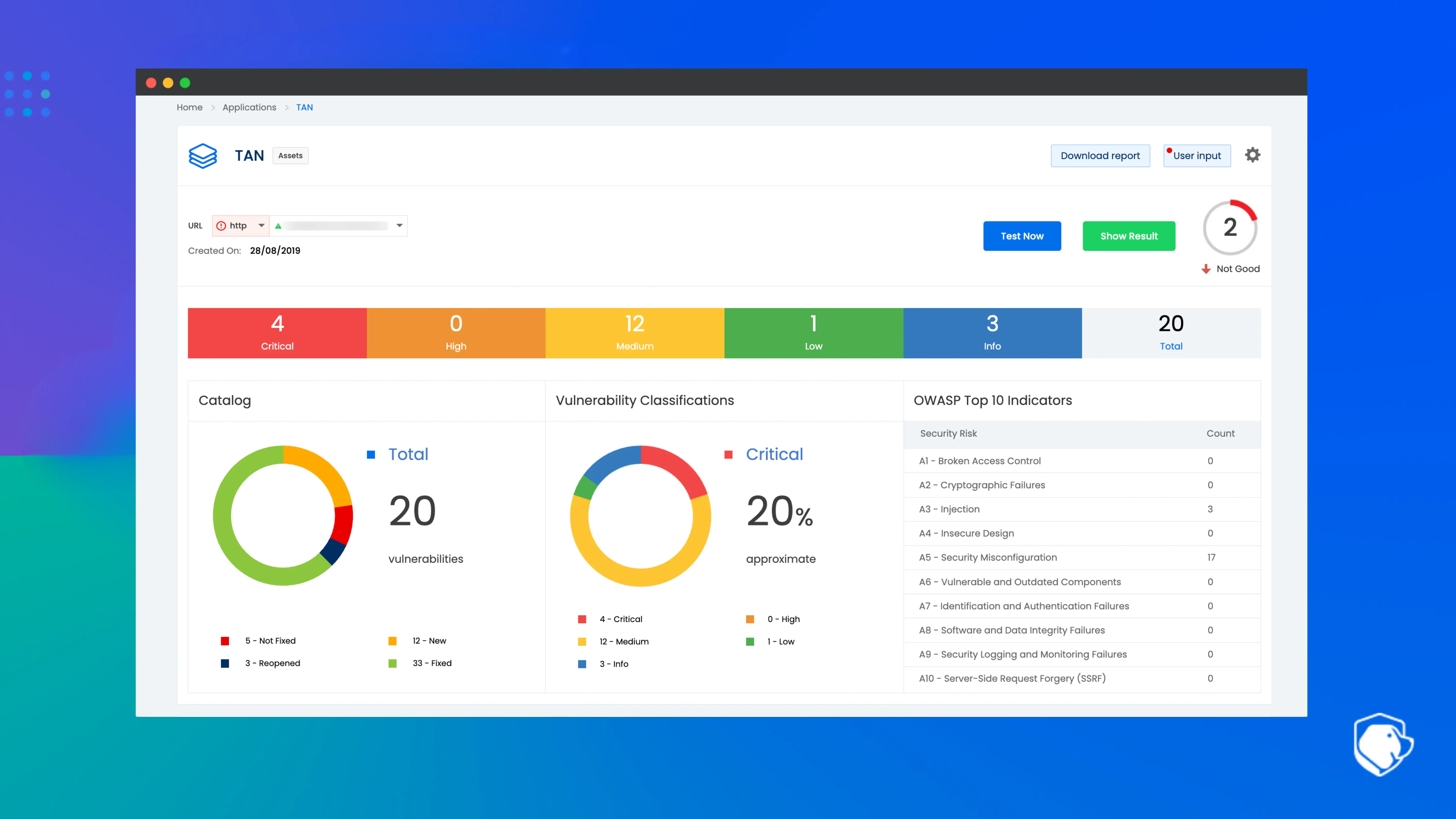
Beagle Security provides continuous, agentic AI pentesting that behaves more like a penetration tester than a signature scanner. It’s built for real-world complexity: multi-step logins, single-page apps, GraphQL APIs, and brittle flows that often trip automated scanners. Beagle Security’s core advantage is signal quality, i.e. less noise, more context, and reports that slot neatly into engineering workflows.
Beagle Security prioritizes “time to clear risk.” It reduces false positives, maps findings to business impact, and integrates with CI/CD so teams can block risky releases, retest on fix, and show progress to leadership. For organizations consolidating security tooling, it also becomes a pragmatic “source of truth” for application exposure across web apps and APIs.
Beagle Security key features:
AI-driven automated penetration testing
Advanced support for web apps, APIs, and GraphQL
Continuous testing integrated into CI/CD pipelines
Compliance-ready reporting (OWASP, HIPAA, PCI DSS)
Smart vulnerability prioritization to reduce noise
Beagle Security pricing
Beagle Security offers flexible pricing, with plans for growing startups as well as enterprise-grade deployments. Tiered pricing ensures scalability without hidden costs.
Essential plan: $1,188/year (2 tests per month)
Advanced plan: $4,308/year
Enterprise plans: Custom quote
Ratings & reviews
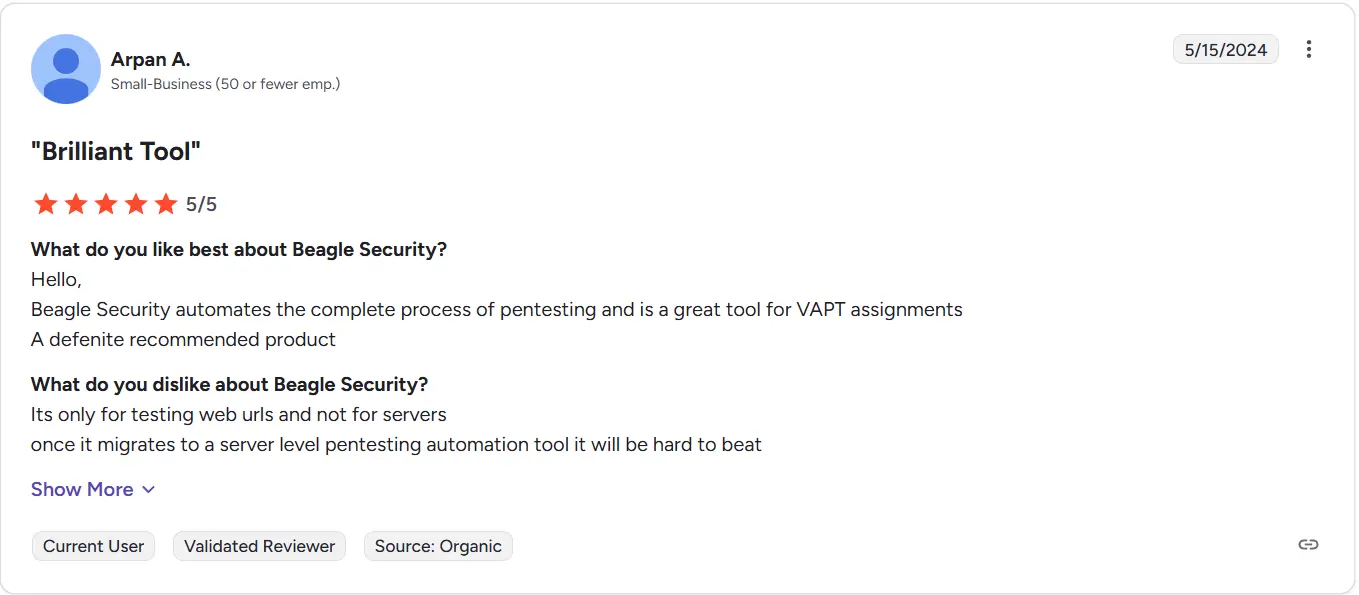
G2 rating: 4.7/5 (87 reviews)
On G2, Beagle Security is praised for ease of integration and accuracy of results. Teams highlight the platform’s ability to catch vulnerabilities automatically before deployment.
ZAP by Checkmarx
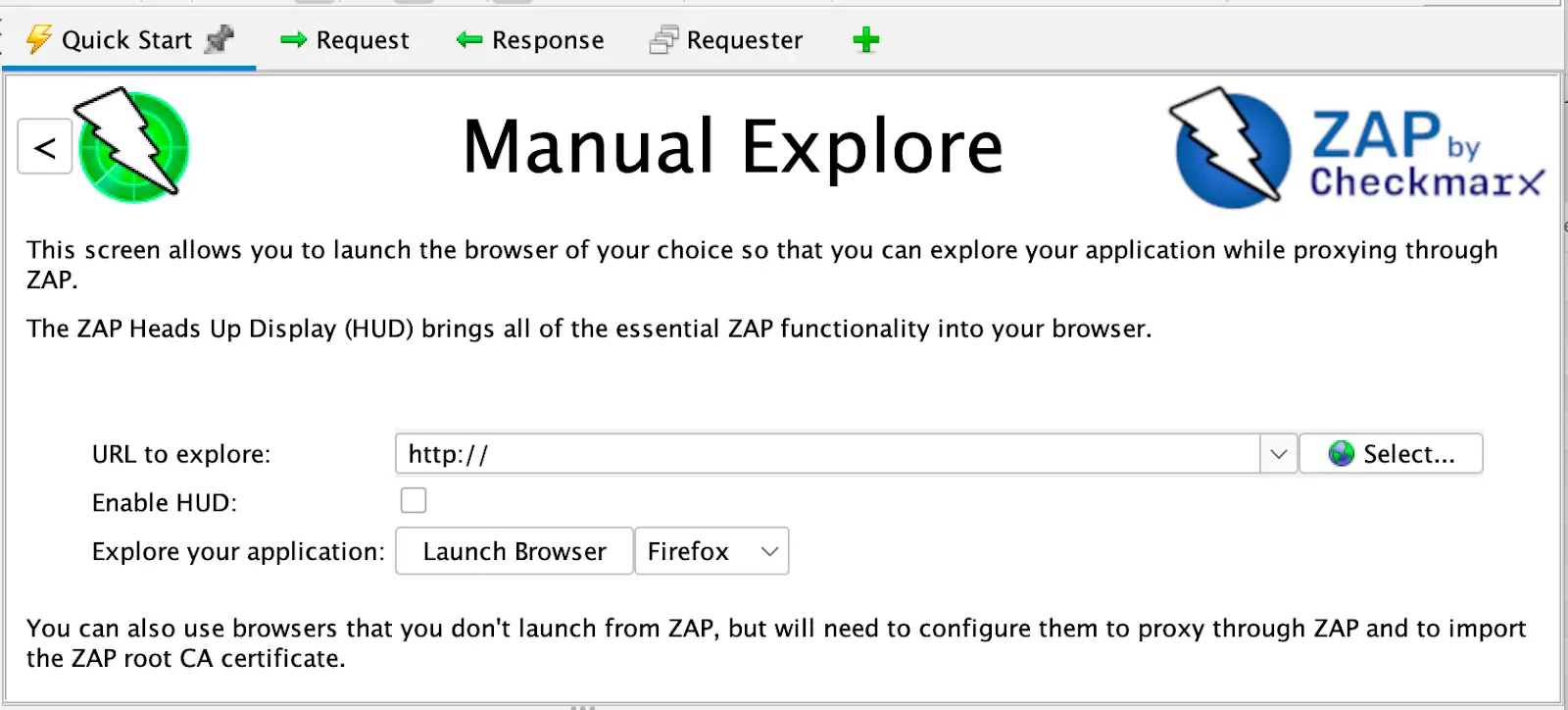
Zed Attack Proxy (ZAP) remains the most accessible entry point to DAST. It’s open source, widely documented, and backed by a committed community.
For smaller teams, internal security champions, or budget-constrained programs, ZAP enables meaningful testing without procurement friction. With scripting and add-ons, advanced users can extend it significantly.
That said, ZAP typically requires more hands-on effort to scale and to maintain parity with enterprise workflows. If you already have seasoned AppSec engineers and want fine-grained control, ZAP is a strong building block. If you need turnkey reporting, compliance mapping, and enterprise support, you’ll want to pair ZAP with internal processes. Or look to a commercial DAST.
ZAP by Checkmarx key features:
Open-source and free to use
Active and passive scanning capabilities
Extensible with community add-ons
ZAP by Checkmarx pricing
Free and open-source.
ZAP ratings & reviews
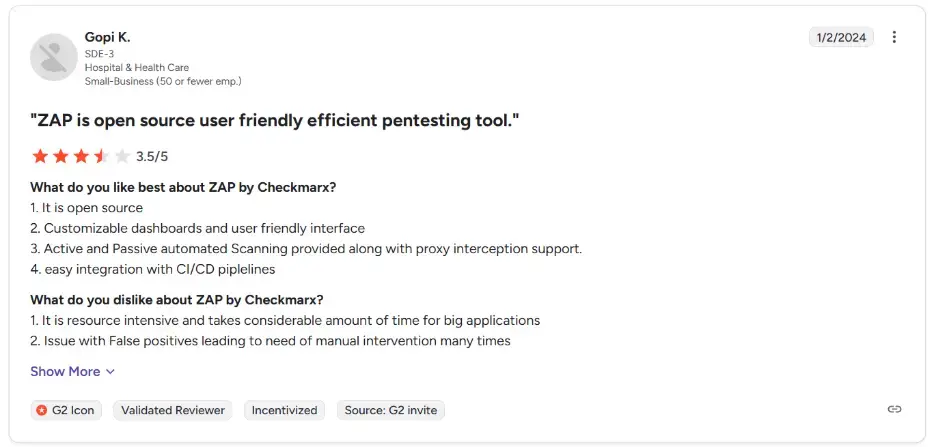
G2 rating: 4.7/5 from 12 reviews.
Strong community support but limited enterprise reviews.
Burp Suite
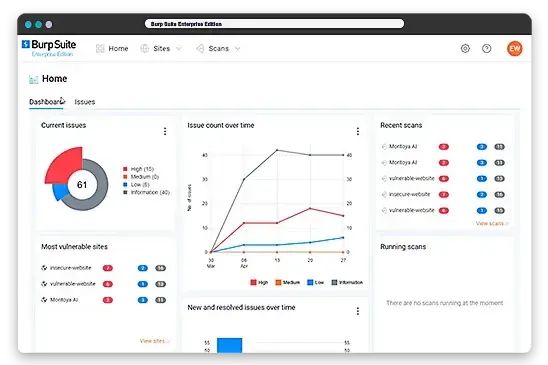
Burp Suite is the standard toolkit for many penetration testers. The Professional edition excels for exploratory testing, where human expertise matters; the Enterprise edition adds scheduled and automated scans for continuous coverage.
If you have in-house penetration testing capabilities and want to combine manual depth with repeatable automation, Burp fits well.
Operationally, the learning curve can be steeper for non-specialists, and translating raw findings into developer-ready remediation plans may require an internal playbook. Still, for teams that value hands-on control and deep manual verification, Burp Suite is a proven choice.
Burp Suite key features:
Manual and automated testing support
Powerful interception proxy
Enterprise Edition enables large-scale automation
Burp Suite pricing
Burp Suite pricing in 2026 is structured into three editions, each tailored to different audiences.
Community edition: Free
Professional edition: $475 per user per year
Enterprise Edition (DAST): Custom pricing
Pricing typically starts from $6,040 per year and can reach $34,900 annually, depending on the configuration.
Burp Suite ratings & reviews
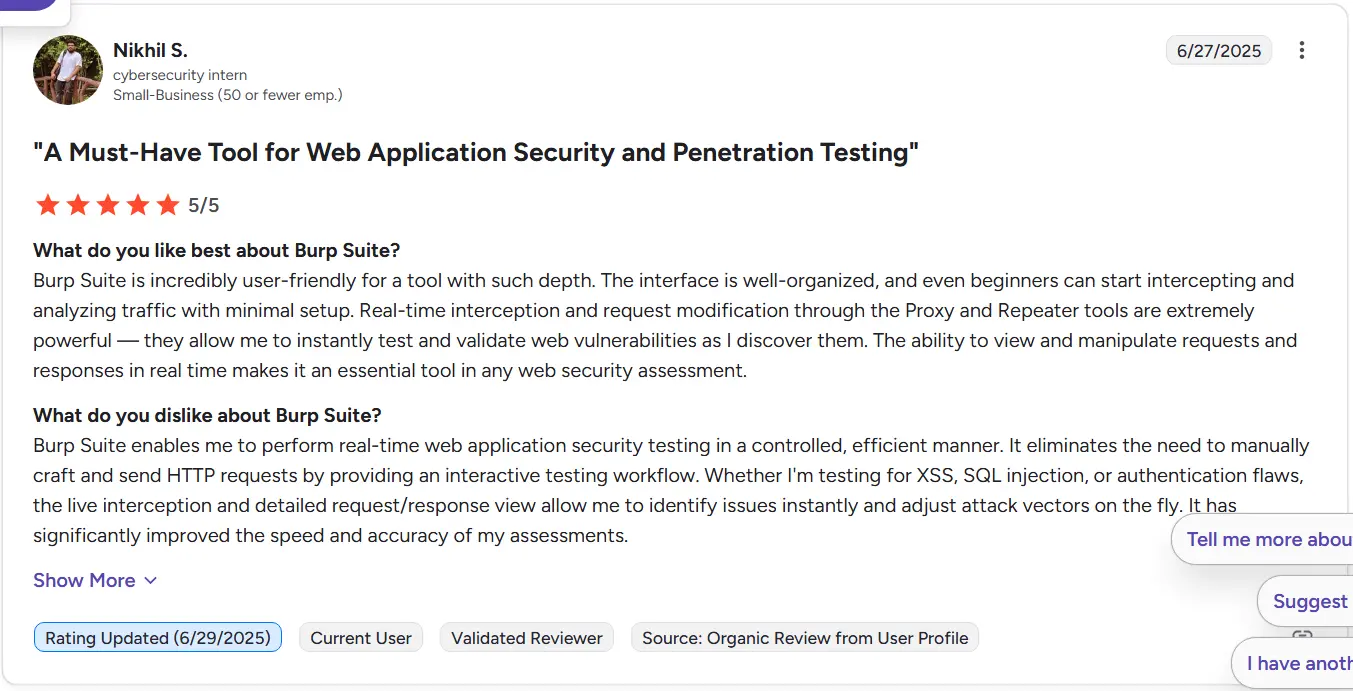
G2 rating: 4.8/5 from 124 reviews.
Best SAST Tools
Semgrep
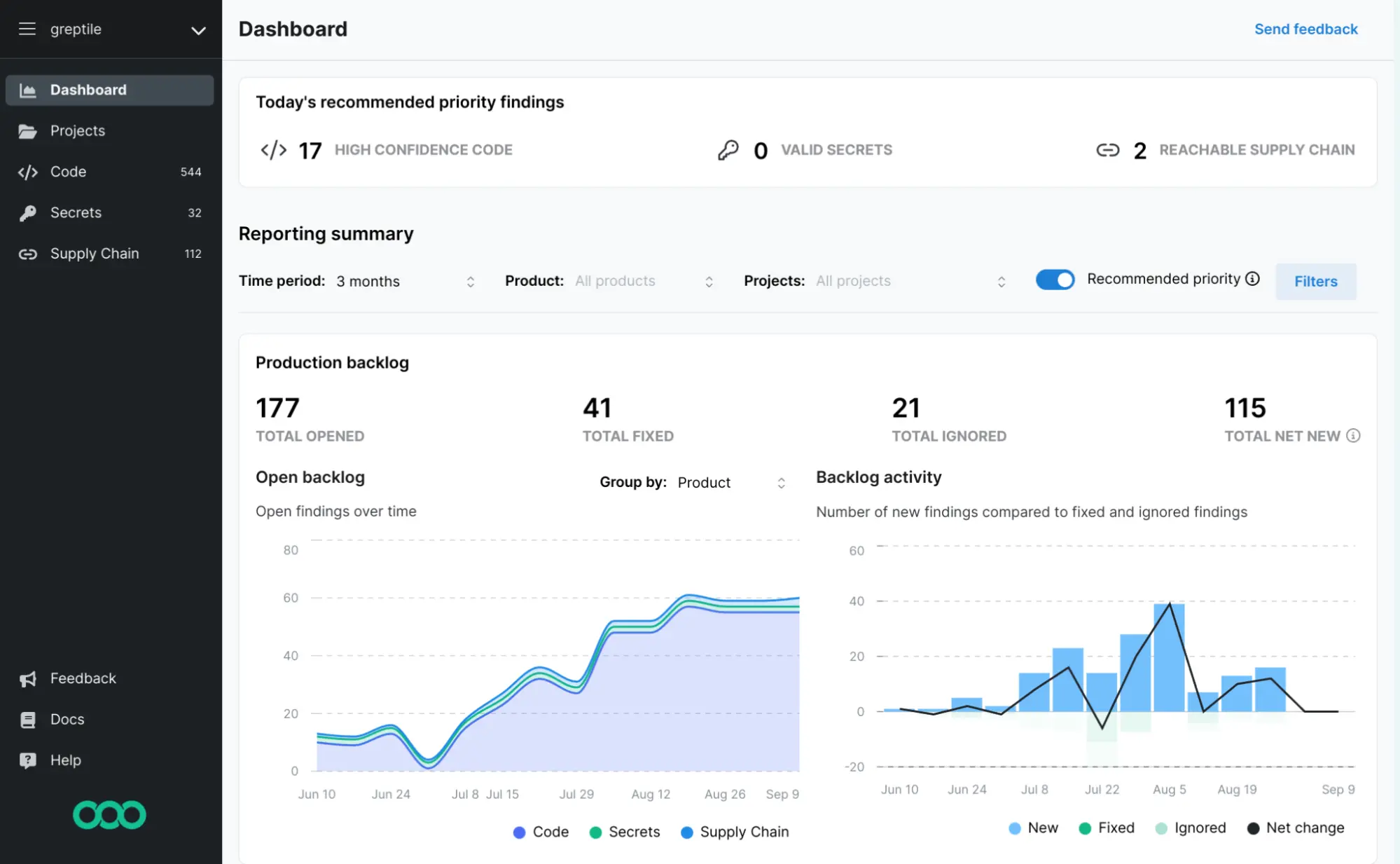
Semgrep leads SAST for developer-first programs. It’s lightweight, fast, and rule-driven. This means you can tailor checks to your codebase, frameworks, and risk appetite.
It runs locally and in CI, making it natural to adopt without slowing developers down. The open rules marketplace and ease of authoring new rules are big reasons teams standardize on Semgrep.
Mature programs use Semgrep to turn security policy into code. Instead of generic alerts, you get actionable guidance at PR time, lowering the cost of fixes.
Semgrep key features:
Lightweight and fast static analysis
Highly customizable rule sets
CI/CD pipeline integrations
Strong community-driven rule marketplace
Semgrep pricing
Semgrep has a free tier and paid plans start around $40 per contributor/month for more advanced features. Their Enterprise plan requires you to contact the team to get a custom quote.
Semgrep ratings & reviews
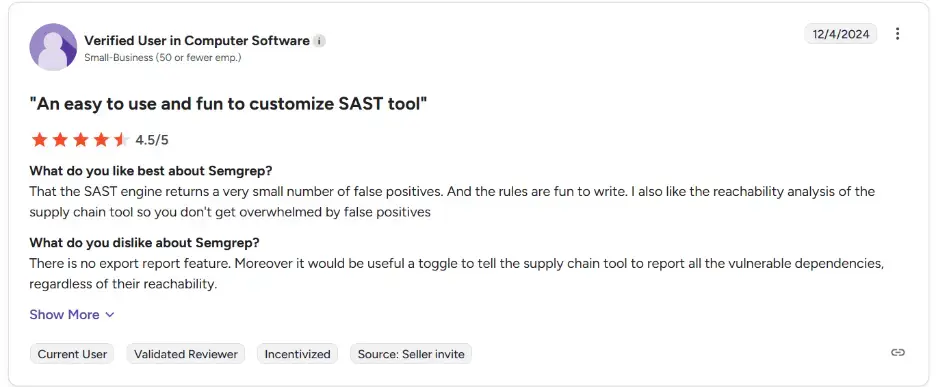
G2 rating : 4.6/5 from 54 reviews.
SonarQube

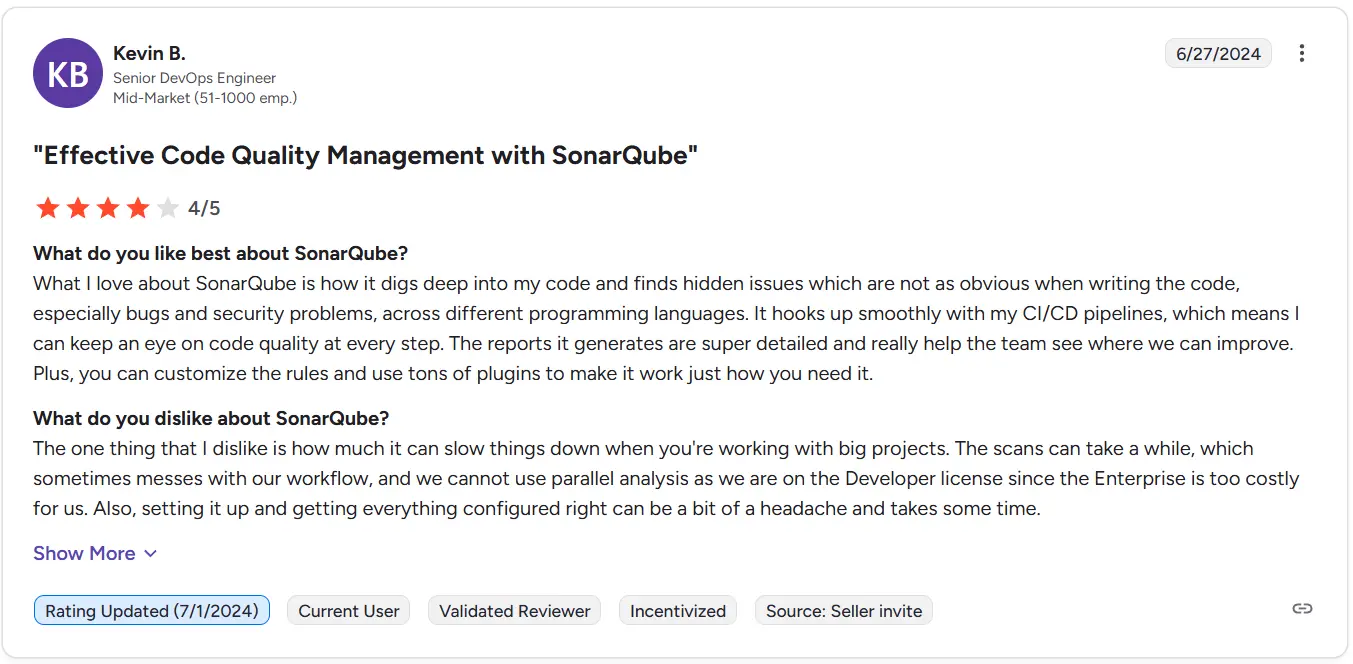
SonarQube is a well-regarded SAST tool, combining code quality analysis with security checks. Enterprises use it to identify vulnerabilities and enforce coding standards across teams.
SonarQube key features:
Multi-language support
Security vulnerabilities + code quality checks
Visual dashboards for team collaboration
SonarQube pricing
Pricing starts at $32/month. They also have a community edition.
Ratings & reviews
G2 rating: 4.5/5 from 125 reviews
Best SCA Tools
Mend (formerly WhiteSource)
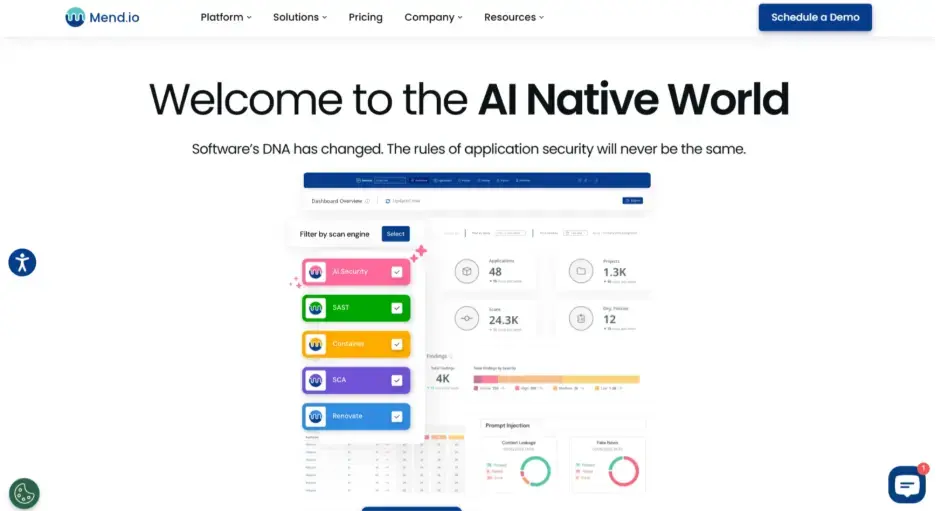
Mend stands out as one of the best Software Composition Analysis (SCA) tool in 2026. It provides visibility into open-source dependencies, licensing risks, and known vulnerabilities.
Mend key features:
Detects open-source vulnerabilities
License compliance management
Real-time alerts for newly disclosed risks
Mend pricing
The paid plans start at $1000 per developer per year.
Mend also offers a Premium package for access to their advanced AI capabilities. Pricing for this is unavailable.
Ratings & reviews
G2 rating: 4.3/5 from 112 reviews
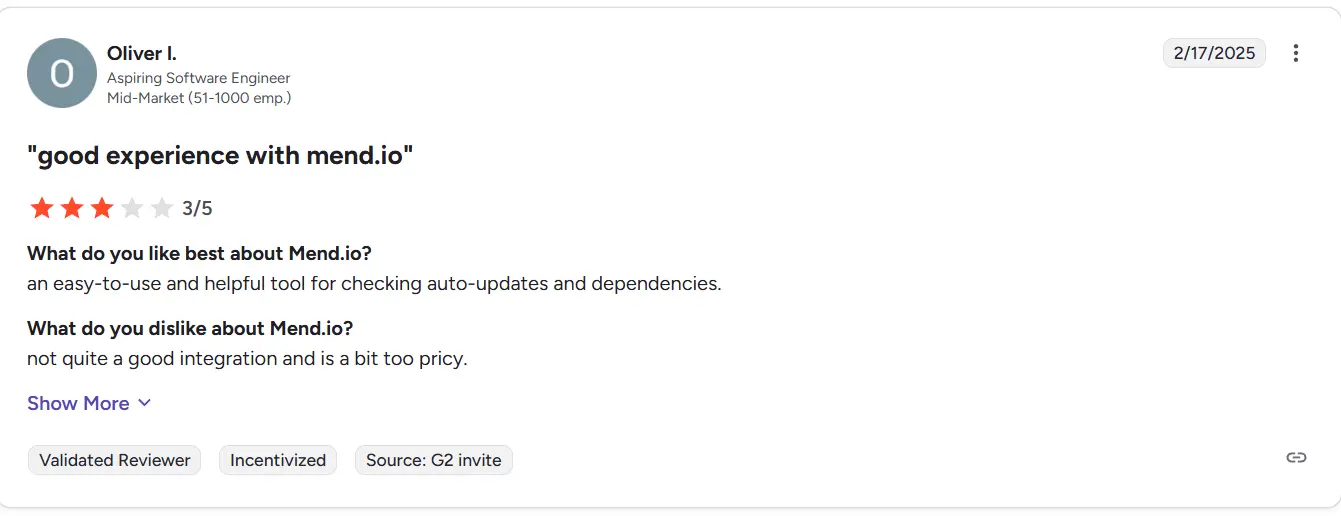
Snyk
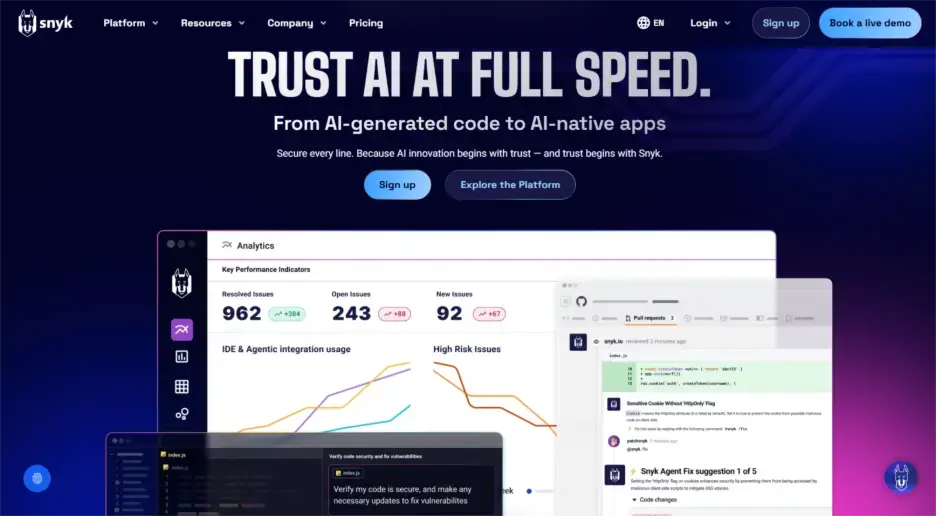
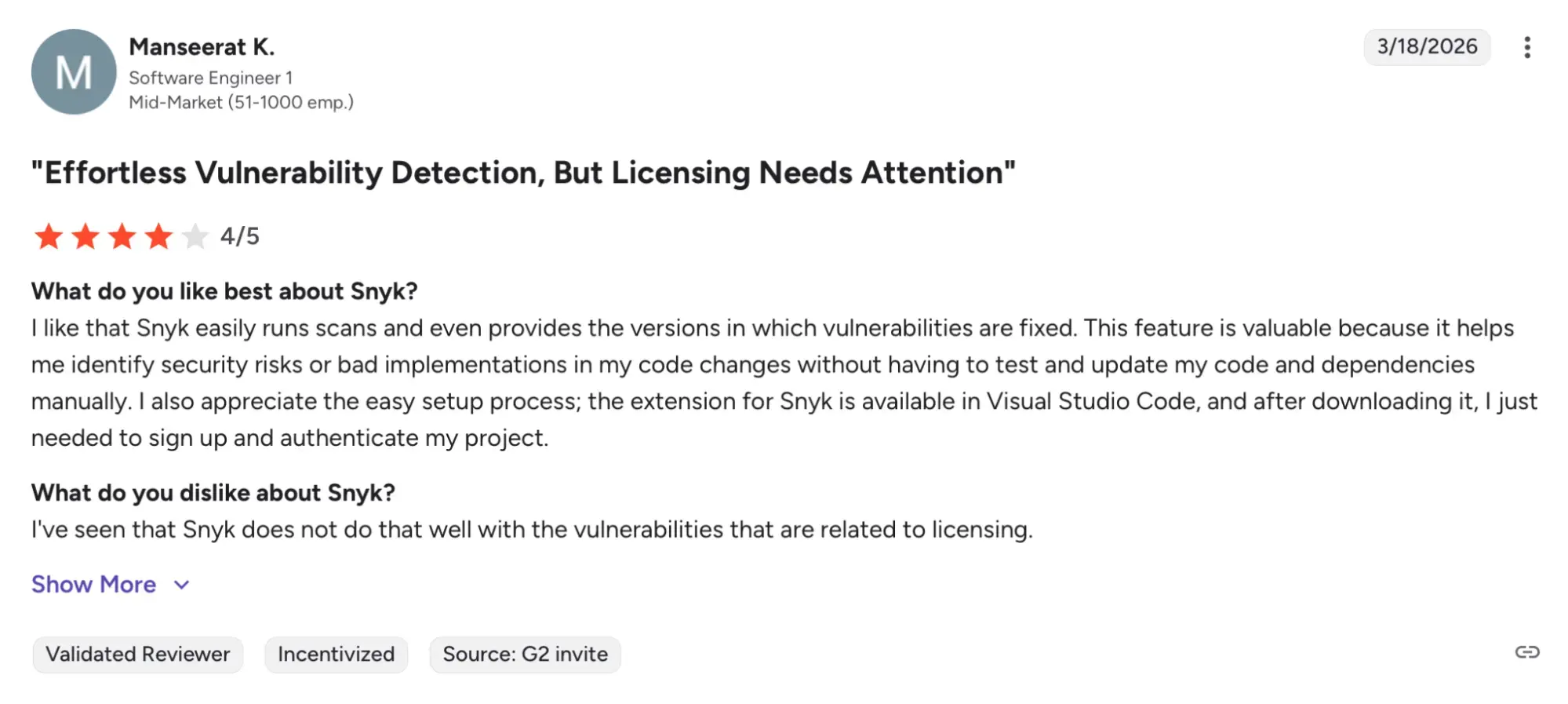
Snyk is a developer-friendly SCA tool with deep integrations across the development ecosystem. It covers open-source, containers, and Infrastructure-as-Code.
Snyk key features
Snyk’s SAST identifies and mitigates vulnerabilities pre-deployment.
Developers get real-time feedback and an intuitive UI to fix issues.
It integrates with development tools and provides remediation guidance.
Snyk also offers SCA, container, and IaC security scanning.
Snyk pricing
Snyk offers a free subscription plan for you to get started.
The paid Team subscription plan starts at $25/developer per month. A limitation here is that the Team plan requires a minimum of 5 developers, according to the information available on the pricing page.
Ratings & reviews
G2 rating: 4.5/5 from 125 reviews.
Best RASP Tools
Contrast Security
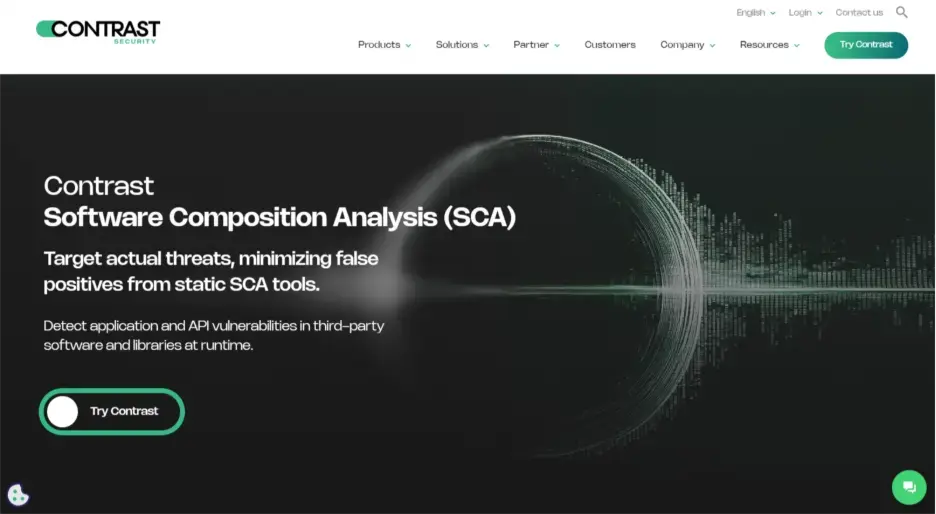
Contrast Security leads the RASP space by embedding protection directly into applications. It detects and blocks attacks in real-time.
Contrast Security key features
Runtime detection and blocking of threats
Context-aware vulnerability insights
Continuous monitoring
Contrast Security pricing
Enterprise-focused pricing, tailored per deployment.
Ratings & reviews
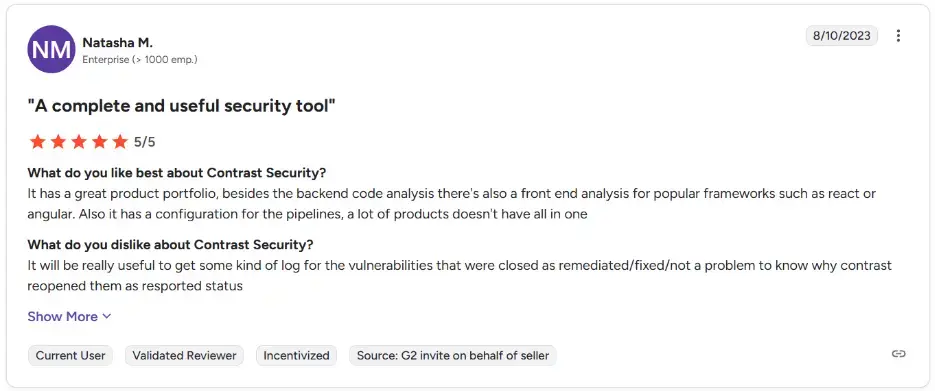
G2 rating: 4.5/5 from 51 reviews
Imperva RASP
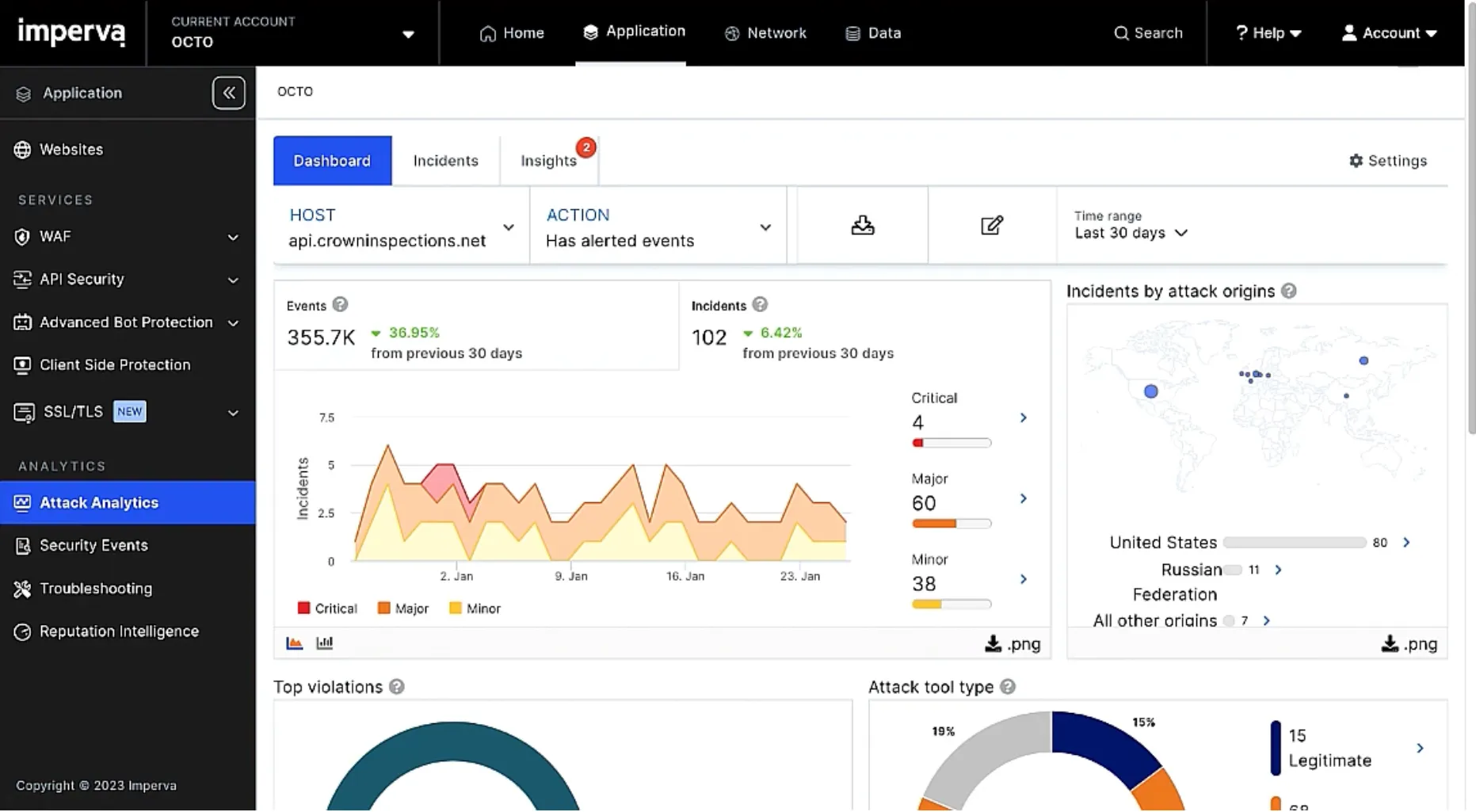
Imperva’s RASP solution offers runtime visibility and protection, often deployed in organizations already using Imperva’s broader ecosystem.
Imperva key features
Real-time detection of app-layer attacks
Seamless integration with Imperva WAF and security suite
Imperva pricing
Pricing has not been listed publicly.
Ratings & reviews
G2 rating: 5/5 from just 2 reviews
Key factors to consider when choosing an AppSec tool
Choosing the right AppSec tool depends on your business needs. Here are the factors decision-makers should evaluate:
Specific use case: Pre-production testing (SAST, SCA, DAST) or runtime protection (RASP)?
Integration: Can the tool integrate seamlessly with your CI/CD pipelines, ticketing systems, and existing workflows?
Scalability: Will the tool support your growing application portfolio?
Ease of use: Is it developer-friendly, or does it require security specialists to operate?
Reports and analytics: Does it provide actionable insights tailored for both developers and executives?
Support: Is enterprise-grade support available when issues arise?
Budget: Does the pricing align with your security investment strategy?
Deployment options: Does it support cloud, hybrid, or on-premises environments?
Final thoughts
The landscape of AppSec tools in 2026 reflects the growing complexity of securing applications in a fast-moving digital world. From SAST and SCA that catch vulnerabilities early, to DAST and RASP tools that provide deeper coverage and runtime protection, no single category is enough on its own.
However, for most organizations looking for a comprehensive and scalable AppSec strategy, Beagle Security stands out as the best overall choice. By combining AI-driven DAST capabilities, developer-friendly workflows, and compliance-ready reports, it bridges the gap between security and innovation.
For decision-makers, the key takeaway is clear: Invest in tools that not only secure your applications but also align with your organizational culture, developer workflows, and long-term growth strategy.


![Top ZAP alternatives and competitors [October 2026]](/blog/images/top-zap-alternatives-cover.webp "Top ZAP alternatives and competitors [October 2026]")




![Top 10 penetration testing companies [2026]](/blog/images/top-penetration-testing-companies-cover.webp "Top 10 penetration testing companies [2026]")


![Top vendor application security tools [2026]](/blog/images/top-vendor-application-security-testing-tools-2026-cover.webp "Top vendor application security tools [2026]")


![Top Snyk alternatives & competitors [2026]](/blog/images/top-snyk-alternatives-cover.webp "Top Snyk alternatives & competitors [2026]")