Top Invicti alternatives in the market [2026]
![Top Invicti alternatives in the market [2026]](/blog/images/invicti-alternatives.webp "Top Invicti alternatives in the market [2026]")
Invicti (formerly Netsparker) remains a dominant name in application security testing, known for proprietary proof based scanning and strong automation. It’s a reliable choice for organizations that need validated vulnerability findings at scale.
But the landscape has shifted. AI generated code, microservices, API first architectures, and continuous deployment have teams reassessing whether traditional scanning keeps up, and Invicti’s expansion into posture management has added real capability along with real complexity.
This guide covers the leading Invicti alternatives in 2026, from enterprise platforms to newer AI driven tools, to help you find one that strengthens your security culture without slowing development down.
Best Invicti alternatives: TL;DR
| Software | Starting price | Strengths | Best for |
|---|---|---|---|
| Beagle Security | $119/month | Agentic AI pentesting, concurrent testing, developer friendly reports | Agile teams and modern applications with complex login flows |
| Rapid7 InsightAppSec | $175/month | Lightweight IAST capabilities, integration with other Rapid7 tools | Organizations already using the Rapid7 Insight Platform |
| Tenable WAS | $7,434/year | Risk based prioritization, comprehensive vulnerability coverage | Large enterprises focused on broad exposure management |
| Qualys WAS | Custom quote | Integrated vulnerability management, asset discovery, compliance reports | Organizations already using the Qualys Cloud Platform |
| ZAP | Free | Open source, accessible to all skill levels, strong community | Individual developers, small teams, budget conscious projects |
| Burp Suite | Custom quote | Highly customizable, strong manual penetration testing tools | Expert security professionals and dedicated pentesters |
| Checkmarx | Custom quote | Comprehensive SAST, DAST, and SCA suite | Organizations needing a full spectrum, enterprise grade AppSec platform |
| Veracode | Custom quote | Cloud native, comprehensive scanning (SAST, DAST, IAST), AI generated fixes | Large enterprises with a long term AppSec strategy |
| HCL AppScan | Custom quote, pay per scan available | Full suite of AppSec tools, AI driven accuracy, on premises and cloud options | Enterprises needing a flexible, comprehensive solution with on premises support |
Best Invicti alternatives
1. Beagle Security
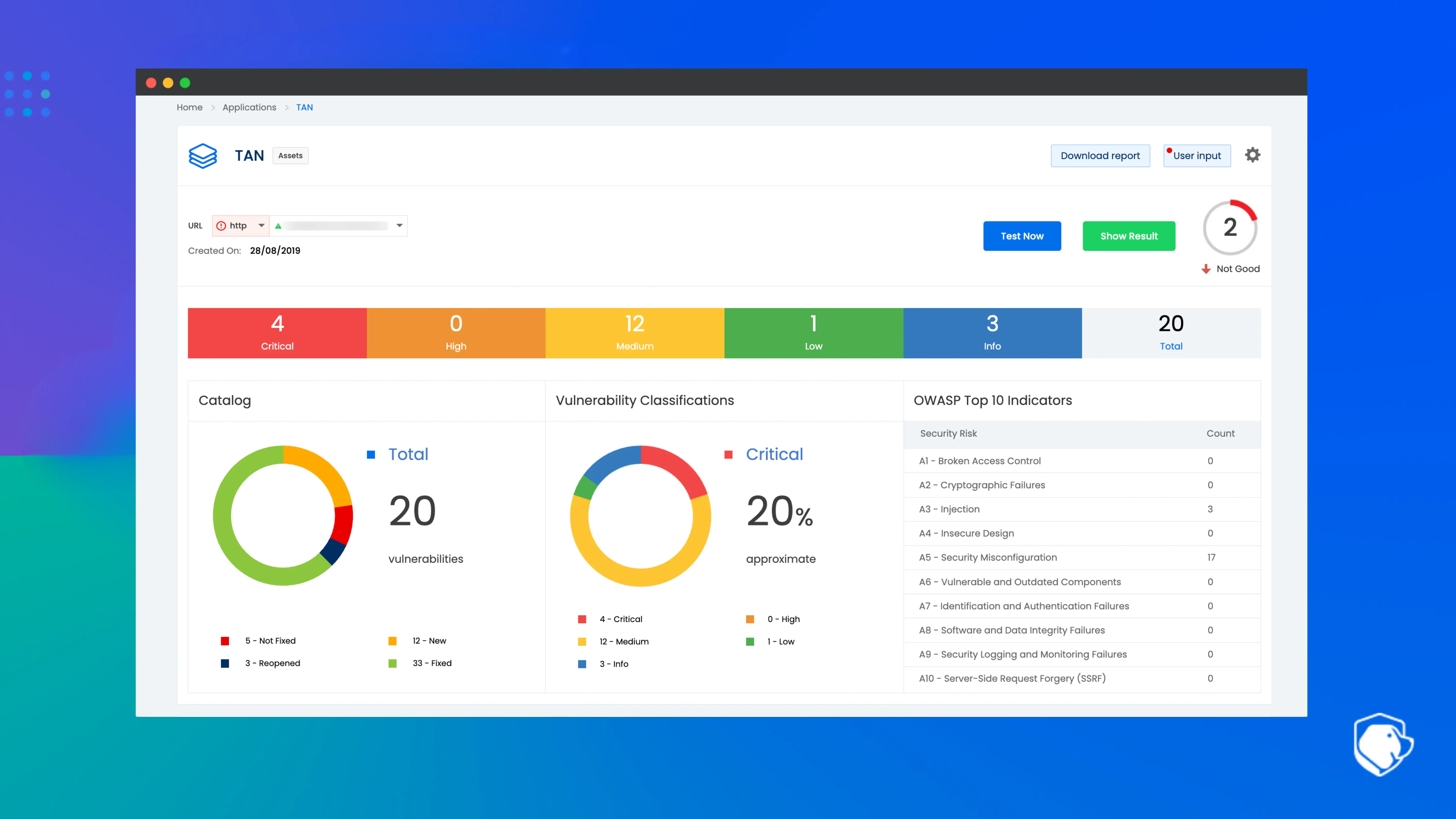
Key overview
Beagle Security takes an AI native approach to DAST, using agentic AI to run penetration tests that behave more like a human tester working through an application than a traditional signature based scanner. It’s built specifically for teams that need to test modern, authenticated applications without dedicating a security specialist to configure every scan.
Its differentiator is Cosmog, a secure outbound only tunnel that lets organizations scan internal staging and development environments without exposing inbound firewall rules, along with concurrent test based pricing that avoids the per target restrictions common elsewhere in this list.
Pricing starts at $1,188 per year. It holds a 4.7 out of 5 rating on G2, with users praising its intuitive interface, AI based test engine, and developer first reports.
Key features
Context aware testing that handles complex login flows, including 2FA
Simulates real world attacker behavior to test business logic
Full API security support for REST and GraphQL
Contextual, developer friendly reports with remediation guidance specific to the tech stack
Direct integration with CI/CD pipelines
Pricing
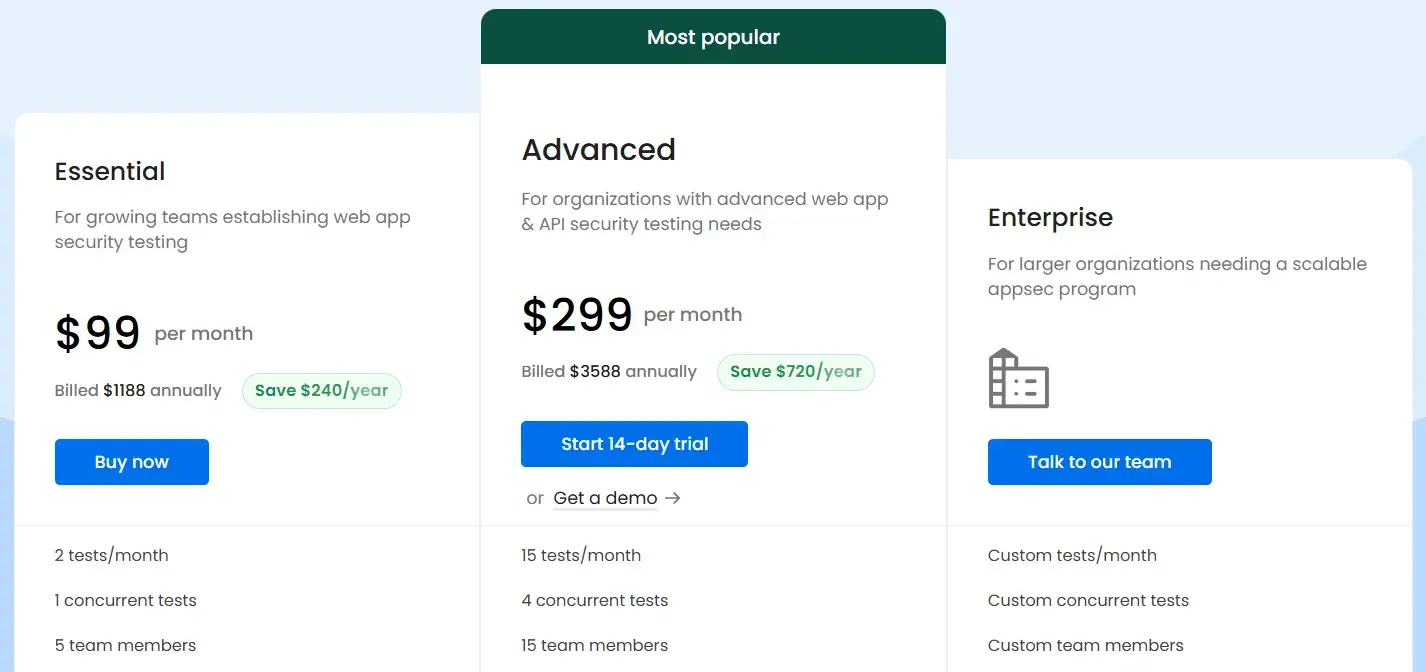
Tiered pricing starting at $1,188 per year, advanced at $3588 per year and enterprise is custom based. A 14 day advanced free trial is available.
Reviews
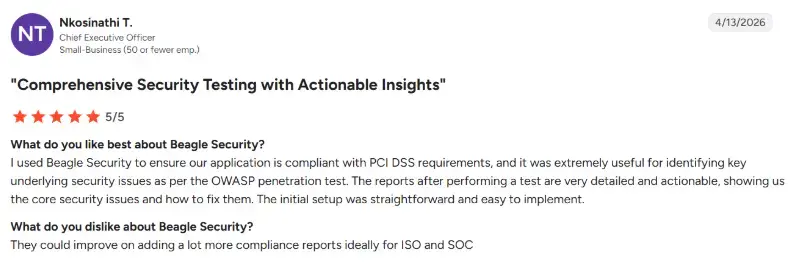
Holds a 4.7 out of 5 rating on G2. Users praise its intuitive interface, AI based test engine, and developer first reports.
2. Rapid7 InsightAppSec
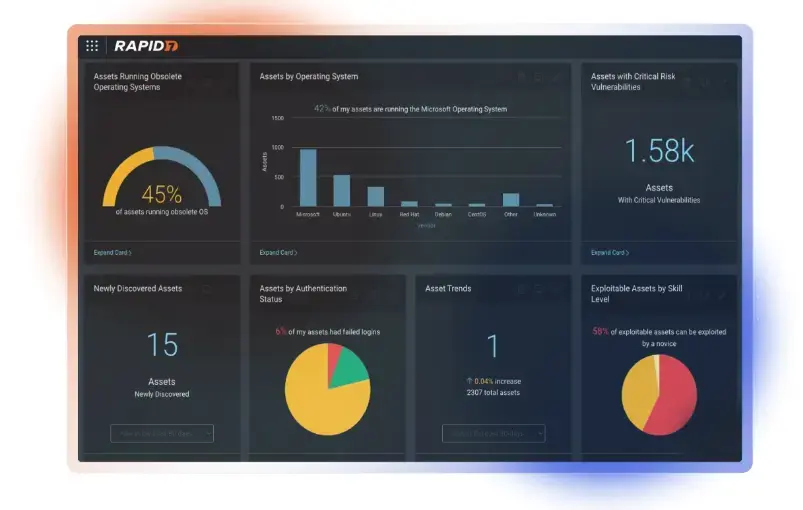
Key overview
Rapid7 InsightAppSec combines DAST with lightweight IAST capabilities, positioned within the broader Rapid7 Command Platform rather than as a standalone scanner. That platform fit is its clearest strength: organizations already using Rapid7’s other Insight tools get a more unified view of exposure across infrastructure and applications.
Its Universal Translator engine interprets modern protocols including REST, JSON, and GraphQL, and its Attack Replay feature lets developers confirm a fix worked without triggering a full rescan. For teams outside the Rapid7 ecosystem, the value case is less immediate.
Pricing starts at $175 per month per application, which can add up quickly for organizations with a large application portfolio. It holds a 3.9 out of 5 rating on G2, with users appreciating the Rapid7 tool integration, and common complaints centered on a steep learning curve and scan performance.
Key features
DAST with lightweight IAST through agents
Attack Replay for developer validation
Scan gating within CI/CD pipelines
ServiceNow certified integrations
Hybrid scan engine deployment options
Pricing
Starts at $175 per month for a single application, using a per application pricing model, which can get costly for organizations with many applications. A 30 day free trial is available.
Reviews
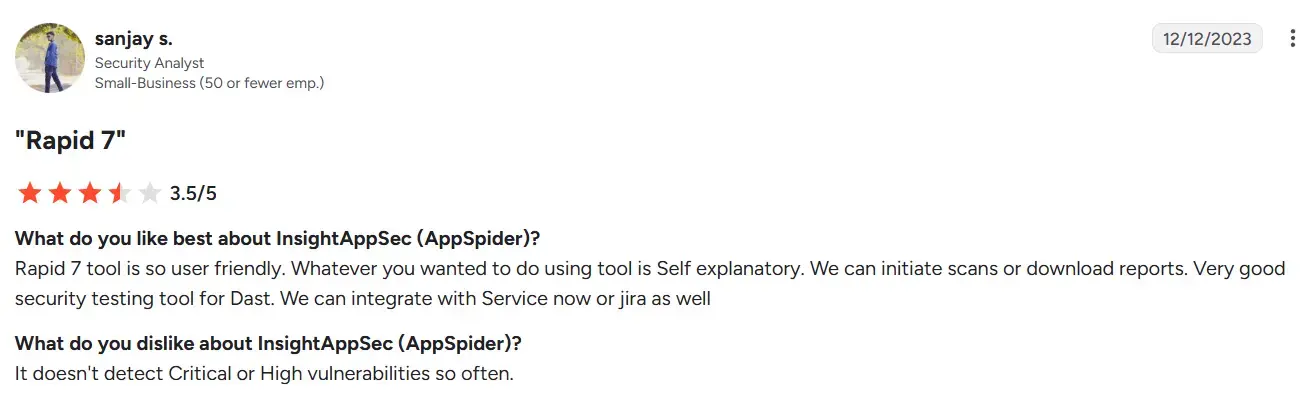
Holds a 3.9 out of 5 rating on G2, based on a relatively small review sample. Users appreciate its integration with other Rapid7 tools, with common complaints centered on a steep learning curve and performance issues during scans.
3. Tenable WAS
Key overview
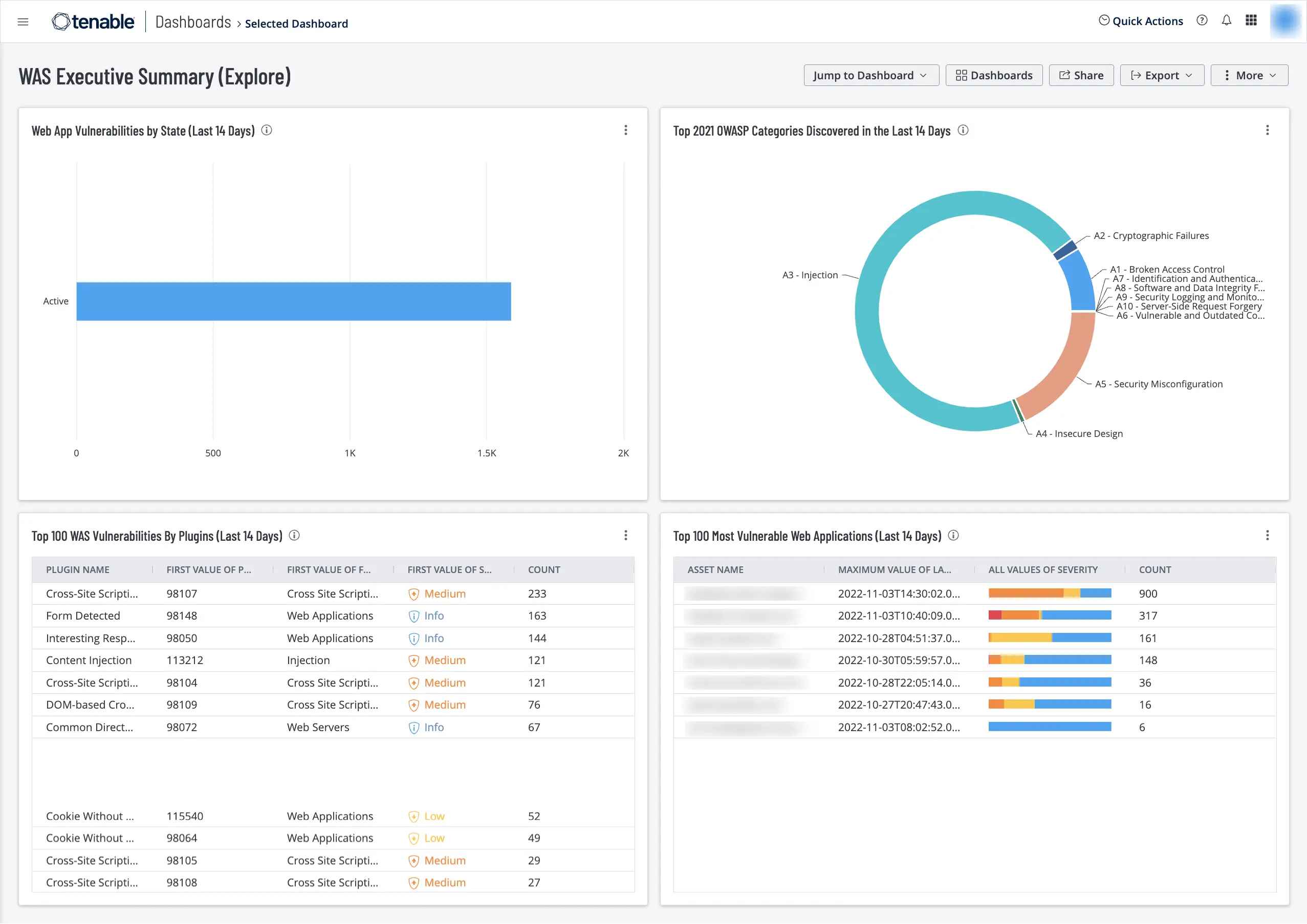
Tenable Web Application Scanning brings a risk based lens to DAST, prioritizing findings by exploitability rather than surfacing every vulnerability with the same level of urgency. That approach comes from Tenable’s broader vulnerability management background, and it shows in how the platform is built to sit alongside network and infrastructure scanning rather than operate as a standalone web security tool.
That positioning makes it a natural choice for organizations already inside the Tenable ecosystem, since Web Application Scanning shares a platform with Tenable’s exposure management tools rather than requiring a separate dashboard and workflow. For teams starting from scratch with no existing Tenable footprint, the value case is less immediate.
Pricing starts at $7,434 per year for 5 FQDNs, and the platform holds a 4.5 out of 5 rating on G2. Reviewers consistently highlight strong vulnerability coverage and intuitive dashboards, with the most common criticism being a more complex initial setup and scan times that can stretch out on larger environments.
Key features
Extensive plugin library with high signature coverage
Predictive Vulnerability Priority Rating system
AI asset governance
Scan by tag automation
Pricing
Starts at $7,434 per year for 5 FQDNs. A 30 day free trial is available, though it’s often limited in functionality.
Reviews
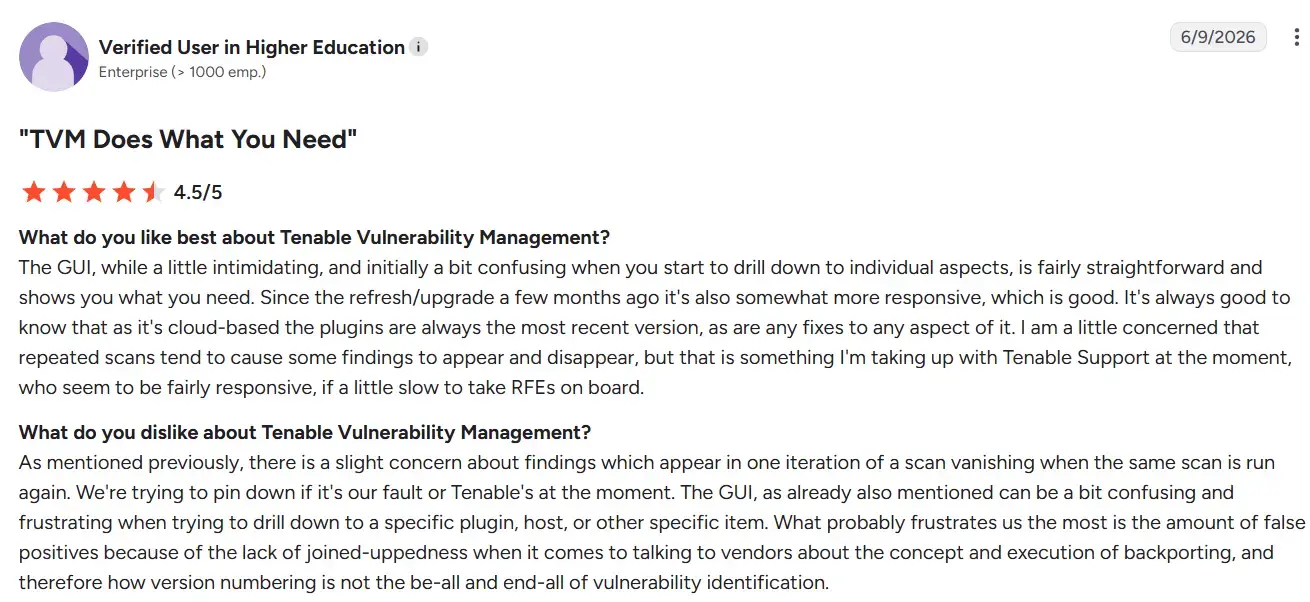
Holds a 4.5 out of 5 rating on G2. Users praise its vulnerability coverage and dashboards, while some mention that initial setup can be complex and scan times can run long.
4. Qualys WAS
Key overview
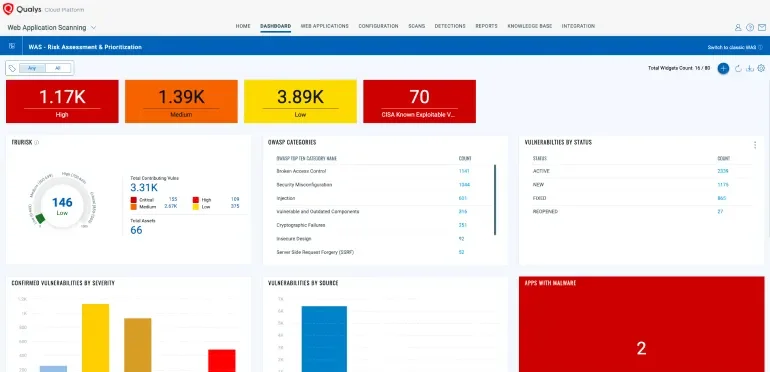
Qualys WAS is part of the broader Qualys VMDR platform, built to help organizations discover web assets and continuously monitor them for vulnerabilities alongside the rest of their vulnerability management program. Its TruRisk™ engine prioritizes findings by exploitability and severity, which helps security teams focus attention where it actually matters.
Like Tenable, its biggest strength is platform consolidation rather than standalone DAST depth. Organizations already running Qualys for broader vulnerability management get compliance ready reporting and asset discovery bundled in, though users have noted a steep learning curve and higher false positive rates compared to more specialized tools.
Pricing is custom quoted, based on a per target cost. It holds a 4.3 out of 5 rating on G2, recognized for strong asset visibility and integrated vulnerability management.
Key features
DAST with a TruRisk™ prioritization engine
CI/CD integrations
Compliance ready reporting Integrated vulnerability management and asset discovery
DAST integrated with patch management
OpenAPI drift detection
Pricing
Custom quote, based on a per target cost. A 30 day free trial is available.
Reviews
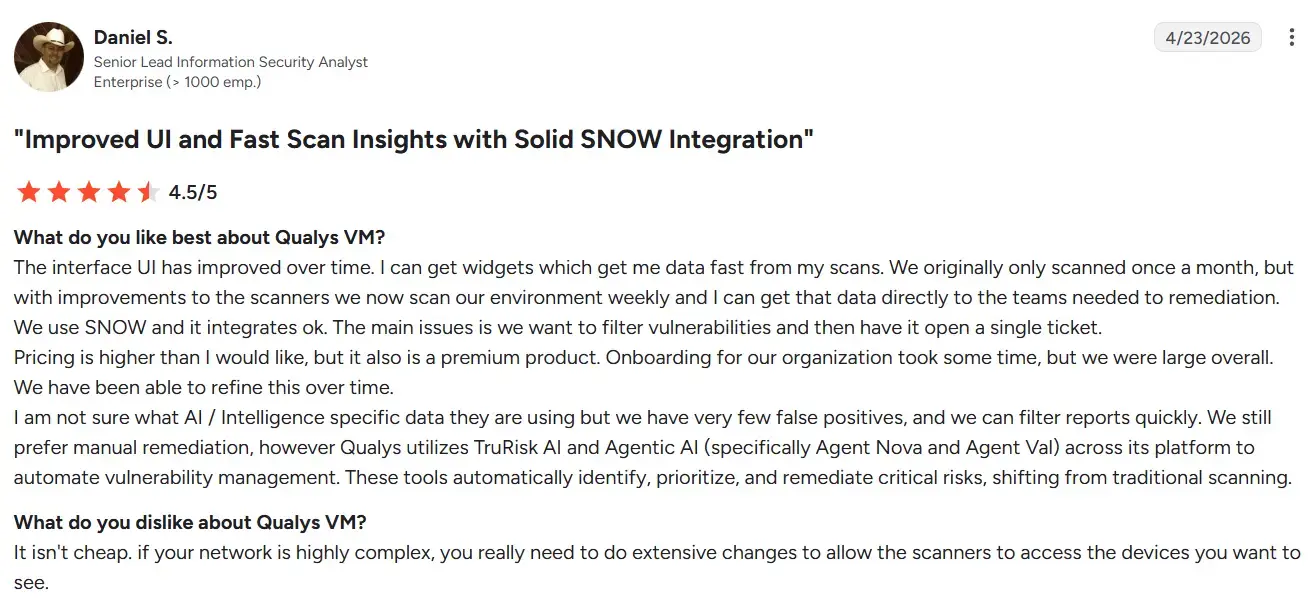
Holds a 4.3 out of 5 rating on G2, recognized for strong asset visibility and integrated vulnerability management.
5. ZAP by Checkmarx
Key overview
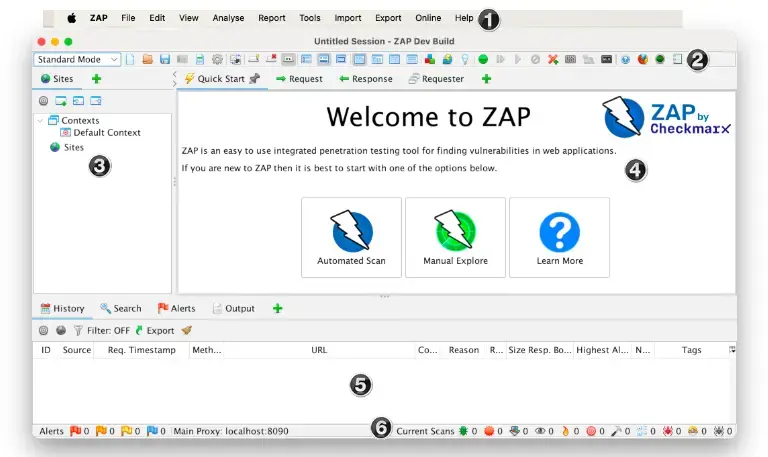
ZAP remains one of the most widely used open source DAST tools in the world, originally built as a community project under OWASP and now benefiting from broader backing through Checkmarx. It supports both automated and manual testing, which makes it flexible enough for baseline scans as well as deeper exploratory work.
Its biggest appeal is cost: there’s no licensing fee, which makes it a natural fit for startups, educational institutions, and budget conscious teams willing to invest engineering time instead of money. That tradeoff is real, though, since false positive management is manual and complex authentication flows often need custom scripting.
ZAP is free and open source. It holds a 4.7 out of 5 rating on G2, praised for accessibility and effectiveness, with initial setup cited as carrying a real learning curve.
Key features
Automated scanner tests for common vulnerabilities like XSS and SQL injection
OWASP Top 10 reports
Accessible to users of all skill levels
Supports API security testing, scheduled testing, and SSO
Pricing
Free and open source.
Reviews
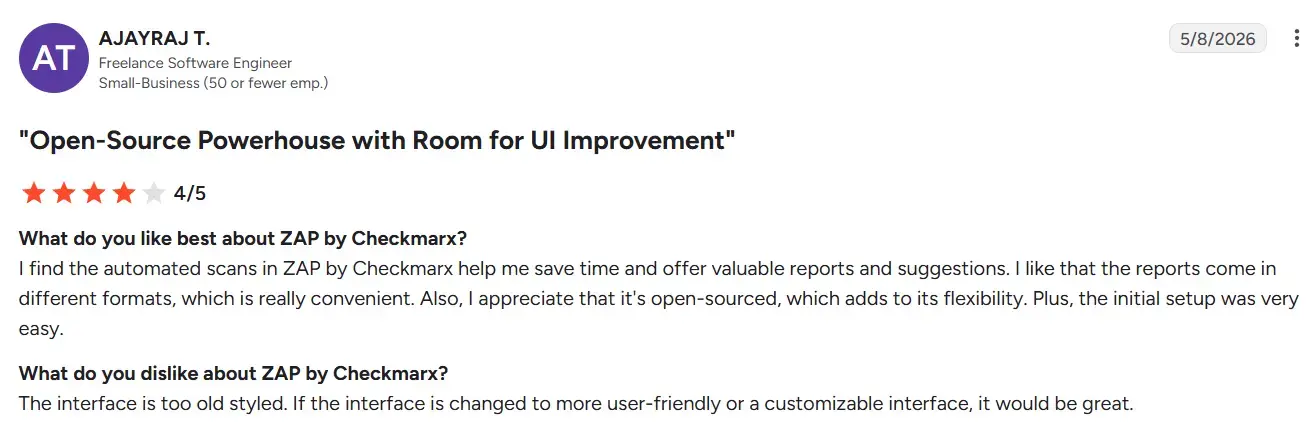
Holds a 4.7 out of 5 rating on G2. Praised for accessibility and effectiveness, though initial setup carries a real learning curve.
6. Burp Suite
Key overview
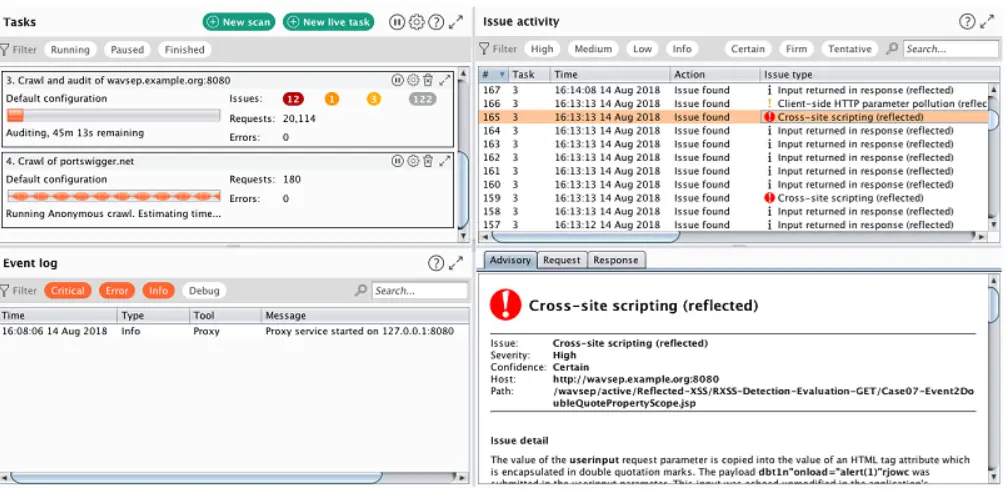
Burp Suite is one of the most established tools for manual web application security testing, built by PortSwigger around a powerful interception proxy that lets security professionals analyze and manipulate HTTP traffic directly. Its core strength is manual testing depth rather than automation.
The Enterprise edition adds scalable, automated scanning and CI/CD integration on top of that manual foundation, letting organizations combine routine automated checks with the deeper manual testing Burp Suite is known for. It takes real expertise to use well, and is generally considered resource intensive for large scale or continuous scanning.
Pricing is typically custom, depending on the edition (Community, Professional, or Enterprise) and features required, with no free trial available. It holds a 4.8 out of 5 rating on G2, with users praising its depth for manual testing and flagging the learning curve as the main drawback.
Key features
Primarily manual penetration testing, with DAST capabilities included Scheduled testing, CI/CD integrations, and SPA scanning
PCI DSS and OWASP Top 10 reports
SSO support and API security testing
Pricing
Typically custom, depending on the edition (Community, Professional, or Enterprise) and features required. For larger organizations running enterprise grade scanning, it can be a significant investment, often requiring dedicated security personnel to get full value from it.
Reviews
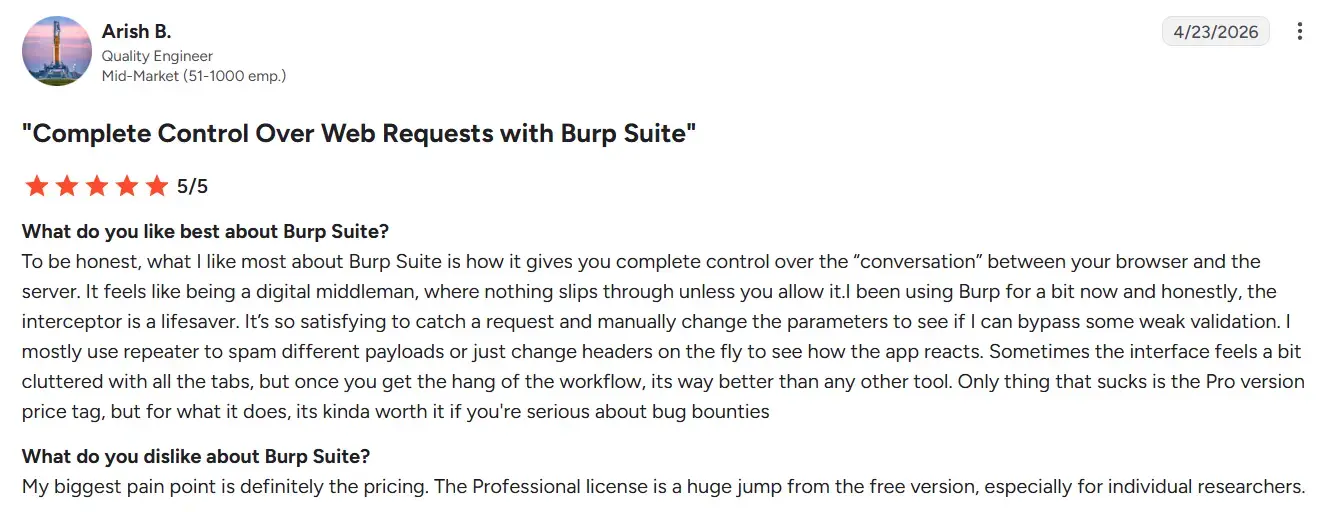
Holds a 4.8 out of 5 rating on G2. Users appreciate its depth for manual testing and flexibility for advanced security professionals, with common complaints centered on the learning curve and how resource intensive it can be for large scale or continuous scanning.
7. Checkmarx
Key overview
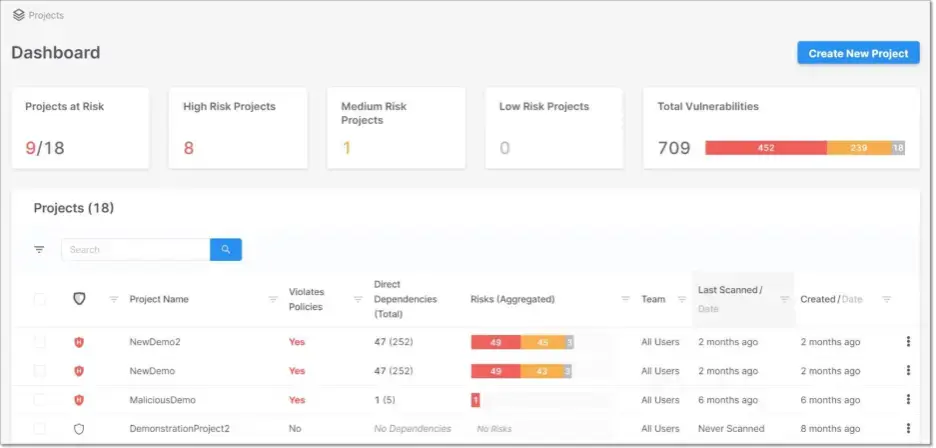
Checkmarx is built around source code analysis, with a SAST engine that scans code early in development to catch issues like injection flaws, insecure cryptographic usage, and logic errors across a wide range of languages and frameworks. It also includes software composition analysis to flag vulnerabilities and license issues in open source dependencies.
Its strength is breadth: SAST, DAST, and SCA in one platform, integrated directly with tools like GitHub, GitLab, Bitbucket, and major IDEs so developers get feedback inside their existing workflow. Enterprise deployments often need real tuning to keep false positives manageable across large codebases.
Pricing isn’t publicly disclosed, and requires direct contact with sales for a custom quote across its Start with SAST, Start with SSCS, Essentials, and Professional plans. It holds a 4.2 out of 5 rating on G2, praised for its interface and fix suggestions, with some users citing support delays and slower scan times.
Key features
A comprehensive suite of security solutions, including SAST, DAST, and SCA
Integrates with popular development tools like GitHub, Bitbucket, and GitLab
Pricing
Checkmarx offers a structured set of plans for varying levels of application security maturity. Pricing isn’t publicly disclosed, and all tiers require direct contact with sales for a custom quote. Plans include Start with SAST, Start with SSCS, Essentials, and Professional.
Reviews
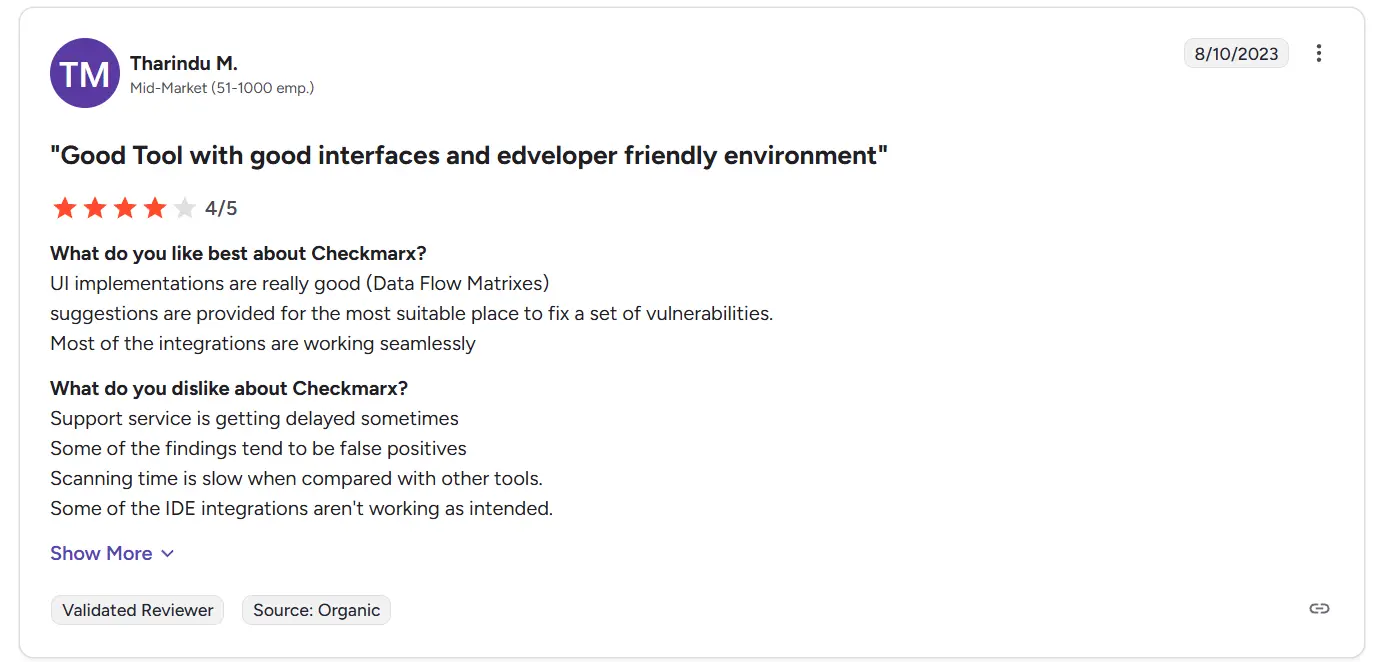
Holds a 4.2 out of 5 rating on G2. Praised for its interface and helpful vulnerability fix suggestions, with some users reporting support delays, occasional false positives, slower scan times, and IDE integration issues.
8. Veracode
Key overview
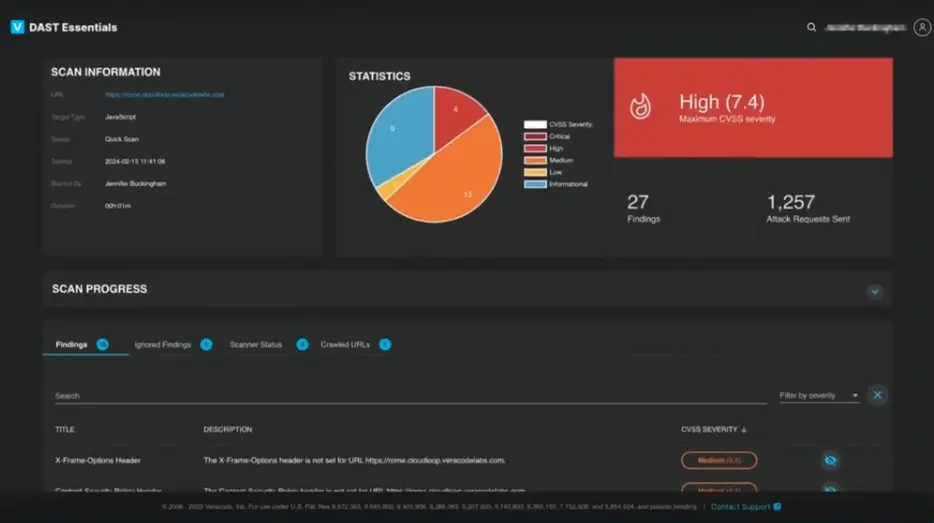
Veracode is a long standing enterprise AppSec platform spanning SAST, DAST, IAST, SCA, and infrastructure as code security under one roof. Its most distinctive capability is binary analysis, which lets it scan compiled applications without needing access to source code, useful for third party software or situations where code can’t be shared externally.
The platform leans heavily into compliance and governance, with structured reporting and policy enforcement that suits organizations operating under PCI DSS, HIPAA, ISO 27001, or SOC 2. It also offers AI generated fix suggestions to speed up remediation, though onboarding is often described as complex.
Pricing isn’t published and scales with the number of applications and scans, so getting an actual number means talking to sales directly. It holds a 3.7 out of 5 rating on G2, praised for comprehensive scanning and support, with some users noting a costly pricing model.
Key features
A comprehensive platform offering SAST, DAST, IAST, SCA, and IaC security
Integrates with popular IDEs and CI/CD pipelines
Provides AI generated code fix suggestions
Uses a patented binary code analysis method
Pricing
Not published publicly. Veracode uses a tiered structure based on the number of applications and scans performed, so scheduling a demo with sales is the only way to get an actual number.
Reviews
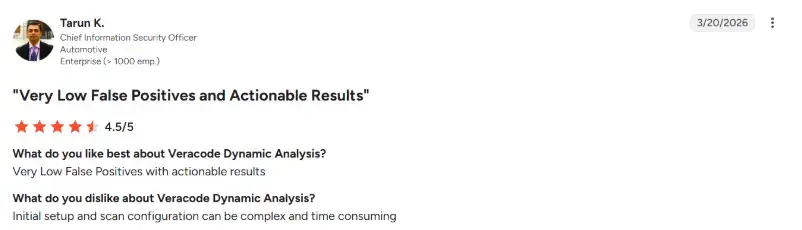
Holds a 3.7 out of 5 rating on G2. Praised for comprehensive scanning capabilities and committed support, with some users noting complex implementation and a costly pricing model.
9. HCL AppScan
Key overview
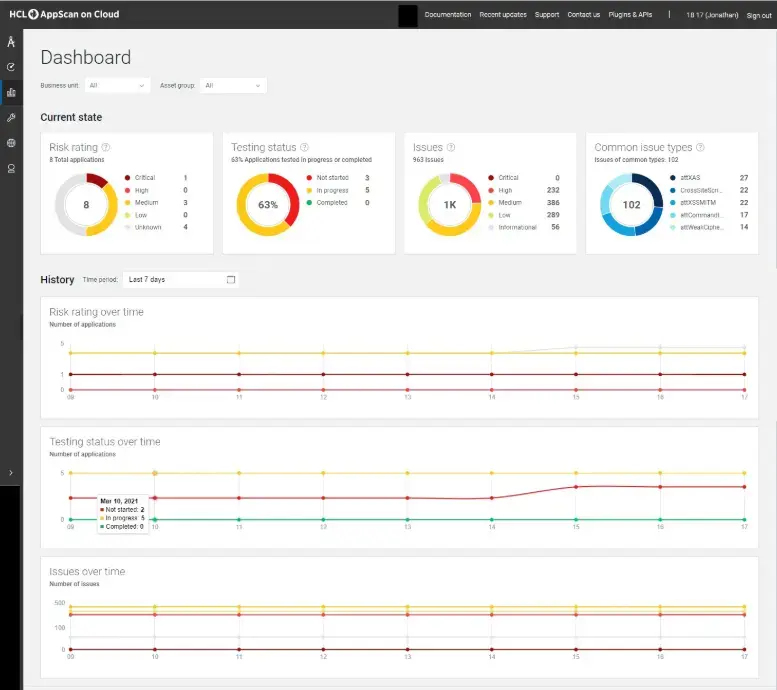
HCL AppScan offers a full application security suite, DAST, SAST, IAST, SCA, and API testing, built for enterprises that need flexibility in how they deploy it. Both on premise and cloud based scanning are supported, which matters for organizations with strict data residency requirements.
AI driven analysis helps reduce false positives and prioritize risk, with centralized dashboards giving visibility across a development portfolio and remediation focused reporting to speed up fixes. Some users report a difficult installation process and thinner documentation than they’d like.
Pricing is typically custom quoted for enterprise deployments, though a pay per scan option exists for the cloud version, currently around $29.99 for a single scan. It holds a 4.1 out of 5 rating on G2 for ease of use and accurate scan results.
Key features
A full suite of technologies, including SAST, DAST, IAST, SCA, and API testing
AI driven accuracy that reduces false positives and prioritizes risk
Centralized dashboards with remediation focused reporting
Integrates with developer workflows
Pricing
Typically custom quoted for enterprise deployments. A pay per scan option is available for the cloud version, currently listed at $29.99 for a single scan (discounted from a $299 list price), with a 50 scan pack available at $699. A 30 day free trial is available.
Reviews
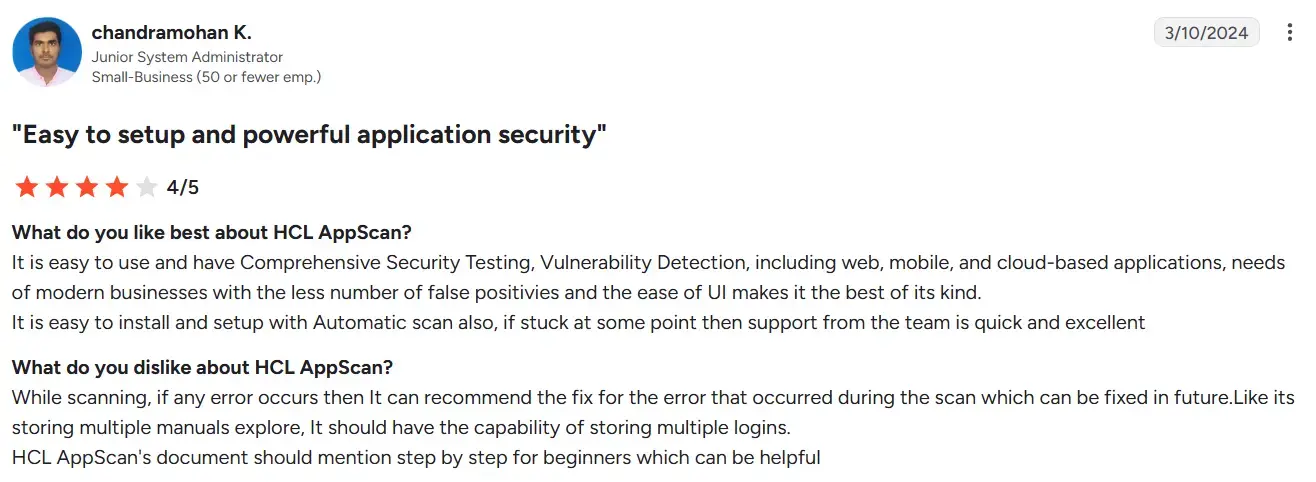
Holds a 4.1 out of 5 rating on G2. Users appreciate accurate scan results, with some reporting a difficult installation process and thin documentation.
Key factors to consider when choosing an Invicti alternative
Pricing model
Pricing structures in 2026 vary widely across vendors, and the differences can meaningfully affect long term total cost of ownership.
Some platforms use per application or per FQDN licensing. Others use concurrent testing limits, usage based quotas, asset based pricing, or fully custom enterprise contracts. Entry level pricing may look competitive on its own, but costs can scale quickly as your application portfolio grows or as new microservices and APIs get added.
When evaluating alternatives, consider how pricing scales with additional applications, subdomains, and APIs, whether ephemeral environments like staging or short lived deployments get counted, whether target based pricing creates long term lock in, and whether the platform supports predictable budgeting as your organization grows.
Ease of use and integration
In modern DevSecOps environments, security tools need to operate at the speed of development. A powerful scanner that slows down pipelines or needs heavy configuration will struggle to gain real adoption among engineering teams.
Look for intuitive dashboards with minimal onboarding friction, native integrations with CI/CD tools like GitHub Actions, GitLab, Jenkins, and Azure DevOps, IDE integrations that deliver feedback directly in the developer workflow, automated ticket creation in Jira or ServiceNow, and remediation guidance mapped to your specific frameworks and technologies.
Ease of integration is often the real difference between a tool that’s technically capable and one that actually gets used consistently across teams.
Advanced capabilities and AI maturity
Modern applications are API first, cloud native, and frequently built with microservices and single page frameworks. Traditional rule based scanners can struggle with dynamic authentication flows, stateful sessions, and business logic vulnerabilities.
In 2026, worth evaluating for: AI powered authentication and session handling, business logic flaw detection, GraphQL and REST API security testing, infrastructure as code scanning support, adaptive crawling for single page applications, and behavioral validation that reduces false positives.
It’s also worth checking how mature a platform’s AI actually is. Some vendors use AI mainly for reporting or prioritization, while others build autonomous reasoning directly into the testing engine. Choose based on where your application architecture is today, and where it’s likely to be in the next three to five years.
Support model and community strength
Support quality plays a real role in long term success, especially for teams without dedicated application security engineers.
Open source tools like ZAP rely heavily on community forums, documentation, and peer contributions. That gives flexibility and cost savings, but troubleshooting and optimization depend more on internal expertise. Enterprise vendors typically offer structured support, onboarding assistance, and service level agreements, and some modern platforms add proactive guidance and faster iteration based on user feedback.
When evaluating support, consider availability of live technical support, responsiveness and expertise of support engineers, documentation and knowledge base depth, and the strength of the community and third party integration ecosystem.
Final thoughts
Invicti remains a capable, mature DAST solution, particularly valued for its proof based scanning and enterprise scalability. But the 2026 application security landscape is defined by continuous deployment, AI generated code, API sprawl, and increasingly complex business logic.
As a result, many organizations are expanding their evaluation criteria beyond traditional vulnerability detection, looking for platforms that balance detection accuracy with operational efficiency, developer adoption, runtime validation, and pricing flexibility.
Whether you choose an open source tool like ZAP, an enterprise focused platform like Veracode or HCL AppScan, or a newer AI native platform like Beagle Security, the key is alignment: with your development velocity, compliance obligations, application architecture complexity, internal security expertise, and long term growth plans.
The right alternative should protect your applications today while scaling with your organization as your codebase expands and your security maturity deepens, moving you from reactive vulnerability management toward proactive exposure resilience.
FAQ
What is the best alternative to Invicti?
It depends on your priorities. Beagle Security fits teams that want AI driven testing for modern applications, Veracode or HCL AppScan fit large enterprises needing a full compliance focused suite, and ZAP fits budget conscious teams comfortable with hands on configuration.
Is there a free alternative to Invicti?
ZAP by Checkmarx is the only fully free option in this comparison, open source and community maintained. Most other alternatives, including Beagle Security and Rapid7, offer a free trial rather than a permanent free tier.
What is the difference between Invicti and Beagle Security? Invicti relies on proof based scanning to validate findings automatically within a broader ASPM platform. Beagle Security uses agentic AI to test business logic and authenticated workflows directly, with a lighter setup built around modern DevSecOps pipelines.
What is ASPM, and does it matter when choosing an Invicti alternative?
Application security posture management correlates findings across multiple security tools into one governance layer. Invicti added this through its Kondukto acquisition. Most alternatives on this list focus on testing itself rather than ASPM, so if cross tool governance matters most to you, that’s worth weighing directly.


![Top ZAP alternatives and competitors [October 2026]](/blog/images/top-zap-alternatives-cover.webp "Top ZAP alternatives and competitors [October 2026]")




![Top 10 penetration testing companies [2026]](/blog/images/top-penetration-testing-companies-cover.webp "Top 10 penetration testing companies [2026]")



![Top vendor application security tools [2026]](/blog/images/top-vendor-application-security-testing-tools-2026-cover.webp "Top vendor application security tools [2026]")



![Top Snyk alternatives & competitors [2026]](/blog/images/top-snyk-alternatives-cover.webp "Top Snyk alternatives & competitors [2026]")