Acunetix vs Qualys: Which is the best choice for you? [2026]
![Acunetix vs Qualys: Which is the best choice for you? [2026]](/blog/images/blog-banner-six.webp "Acunetix vs Qualys: Which is the best choice for you? [2026]")
Acunetix vs Qualys: Which is the best choice for you? [2026]
If you’re evaluating Dynamic Application Security Testing (DAST) tools, you’ll inevitably encounter Acunetix and Qualys Web Application Scanning (WAS). Both platforms offer automated vulnerability detection, but they’re built for different needs, target distinct markets, and carry contrasting architectural philosophies. Acunetix focuses on deep-dive web application scanning, while Qualys WAS is part of a broader cloud platform designed for unified IT security and compliance management.
The choice between them depends on whether you prioritize a specialized scanner or a suite-based solution. But there’s a third consideration that’s reshaping how forward-thinking teams approach DAST in 2026: AI-powered penetration testing that adapts to modern application patterns without the configuration overhead, rigid licensing, or legacy architecture that both platforms carry.
This guide breaks down the practical trade-offs between Acunetix and Qualys WAS, highlights their core strengths and limitations, and explores how Beagle Security’s agentic AI-first architecture addresses the workflow friction that traditional DAST tools struggle to solve.
Acunetix vs Qualys at a glance
| Feature | Acunetix | Qualys WAS |
|---|---|---|
| Target market | Mid-market, specialized DAST | Enterprises, compliance-heavy IT security |
| Scanning technology | DAST with IAST integration (AcuSensor) | DAST, part of a vulnerability management suite |
| Ease of use | Moderate learning curve | Complex UI & workflows |
| AI features | Limited | Limited |
| API security | Limited (REST, Swagger/Postman) | REST/SOAP |
| Free trial | No | Yes (30-day free trial of the "TotalAppSec" ) |
| Pricing starts at | $7,000/year (per FQDN) | Custom quote (per-target licensing) |
| G2 rating | 4.1/5 | 4.5/5 |
An alternative web & API penetration testing platform: Beagle Security
Both Acunetix and Qualys WAS are strong legacy options, but they often struggle with the pace and complexity of modern DevSecOps, especially when dealing with complex login flows (like 2FA), GraphQL APIs, and fragmented pricing models.
Beagle Security is a next-generation DAST platform built to eliminate the overhead of traditional scanners. It is an agentic AI-powered penetration testing tool that mimics real-world attacker behavior to find business-logic and context-specific flaws that are often missed by signature-based tools. With predictable, concurrent test-based pricing, it is a flexible and cost-effective alternative.
Why choose Beagle Security over Acunetix & Qualys?
AI-enabled automation: Features AI-based login handling and business logic detection, which both Acunetix and Qualys lack.
Flexible pricing: Uses a concurrent test-based model instead of the restrictive, escalating per-FQDN (Acunetix) or per-target (Qualys) licensing.
Developer-first reports: Provides contextual remediation guidance tailored to the user’s tech stack, which is more actionable than the basic reporting offered by Qualys.
Modern stack support: Offers full GraphQL support and out-of-the-box testing for 2FA-enabled applications and complex SPAs.
Acunetix vs Qualys vs Beagle Security: Customer reviews comparison
Acunetix reviews
Source: G2
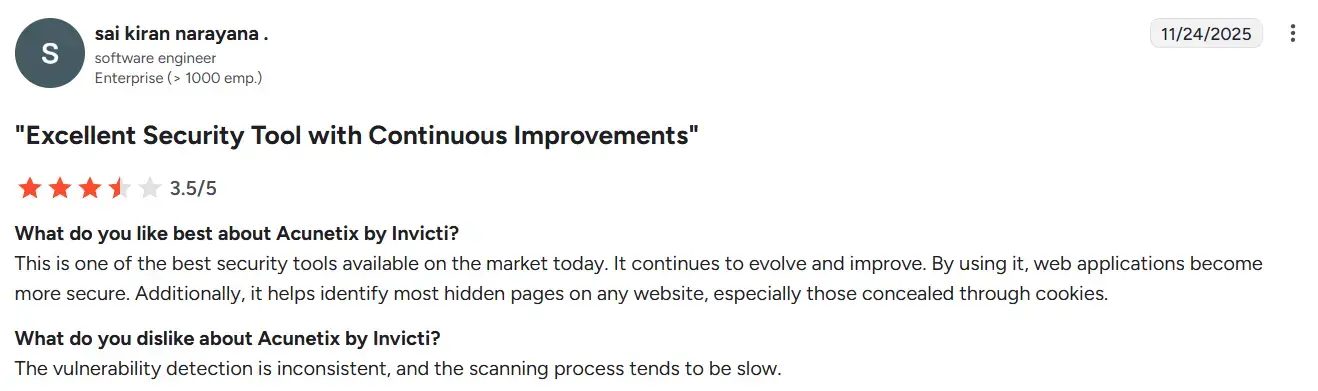
Users consistently praise the ease of use and accurate vulnerability detection of Acunetix, highlighting its ability to quickly identify critical security issues in web applications. The intuitive interface and comprehensive reporting make it a valuable tool for both developers and security professionals. However, some users note that the scanning process can be resource-intensive and time-consuming, especially for larger applications.
Qualys reviews
Source: G2
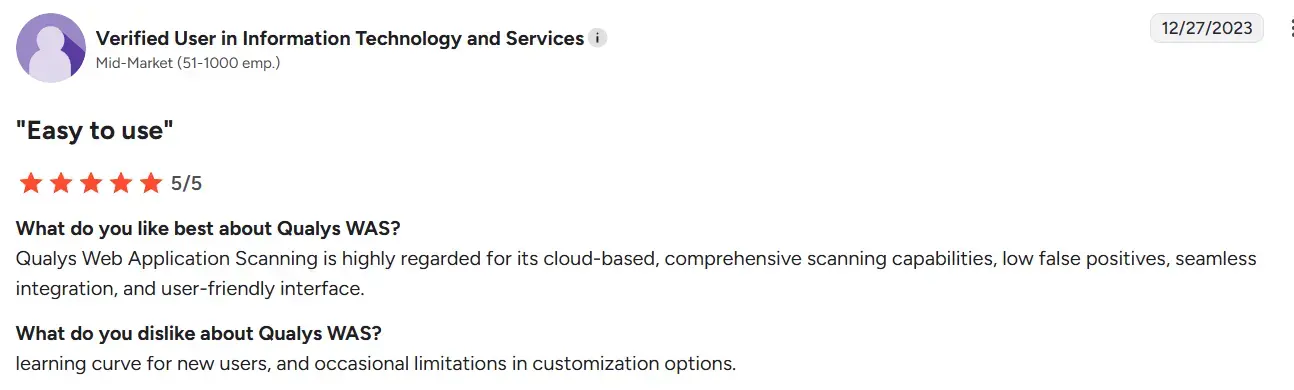
Users consistently praise the user-friendly interface and comprehensive scanning capabilities of Qualys WAS, highlighting its effectiveness in identifying vulnerabilities and providing detailed reports. Many appreciate the seamless integration and excellent customer support, although some note a common limitation with the high pricing that may deter smaller organizations.
Beagle security reviews
Source: G2
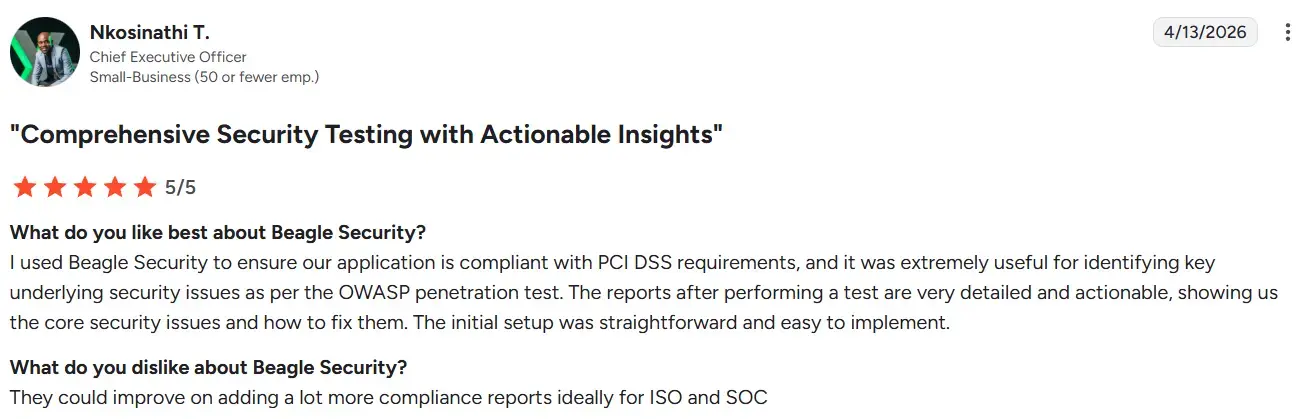
Beagle Security is frequently praised for its realistic attack simulations, developer-friendly reports and clear user-friendly interface. Users appreciate the platform’s ability to strike a mix between ease and depth, as well as its agentic AI penetration testing that seems customized rather than generic. Even for teams without extensive security knowledge, onboarding is simple, and starting a test only requires a few clicks. It is easier for engineering teams to take action without waiting for security engineers since reports are formatted to provide both technical clarity and business relevance.
Acunetix vs Qualys vs Beagle Security: Feature comparison
| Feature | Acunetix | Qualys WAS | Beagle Security |
|---|---|---|---|
| DAST | Yes | Yes | Yes |
| API security | Limited REST | REST/SOAP | REST + GraphQL (Full Support) |
| Business logic testing | No | No | Yes |
| AI-based login handling | No | No | Yes |
| CI/CD integration | Basic | Limited | Seamless |
| Reporting | Available (PCI, HIPAA) | Basic | Contextual & dev-first |
| 2FA-enabled app support | No | No | Yes |
| False positive filtering | Manual effort | Manual effort | AI-assisted |
Acunetix features
Acunetix is positioned as a comprehensive DAST solution known for its effective scanning of traditional web applications.
IAST integration: Offers AcuSensor IAST integration for deeper insight into source code execution during DAST scans, combining black-box and white-box methods.
Compliance ready: Provides HIPAA and PCI DSS compliance-focused reporting.
Coverage: Excellent detection of common flaws, including the OWASP Top 10.
Acunetix weaknesses & limitations:
Rigid licensing: The per-FQDN pricing model can become restrictive and expensive for organizations with many applications or dynamic environments (like Dev/Staging/Prod).
Limited modern support: Struggles with intelligent crawling for complex, modern web technologies like SPAs and GraphQL.
Authentication challenges: Multi-step or token-based authentication often requires extensive manual configuration.
Qualys WAS features
Qualys Web Application Scanning is a module within the larger Qualys Cloud Platform, making it a natural fit for organizations already using Qualys for vulnerability management.
Integrated platform: Seamless integration with other Qualys modules for asset discovery and vulnerability management across IT assets.
Compliance focus: Strong dashboard and policy compliance coverage, highly suitable for environments with heavy regulatory requirements.
Broad scanning: Capable DAST engine with scan scheduling and a unified dashboard for alerts.
Qualys WAS weaknesses & limitations:
Complex User Interface (UI): Users frequently report that the interface is outdated and unintuitive, leading to a steep learning curve.
No AI or business logic: Lacks AI-driven features for advanced logic detection or automated login handling.
Limited DevSecOps: Offers only limited CI/CD integration and requires manual tuning and configuration to avoid false positives.
Beagle security features
Beagle Security is a next-generation DAST platform built natively for cloud-first, API-heavy architectures. Its agentic AI engine adapts attack strategies based on the specific technology stack it encounters, eliminating the manual configuration overhead that traditional scanners demand.
Agentic AI penetration testing engine: Adaptive attack logic that automatically adjusts testing techniques based on your application’s behavior and stack.
Comprehensive API security testing: Full support for REST and GraphQL, including complex authentication workflows and 2FA-enabled applications.
Contextual, compliance-ready reports: Stack-specific remediation guidance for developers alongside compliance coverage for stakeholders.
CI/CD integration: Seamlessly embeds into modern development pipelines for shift-left security testing.
Advanced business logic testing: Simulates real-world attack scenarios, including multi-step authentication flows that traditional DAST tools miss.
Easy onboarding and intuitive UX: Teams can launch comprehensive penetration tests within minutes, without security expertise barriers.
Beagle security weaknesses & limitations:
Newer platform: Ecosystem integrations and enterprise customization options are still maturing compared to legacy platforms, though the product evolves rapidly.
Focused scope: Purpose-built for web and API security
Acunetix vs Qualys vs Beagle Security: Pricing comparison
| Platform | Pricing model | Starting price | Free trial |
|---|---|---|---|
| Acunetix | Per-FQDN licensing | $7,000/year (per FQDN) | No |
| Qualys WAS | Per-target licensing | Custom quote (per-target pricing) | Yes |
| Beagle Security | Concurrent test-based | $1,188/year | 14-day free trial |
*Acunetix pricing according to AWS Marketplace
Acunetix pricing
Acunetix targets mid-market businesses with pricing starting at around $7,000/year per FQDN. The per-domain model creates particular challenges for complex applications; multi-domain setups require separate targets for each subdomain, multiplying licensing costs well beyond initial estimates. The absence of a traditional free trial means teams must engage sales before properly assessing platform fit.
Qualys WAS pricing
Qualys WAS operates on a per-target licensing model with custom quote pricing, making it difficult to estimate costs upfront. For organizations already using the Qualys Cloud Platform, the integration value may justify the spend. For teams seeking a standalone DAST solution, the opaque pricing and per-target model can make budget planning unpredictable as application portfolios grow.
Beagle Security pricing
Beagle Security offers clear, usage-based pricing without arbitrary restrictions on domains or targets. Self-serve plans start at $1,188/year, with enterprise plans starting at $8,500/year for 5 concurrent tests. Teams can add or remove applications at any time and split monthly test quotas across multiple applications, a model that benefits organizations with fluctuating testing needs or diverse application portfolios. A 14-day free trial includes access to all Advanced plan features with one complete penetration test, letting teams evaluate agentic AI-powered testing capabilities before committing.
Which is best for you?
| Choose Acunetix if: | Choose Qualys WAS if: | Choose Beagle Security if: |
|---|---|---|
| You are a mid-sized company prioritizing a dedicated DAST scanner. | You are an enterprise already using the Qualys Cloud Platform. | You need full-spectrum, agentic AI web and API pentesting. |
| You need HIPAA and PCI DSS compliance reporting. | Your primary focus is unified compliance and IT asset management. | You want predictable, scalable pricing with no FQDN lock-ins. |
| You are okay with configuring complex authentication flows manually. | You have the expertise and time to manage manual configurations and a complex UI. | You value actionable, stack-specific remediation advice and a seamless DevSecOps experience. |
While Acunetix and Qualys serve established security programs well, they carry the baggage of legacy licensing and architecture.
If your priority is building a modern, agile AppSec program that scales with your development team and budget, a next-generation solution like Beagle Security is the smarter investment.
Try Beagle Security for free to see how it compares to Acunetix and Qualys
Choosing between Acunetix and Qualys often means weighing two capable but legacy-heavy platforms each carrying rigid licensing models, configuration complexity, and workflow friction that modern teams can struggle to justify.
Beagle Security emerges as the smarter, more agile alternative, purpose-built for today’s web and API security landscape. With AI-powered penetration testing, developer-centric reports and seamless CI/CD integration, Beagle Security delivers everything you need, without the steep learning curves or enterprise bloat.
Get started with a 14-day free trial, or schedule a demo to see how Beagle Security fits your workflow.
FAQs
Is Qualys WAS a DAST tool?
Yes. Qualys Web Application Scanning is a DAST module within the broader Qualys Cloud Platform. It performs automated vulnerability scanning against live web applications and integrates with other Qualys modules for unified vulnerability management.
What is the difference between Qualys and Acunetix?
Acunetix focuses on providing deep-dive web application scanning, Qualys WAS is part of a much broader cloud platform designed for unified IT security and compliance management.
How much does Acunetix cost?
Acunetix pricing starts at approximately $7,000 per year per FQDN. Costs can escalate significantly for organizations managing multiple domains or subdomains, as each requires a separate target configuration under their licensing model.


![Top ZAP alternatives and competitors [October 2026]](/blog/images/top-zap-alternatives-cover.webp "Top ZAP alternatives and competitors [October 2026]")




![Top 10 penetration testing companies [2026]](/blog/images/top-penetration-testing-companies-cover.webp "Top 10 penetration testing companies [2026]")


![Top vendor application security tools [2026]](/blog/images/top-vendor-application-security-testing-tools-2026-cover.webp "Top vendor application security tools [2026]")



![Top Snyk alternatives & competitors [2026]](/blog/images/top-snyk-alternatives-cover.webp "Top Snyk alternatives & competitors [2026]")