Acunetix pricing 2026: Is it worth it?

Web apps and APIs are where most attacks land. Acunetix has been a go-to scanner for security teams for years. But a strong track record does not automatically mean it’s the right fit for your team.
What does Acunetix actually cost in 2026, and does the value hold up against what the market now offers? This guide breaks down Acunetix pricing, explains what drives the cost up, and covers why teams are increasingly looking at alternatives.
TL;DR: How much does Acunetix cost?
Acunetix pricing is quote-based, meaning you won’t find a simple price card on their website.
Acunetix pricing typically starts at around $7,000 per year according to AWS Marketplace.
The cost scales primarily by the number of targets (websites, web apps, or APIs) you want to scan.
Additional factors such as deployment choice (cloud vs. on-prem), number of users, and support level can also influence the final price.
For enterprises with larger application portfolios, quotes can quickly climb into the tens of thousands per year, especially when advanced features and enterprise support are included.
Who is Acunetix for?
Acunetix works best for organizations where security ownership is centralized. If one team owns the tool, runs the scans, and manages the output, the workflow holds up.
It is a reasonable fit for:
Security teams running a defined set of web applications who need consistent, scheduled vulnerability scanning without heavy manual configuration
Organizations where compliance requirements drive the testing cadence, with reporting that maps to PCI DSS, GDPR, and similar frameworks without significant customization
Penetration testers who use automated scanning as a reconnaissance layer before manual testing, particularly on JavaScript-heavy applications where crawl depth matters
Acunetix: Key features
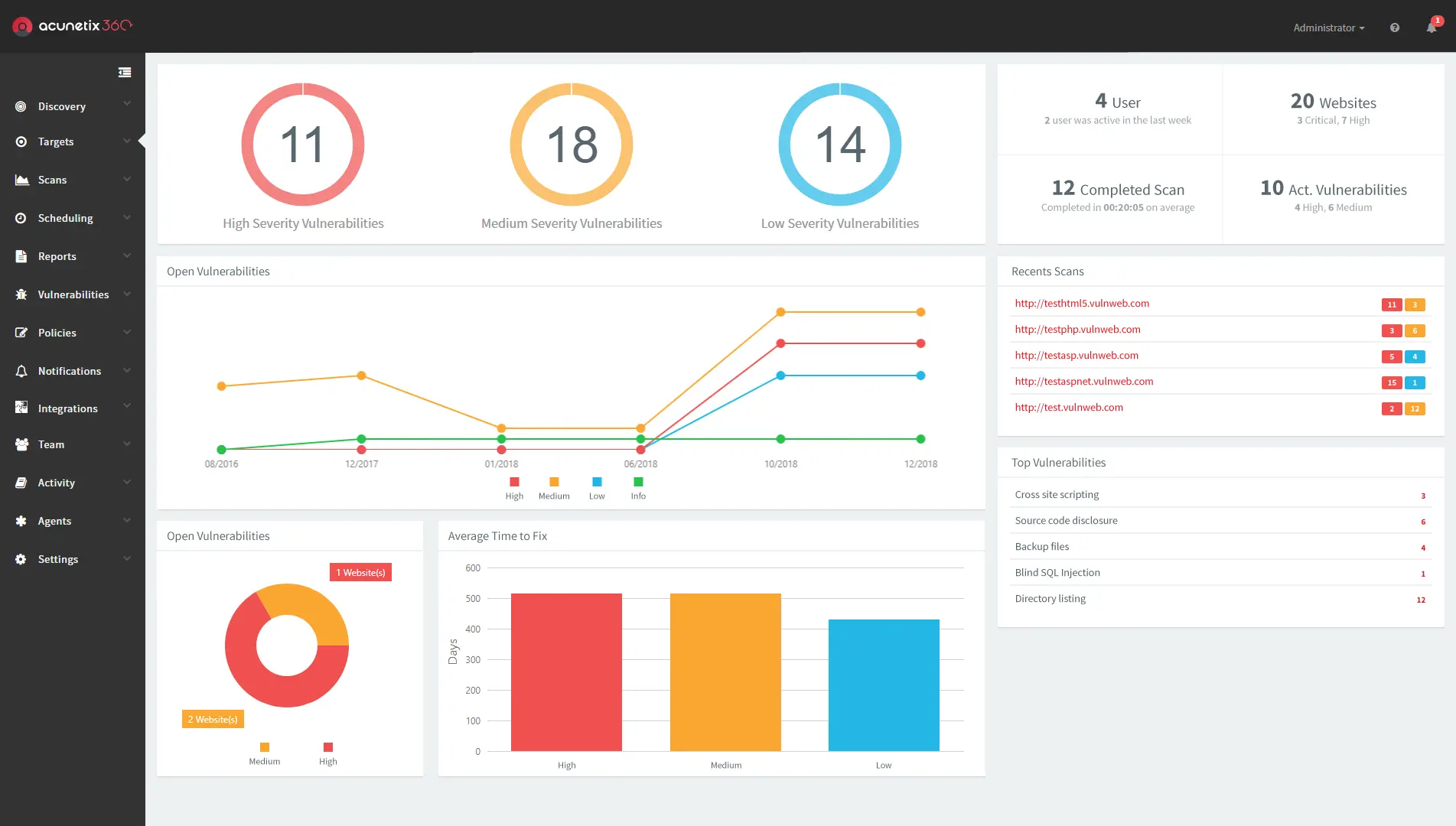
Automated scanning for web applications and APIs
Coverage for OWASP Top 10 vulnerabilities
Detection of misconfigurations and weak authentication
Crawl & scan engine for complex, modern applications
CI/CD integration for DevSecOps pipelines
Compliance reporting for frameworks like PCI DSS and GDPR
Acunetix covers the standard surface area well. The crawl engine handles modern application architectures better than older scanners, and the compliance reporting is useful for teams that need audit-ready output.
Where it falls short is depth of attack simulation and developer usability. The tool surfaces vulnerabilities, but remediation guidance is not built around how developers actually work. For security teams that own the whole process, that is manageable. For teams trying to push responsibility closer to engineering, it creates friction.
G2 review:
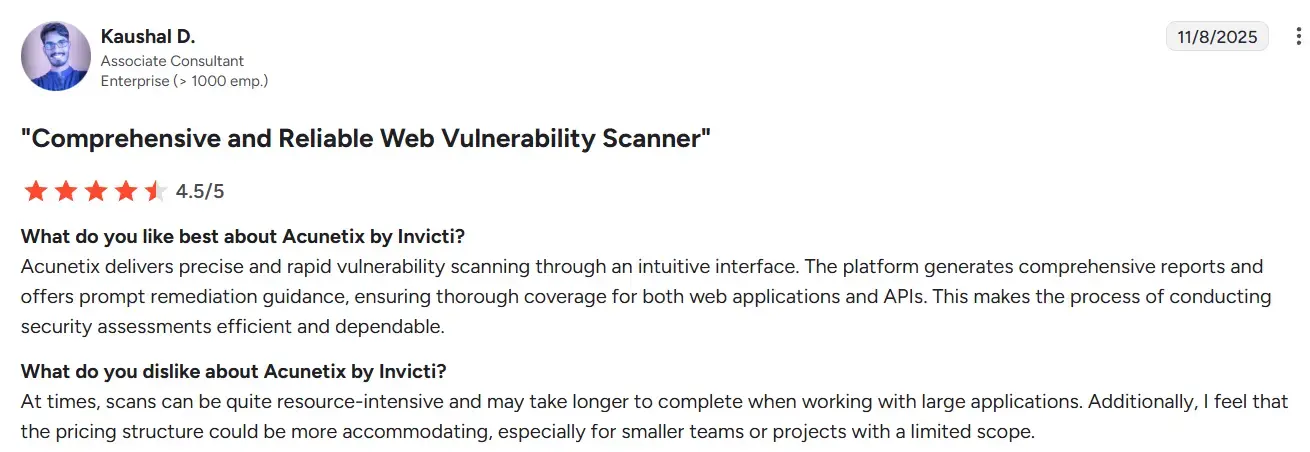
Users consistently point to ease of use and accurate vulnerability detection as the strongest aspects of Acunetix. The reporting output is clear and the interface does not require significant onboarding. The recurring criticism is scan performance, resource-intensive scans slow down significantly on larger applications, and scan times are a real operational constraint for teams running frequent testing cycles.
Is Acunetix the right choice for you?
Acunetix is a credible tool with a long track record. For large organizations with centralized security teams, established procurement processes, and a stable application portfolio, the investment can be justified.
The gaps show up at the edges. The tool surfaces vulnerabilities, but remediation guidance is not built around how developers actually work. For teams trying to push responsibility closer to engineering, that creates friction.
Organizations running API-first or GraphQL-heavy architectures will hit coverage gaps that the scanner does not address well. Traditional DAST tools were built around HTML-rendered web applications. The attack surface of a modern API is a different problem.
Teams trying to embed security into CI/CD pipelines need tooling built for that workflow from the ground up, fast scan times, developer-readable output, and results that fit inside a pull request review cycle. Acunetix was not designed around that use case.
Top alternatives include Burp Suite for deep manual testing, Veracode for policy-driven AppSec, and Beagle Security for teams prioritizing continuous testing, API security, and developer workflows.
Best Acunetix alternative: Beagle Security
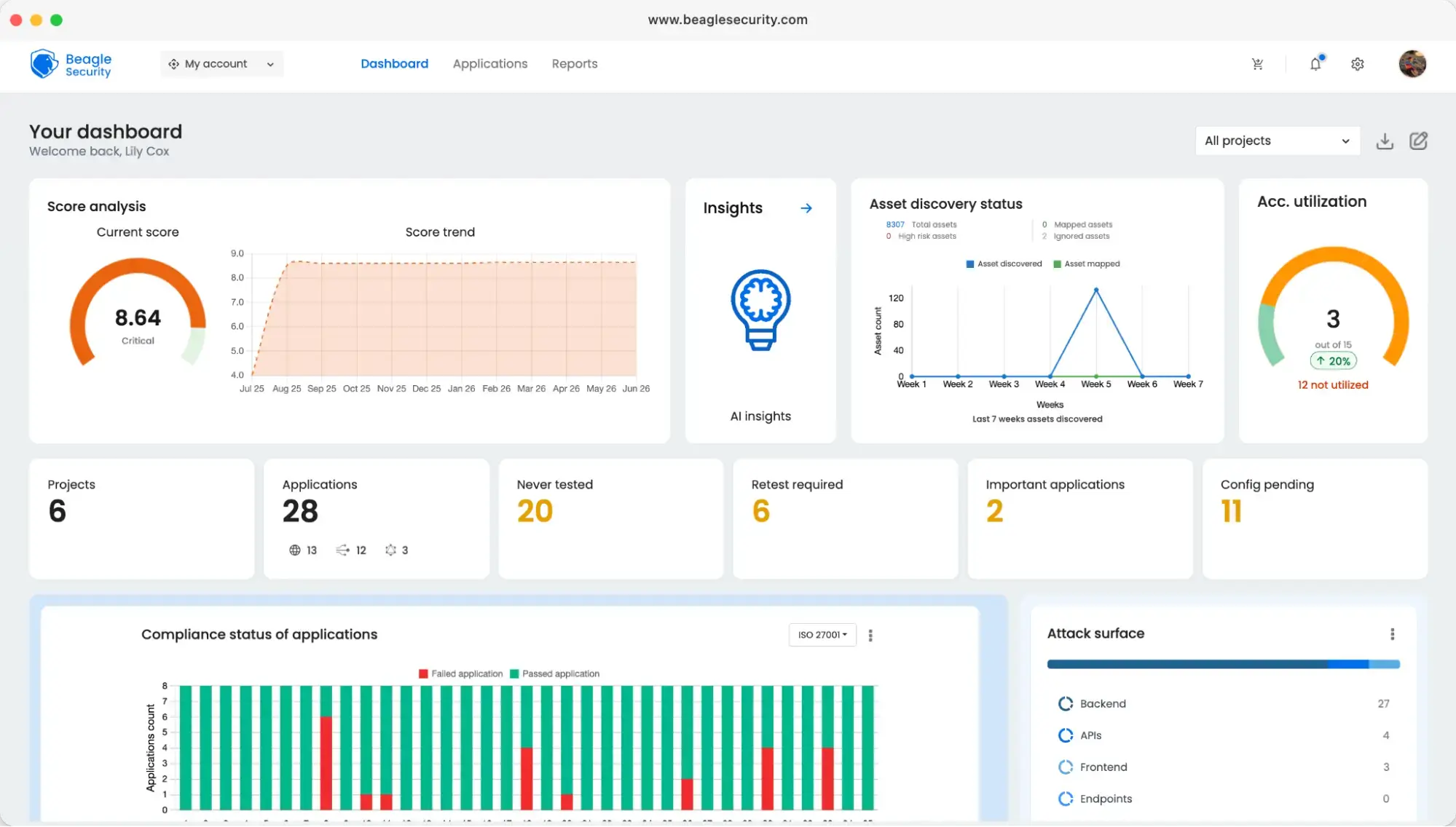
Beagle Security takes a different approach to what security testing should do. Rather than broad signature-based scanning, it runs attack-path simulation across your application, covering business logic flaws, authentication bypasses, and API-specific vulnerabilities that traditional scanners routinely miss.
Unlike Acunetix, Beagle Security is built around how development teams actually work. It integrates directly into CI/CD pipelines, surfaces results in developer-readable formats, and handles complex authentication flows without manual configuration.
Pricing starts at $119/month with a 14-day free trial. Advanced and customized enterprise plans are also available.
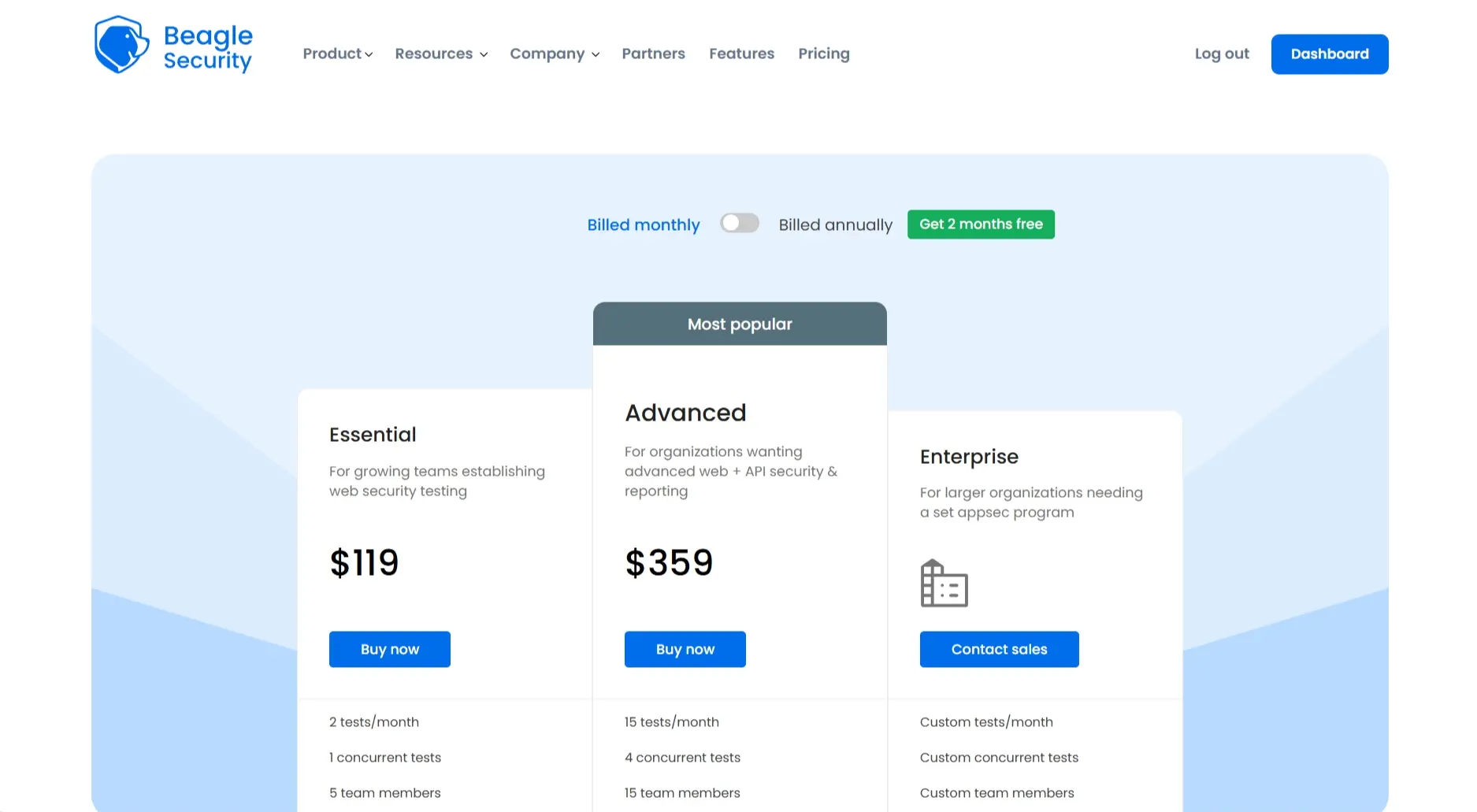
G2 review:
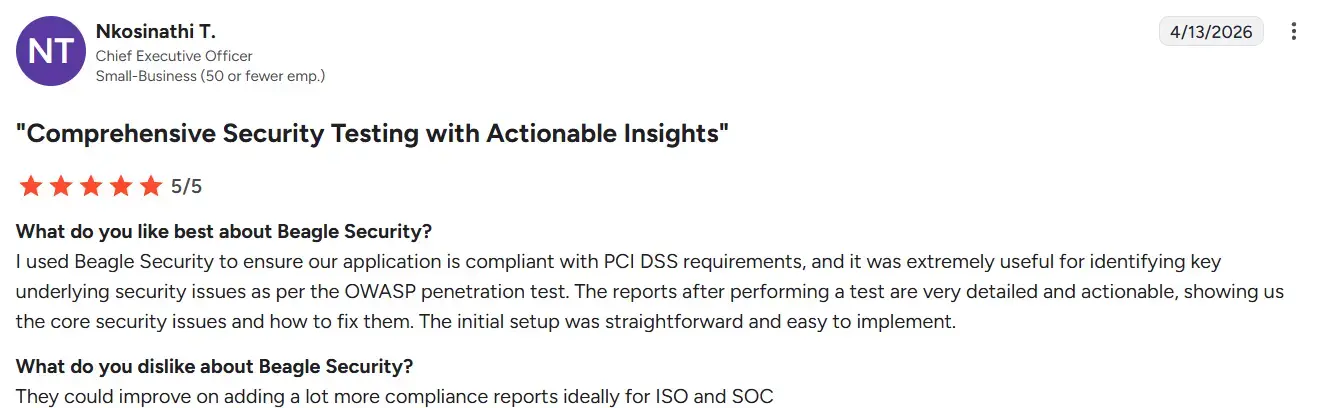
4.7/5 based on 88 reviews, Users consistently praise the ease of use and comprehensive reporting provided by Beagle Security, which simplifies the process of identifying and addressing vulnerabilities. The intuitive interface and actionable insights help users feel confident in their website’s security.
Key features:
Agentic AI penetration testing
Advanced support for APIs and GraphQL endpoints
Handles complex authentication flows with ease
Compliance-ready reports (OWASP, PCI DSS, GDPR)
Vulnerability prioritization to reduce false positives
For most teams, Beagle Security costs 70–80% less than Acunetix. That gap is significant, but the more relevant difference is that the tool is built around how development teams actually work, not just how security teams audit.
Quick comparison
| Category | Acunetix | Beagle Security |
|---|---|---|
| Starting price | $7000/year | $119/month |
| Pricing model | Quote-based, per target | Transparent, fixed tiers |
| GraphQL support | Limited | Full coverage |
| API testing depth | Standard | Deep, attack path simulation |
| False positive rate | Moderate | Reduced via AI triage |
| Free trial | Evaluation on request | 14 days advanced free trial |
Factors influencing Acunetix pricing
Acunetix does not publish a rate card, which means the final number depends on several variables you only discover during the sales process.
The number of targets is where most of the cost lives. Every domain, subdomain, or API endpoint you add to your scan scope moves you into a higher tier. For organizations with sprawling application inventories or microservice architectures, this compounds fast and is difficult to forecast without a detailed asset inventory upfront.
User seats add to the base cost as more people need access, whether that is security engineers triaging findings, developers reviewing vulnerability reports, or compliance teams pulling audit exports. Acunetix is not priced as a developer tool, so wider access tends to mean a bigger invoice rather than broader adoption.
Support and training is where enterprise quotes get expensive quickly. SLA-backed response times, dedicated onboarding, and premium support tiers are priced separately from the core license. For teams without in-house security expertise, these are often necessary costs rather than optional add-ons.
Contract length affects the per-year rate. Multi-year commitments typically come with discounts, but they also reduce your ability to switch tools as your stack changes. Locking into a two or three year contract for a scanner that does not natively support GraphQL or business logic testing is a risk worth weighing before you sign.
Is Acunetix pricing worth it in 2026?
Acunetix is a credible tool with a long track record. For large organizations with centralized security teams, established procurement processes, and a stable application portfolio, the investment can be justified.
The problem shows up at the edges: teams scaling quickly, organizations running API-first architectures, or anyone trying to embed security into development workflows rather than running it as a separate audit function. The pricing model does not flex well in those scenarios, and the tooling is not designed around developer remediation.
Beagle Security takes a different approach to what security testing should do. Rather than broad signature-based scanning, it runs attack-path simulation across your application: covering business logic flaws, authentication bypasses, and API-specific vulnerabilities that traditional scanners routinely miss.
If your security function is centralized, your application portfolio is stable, and enterprise pricing is not a constraint, Acunetix is a defensible choice.
If you need transparent pricing, continuous testing that fits inside a CI/CD pipeline, or meaningful coverage across GraphQL and API-heavy architectures, Beagle Security is worth a direct comparison before you commit to a vendor.
FAQ
Is Acunetix a good security tool?
Acunetix (by Invicti Security) is frequently praised for its proof-based scanning.However, teams looking for more developer-focused workflows and transparent pricing often consider modern alternatives like Beagle Security.
Is Acunetix free?
Acunetix Manual Tools is a free suite of penetration testing tools for manual web application cybersecurity and security assessment. The tools are available as a separate Windows installation package and are free for both private and commercial use
Is Acunetix DAST?
Acunetix has carved out its niche as the approachable gateway into professional DAST scanning.
What is the difference between Acunetix and Invicti?
Invicti focuses on enterprise-grade integration and automation, while Acunetix is aimed at smaller organizations that take a more hands-on approach.


![Top ZAP alternatives and competitors [October 2026]](/blog/images/top-zap-alternatives-cover.webp "Top ZAP alternatives and competitors [October 2026]")




![Top 10 penetration testing companies [2026]](/blog/images/top-penetration-testing-companies-cover.webp "Top 10 penetration testing companies [2026]")


![Top vendor application security tools [2026]](/blog/images/top-vendor-application-security-testing-tools-2026-cover.webp "Top vendor application security tools [2026]")



![Top Snyk alternatives & competitors [2026]](/blog/images/top-snyk-alternatives-cover.webp "Top Snyk alternatives & competitors [2026]")