Rapid7 vs Invicti (formerly Netsparker): Which is the best choice for you? [2026]
![Rapid7 vs Invicti (formerly Netsparker): Which is the best choice for you? [2026]](/blog/images/rapid7-vs-invicti.webp "Rapid7 vs Invicti (formerly Netsparker): Which is the best choice for you? [2026]")
If you are searching for a web application and API security testing platform in 2026, the decision often narrows down to a few prominent players, Rapid7 and Invicti among them. Both are well established names in the cybersecurity space and frequently land on shortlists for large enterprises and mid market organizations alike.
The real question is whether either platform is actually built for how modern application teams operate today. API first architectures, single page applications, two factor protected apps, microservices, and fast moving DevSecOps release cycles are pushing traditional DAST tools toward their limits.
In this comparison, we break down Rapid7 versus Invicti, examine their strengths and limitations, and introduce a third option built around a different approach, Beagle Security.
Rapid7 vs Invicti at a glance
| Feature | Rapid7 (InsightAppSec) | Invicti |
|---|---|---|
| Target market | Large enterprises, MSSPs | Mid-market to enterprise |
| Scanning technology | DAST + IAST (via Insight agents) | DAST with advanced automation |
| Ease of use | Steep learning curve | Moderate learning curve |
| AI features | Limited/none | Limited |
| Free trial | 30-day trial | 7-day trial |
| Pricing starts at | Custom quote (typically $20k+) | ~$37,000/year |
| G2 rating | 3.9/5 | 4.6/5 |
An alternative web & API penetration testing platform for comparison: Beagle Security
Beagle Security was built to address the friction found in legacy web & API testing platforms. Where traditional tools rely heavily on rule based scanning and manual tuning, Beagle Security uses agentic AI-driven testing to simulate how real attackers navigate modern applications.
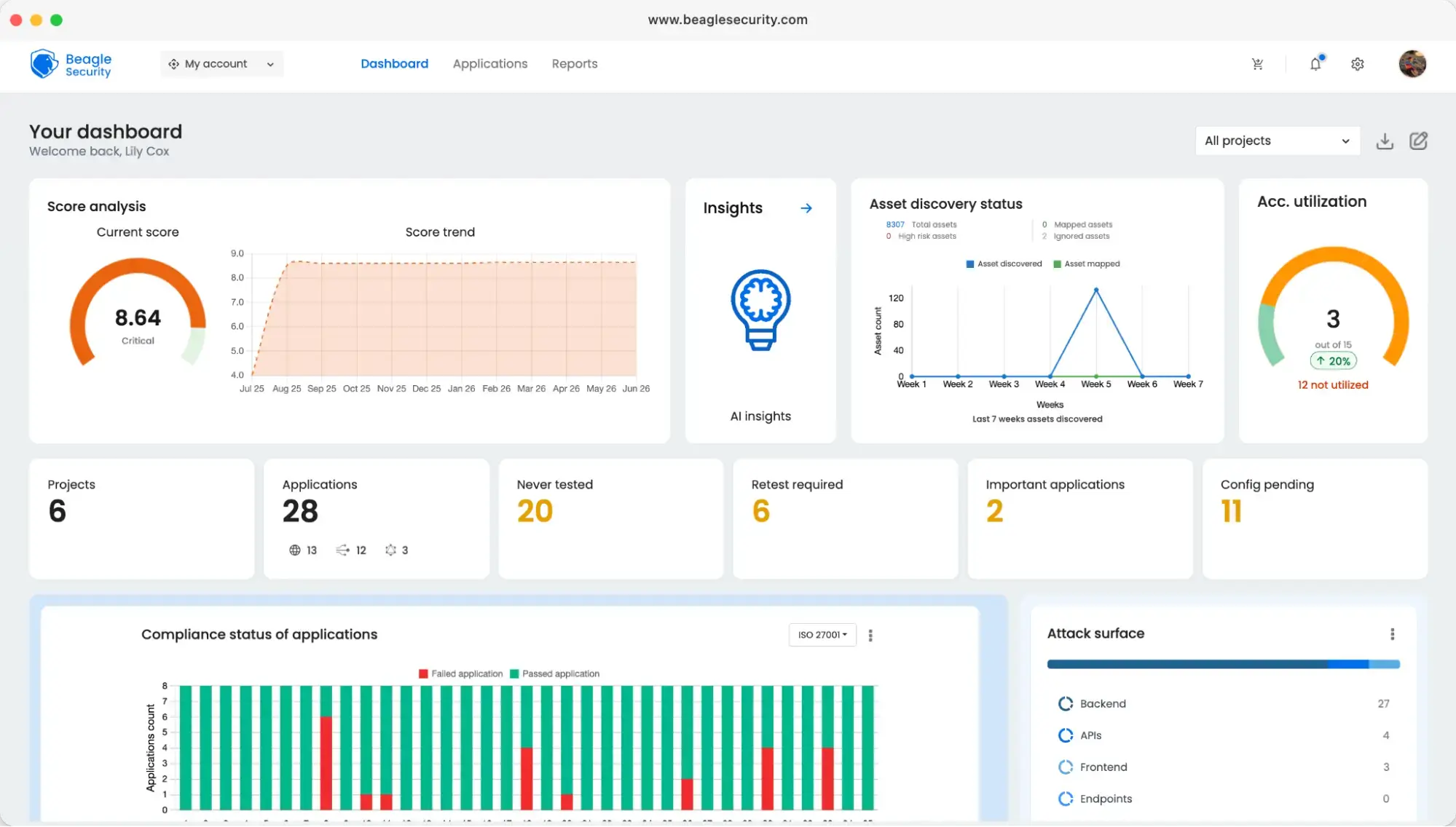
Instead of simply injecting payloads, the platform understands authentication flows, navigates login protected areas, tests business logic sequences, identifies exploit chains, and filters false positives contextually.
It is built for modern development teams, MSSPs, and enterprises that need deep API and GraphQL coverage, two factor authentication testing, direct CI/CD integration, and scalable pricing without per domain penalties.
A key differentiator is its concurrent test based pricing model. Unlike Rapid7, which prices per application, and Invicti, which prices per FQDN, Beagle Security allows unlimited applications under the same plan. You pay based on how many tests run simultaneously, which removes a common source of friction for teams with multiple staging environments, microservices, API gateways, and frequent releases.
Onboarding is fast and does not require significant technical support or training. Reports go beyond static CVE listings, providing remediation guidance specific to the technology stack in use, which tends to make fixes faster and more relevant to the team implementing them.
TL;DR - Why choose Beagle Security over Rapid7 & Invicti?
Fast to start : testing can begin within minutes of signup.
Contextual vulnerability reports : remediation guidance tailored to your tech stack.
No per FQDN restrictions : concurrent test based pricing for enterprise plans.
Built for developers and MSSPs : transparent plans with no hidden costs.
Agentic AI capabilities : AI based login navigation, business logic coverage, intelligent test case generation, real world exploit simulation, and false positive filtering.
Rapid7 vs Invicti vs Beagle Security: feature comparison
| Feature | Rapid7 | Invicti | Beagle Security |
|---|---|---|---|
| API security testing | Yes | Yes | Full REST + GraphQL |
| Business logic testing | Manual configuration required | Recorder-based (not AI-driven) | Yes |
| AI-based login handling | No | No | Yes |
| CI/CD integration | Advanced | Advanced | Seamless |
| Reporting | Extensive | Structured | Contextual & dev-first |
| 2FA-enabled app support | No | No | Yes |
| False positive filtering | Manual | Limited | Agentic AI-assisted |
Rapid7 features
Scheduled scanning and scan blackouts
Risk scoring and vulnerability tracking
Visual dashboards and customizable reporting
IAST integration via Insight agents
CI/CD integrations (e.g., Jenkins, Azure DevOps)
Integration with ServiceNow & broader Rapid7 ecosystem
Compliance focused reports
While InsightAppSec provides traditional DAST, Rapid7 increasingly positions it as part of its broader Command Platform, specifically Exposure Command. This makes it a comprehensive option for large organizations consolidating attack surface management and threat detection across a single ecosystem.
Its biggest strength is ecosystem consolidation. If you already use InsightVM, InsightCloudSec, or InsightIDR, InsightAppSec fits naturally into that workflow. The platform uses a universal translator to handle JavaScript heavy single page apps, and provides attack replay functionality that helps developers reproduce vulnerabilities locally.
There are tradeoffs to weigh. Business logic testing requires manual workflow configuration, two factor authentication automation requires scripting, false positives still need analyst validation, and per application pricing scales aggressively as your portfolio grows. For large enterprises prioritizing centralized governance and compliance reporting, Rapid7 works well. For agile, API heavy teams, it can feel heavier and more costly than necessary.
Invicti features
DAST engine with high scalability
Proof-Based Scanning (automatic vulnerability validation)
AI-powered crawling & form handling
Stateful API testing
Shadow API discovery
CI/CD integrations (Jenkins, GitLab, Azure DevOps)
Role-based access controls
Compliance-ready reporting (SOC 2, ISO 27001, PCI DSS)
Invicti’s biggest differentiator is its transition into a full Application Security Posture Management (ASPM) platform. Powered by recent acquisitions, Invicti now focuses heavily on correlating findings across DAST, SCA, and IAST using predictive risk scoring, rather than just acting as a standalone scanner.
Invicti also performs well in API state tracking, complex parameter relationships, and business logic workflows through manual recording. On the tradeoff side, deep scans can take significant time, the per FQDN pricing model limits flexibility, scaling across staging environments increases cost, and two factor or highly complex authentication still requires tuning. Invicti tends to suit enterprises with dedicated AppSec teams that prioritize deterministic validation over speed of adoption.
Beagle Security features
Agentic AI penetration testing, DAST and business logic testing
Contextual remediation guidance based on tech stack
Full API security support (REST, GraphQL)
Business logic testing without manual recording
Real-world penetration testing simulations
Intelligent test case selection and false positive filtering
Seamless CI/CD integration and DevSecOps alignment
Concurrent test-based pricing for enterprise flexibility
Easy onboarding and intuitive UX
Beagle Security is designed for today’s fast-paced development cycles and complex, modern tech stacks. It offers full-spectrum DAST capabilities enhanced by AI-driven logic, enabling it to test login-protected areas, understand app behavior, and prioritize vulnerabilities based on business impact.
Where Beagle Security truly differentiates itself is in its context-aware reports , offering remediation guidance tailored to specific technologies. This reduces triage time for developers and shortens the feedback loop between security findings and fixes.
It also supports 2FA-enabled login testing, GraphQL and REST APIs, and logic-heavy applications where traditional scanners fall short. The platform runs penetration test-like sequences, mimicking attacker behavior to uncover subtle flaws, while filtering out noise through false positive suppression.
Designed for both security and developer teams, Beagle Security integrates seamlessly with CI/CD pipelines & bug tracking tools, offers instant test launch with no setup time, and comes with concurrent test-based pricing, enabling scalable testing across unlimited apps without worrying about target limits.
Rapid7 vs Invicti vs Beagle Security: Pricing comparison
| Platform | Pricing model | Starting price | Free trial |
|---|---|---|---|
| Rapid7 | Per application | $175/month for 1 app | 30-day trial |
| Invicti | Per-FQDN | Custom based | 7-day trial |
| Beagle Security | Concurrent test-based | Self-serve plans start at $1188/year | 14-day trial |
Rapid7 pricing
Rapid7 does publish pricing for Insight AppSec, which starts at $175/month for a single application. For enterprise organizations having a large number of applications, the annual cost scales up significantly.
Say you have 50 applications: $175 × 50 apps × 12 months = $105,000/year.
While it may be justifiable for companies already invested in the Rapid7 Command Platform ecosystem, for agile teams focused purely on application and API security, the per-app scaling is often cost-prohibitive
Invicti pricing
Invicti uses a per-FQDN pricing model. For teams managing multiple applications, this can quickly drive up costs. Invicti does not have a pricing listed publicly on their website. According to verified sources like AWS Marketplace, Invicti’s pricing for 50 targets starts at $37,000 per year, and will go higher depending on the required features and support tier.
This model becomes especially restrictive for MSSPs or teams managing dynamic environments with frequently changing domains or staging URLs.
While it offers a 7-day trial, the full capabilities aren’t unlocked unless you commit to a paid plan.
Beagle Security pricing
Beagle Security offers transparent and scalable pricing, starting at just $119/month, which comes to $1188/year.
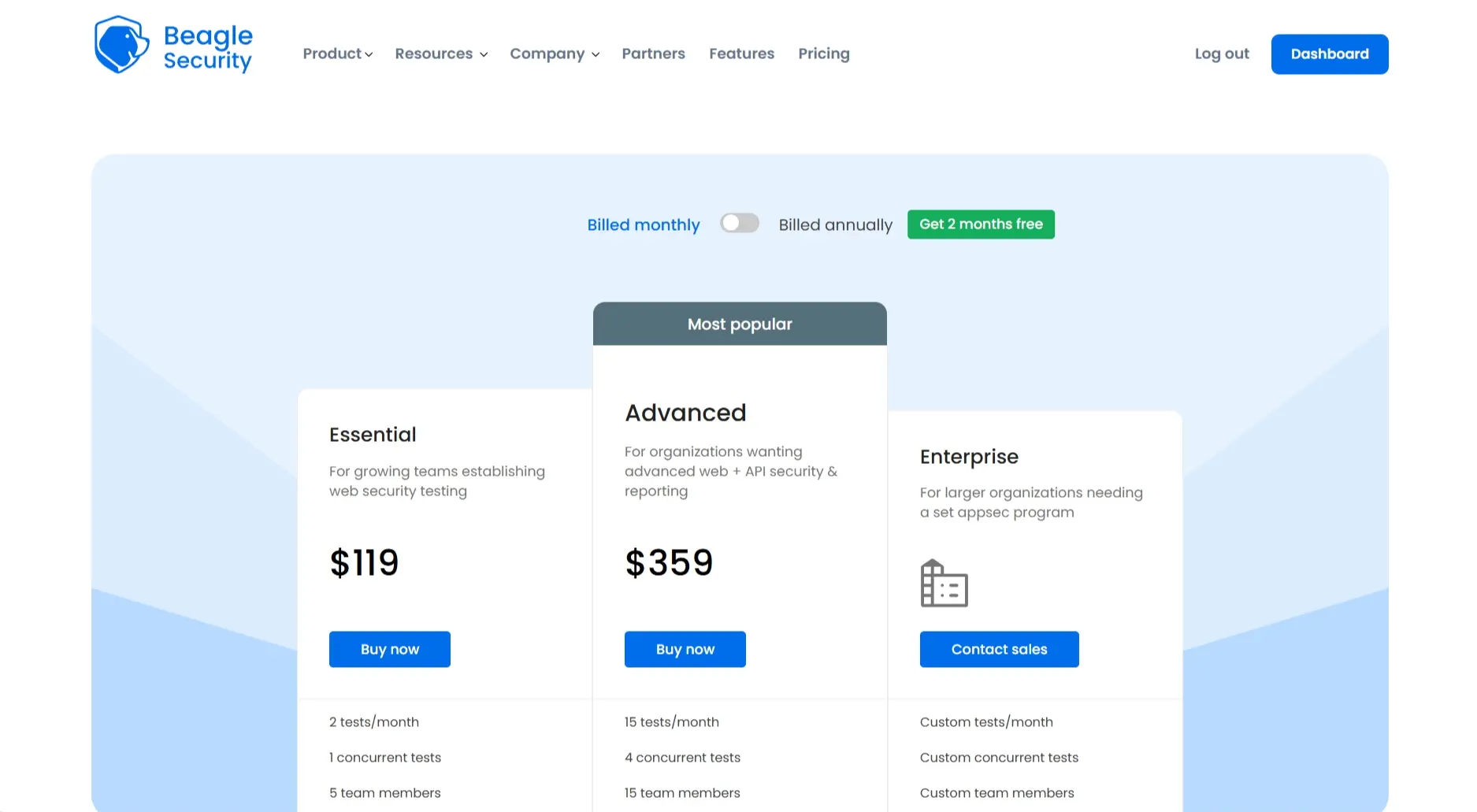
Unlike Rapid7 and Invicti, Beagle Security does not charge based on the number of applications or domains. Instead, pricing is based on the number of concurrent tests.
This makes Beagle Security ideal for teams that want to scale their testing across dozens (or even hundreds) of applications without incurring additional costs.
Rapid7 vs Invicti vs Beagle Security: Customer reviews comparison
| Platform | G2 rating |
|---|---|
| Rapid7(InsightAppSec) | 3.9/5 based on 10 reviews |
| Invicti | 4.6/5 based on 71 reviews |
| Beagle Security | 4.7/5 based on 88 reviews |
*As of latest G2 results in July 2026
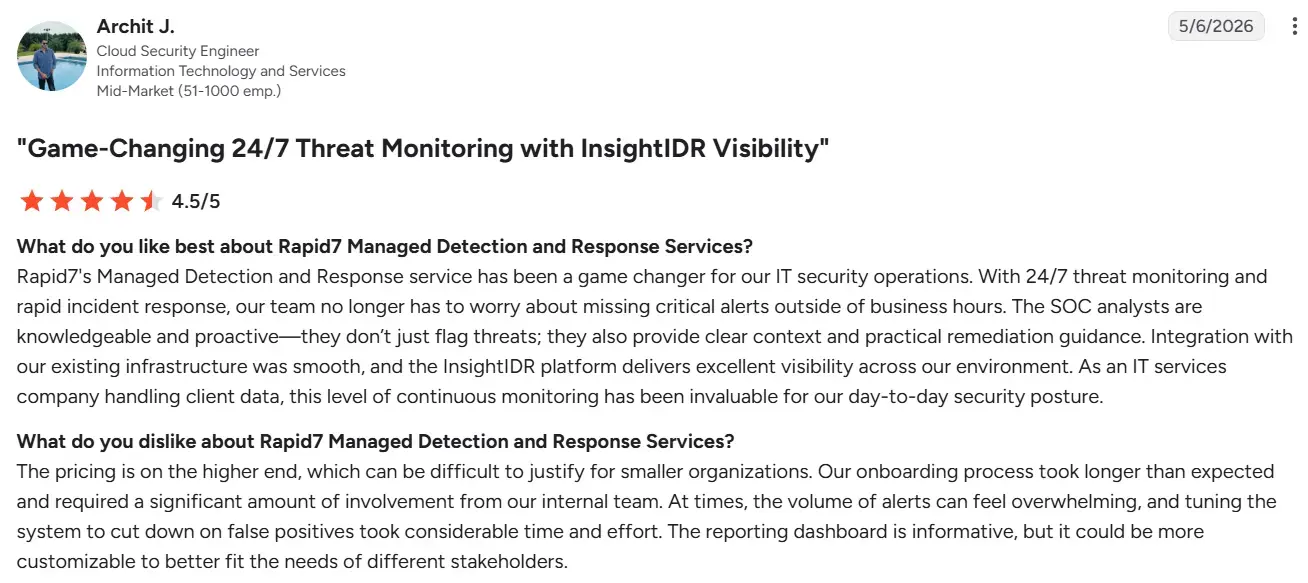
Rapid7 reviews
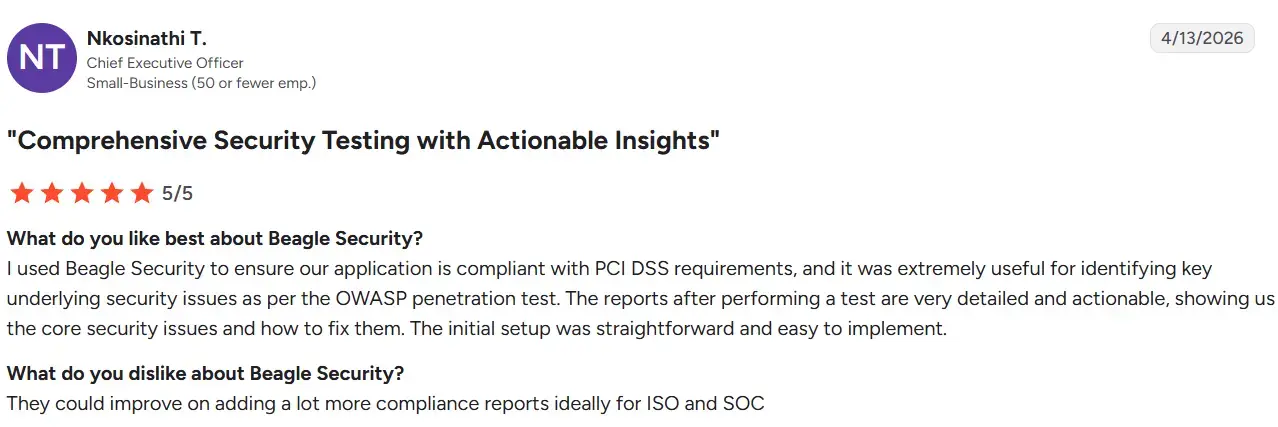
Users appreciate the platform’s integration with other Rapid7 tools and its visualization features. However, some cite a steep learning curve, performance issues during scans, and a lack of context-aware remediation guidance as major drawbacks.
Source: G2
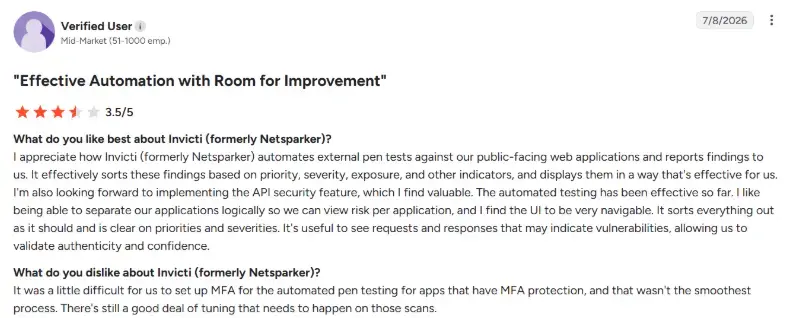
Invicti reviews
Invicti gets high marks for accuracy and automation. But users often point out slow performance during large scans, API testing limitations, and the absence of 2FA support. Teams without dedicated AppSec expertise may find the tool harder to adopt.
Source: G2
Beagle Security reviews
Beagle Security is consistently praised for its intuitive UI, AI-based test engine, and contextual, developer-friendly reports. Many customers also mention fast support response times and quick onboarding, making it a favorite among lean teams and MSSPs.
Rapid7 vs Invicti vs Beagle Security: Which is best for you?
The right fit usually comes down to whether you’re extending an existing platform, need proof based validation, or need coverage for modern, authenticated applications.
| If you need | Best fit |
|---|---|
| Deep integration with other Rapid7 products (InsightVM, InsightCloudSec, InsightIDR) | Rapid7 |
| Dedicated security staff available to manage setup and manual scanning workflows | Rapid7 or Invicti |
| Deterministic, proof based vulnerability validation | Invicti |
| A broad ASPM platform with predictive risk scoring across DAST, SCA, and IAST | Invicti |
| Strong enterprise integrations and applications that don't rely heavily on 2FA or complex logic | Invicti |
| Real world penetration testing built for modern apps, SPAs, and APIs | Beagle Security |
| Testing coverage for 2FA protected apps or business logic heavy workflows | Beagle Security |
| Remediation guidance specific to your tech stack, with AI assisted false positive filtering | Beagle Security |
| Transparent pricing that scales with testing volume rather than app count | Beagle Security |
| Fast onboarding without a dedicated AppSec team to manage the tool | Beagle Security |
Try Beagle Security for free to see how it compares
Choosing between Rapid7 and Invicti can often feel like picking between two massive, complex platforms built for overarching infrastructure tracking rather than agile development
If you’re looking for something that’s actually built for how modern teams work, Beagle Security is the smarter alternative.
It combines enterprise-grade capabilities with intuitive design, flexible pricing, and AI-powered testing, giving you the features you need, without the layers you don’t.
That’s why more dev & security teams and MSSPs are switching from bloated, per-app platforms to Beagle Security.
You can start a 14-day free trial or schedule a demo to get started with the Beagle Security platform.
FAQ
What is the main difference between Rapid7 and Invicti?
Rapid7’s InsightAppSec is positioned as a cloud-native DAST tool with broader Rapid7 ecosystem integration, while Invicti emphasizes proof-based validation and enterprise-grade web app security automation. In plain terms, Rapid7 is often chosen for ecosystem fit, while Invicti is often chosen for validation depth and scanner accuracy.
Is there a cheaper alternative to Rapid7 and Invicti?
Beagle Security prices are based on concurrent tests rather than per application or per FQDN, which tends to cost less for teams running multiple applications. ZAP by Checkmarx is a free, open source option, though it requires more manual configuration than either commercial platform.
Which is better, Rapid7 or Invicti?
Neither is universally better. Rapid7 fits enterprises already using its broader Insight platform, while Invicti fits AppSec teams that want proof based, deterministic validation and are willing to invest time in manual tuning.
What is proof based scanning in Invicti?
Proof based scanning automatically validates vulnerabilities by safely exploiting them, which confirms a finding is real rather than flagging a possible issue for manual review. This is a core part of how Invicti reduces false positives.


![Top ZAP alternatives and competitors [October 2026]](/blog/images/top-zap-alternatives-cover.webp "Top ZAP alternatives and competitors [October 2026]")




![Top 10 penetration testing companies [2026]](/blog/images/top-penetration-testing-companies-cover.webp "Top 10 penetration testing companies [2026]")



![Top vendor application security tools [2026]](/blog/images/top-vendor-application-security-testing-tools-2026-cover.webp "Top vendor application security tools [2026]")



![Top Snyk alternatives & competitors [2026]](/blog/images/top-snyk-alternatives-cover.webp "Top Snyk alternatives & competitors [2026]")