BurpSuite vs Acunetix: Which is the best choice for you? [2026]
![BurpSuite vs Acunetix: Which is the best choice for you? [2026]](/blog/images/burpsuite-vs-acunetix.webp "BurpSuite vs Acunetix: Which is the best choice for you? [2026]")
If you’re evaluating web application and API security testing platforms, two names come up constantly: Burp Suite and Acunetix. Both are well established in the cybersecurity space and frequently land on shortlists for organizations of varying sizes.
The real question is whether either one actually fits your organization’s current needs, especially when flexibility, DevSecOps readiness, and pricing efficiency matter as much as raw detection capability.
This comparison covers Burp Suite versus Acunetix, where each platform is strong and where it falls short, and introduces Beagle Security as a third option worth knowing about.
Burp Suite vs Acunetix at a glance
| Feature | Burp Suite | Acunetix |
|---|---|---|
| Target market | Security professionals, Pen-testers | Mid-market |
| Scanning technology | DAST, Manual testing tools | DAST |
| Ease of use | Steep learning curve | Moderate learning curve |
| AI features | Limited | Limited |
| Free trial | No | No |
| Pricing starts at | Custom quote | $7,000/year |
| G2 rating | 4.8/5 | 4.1/5 |
An alternative web and API penetration testing platform: Beagle Security
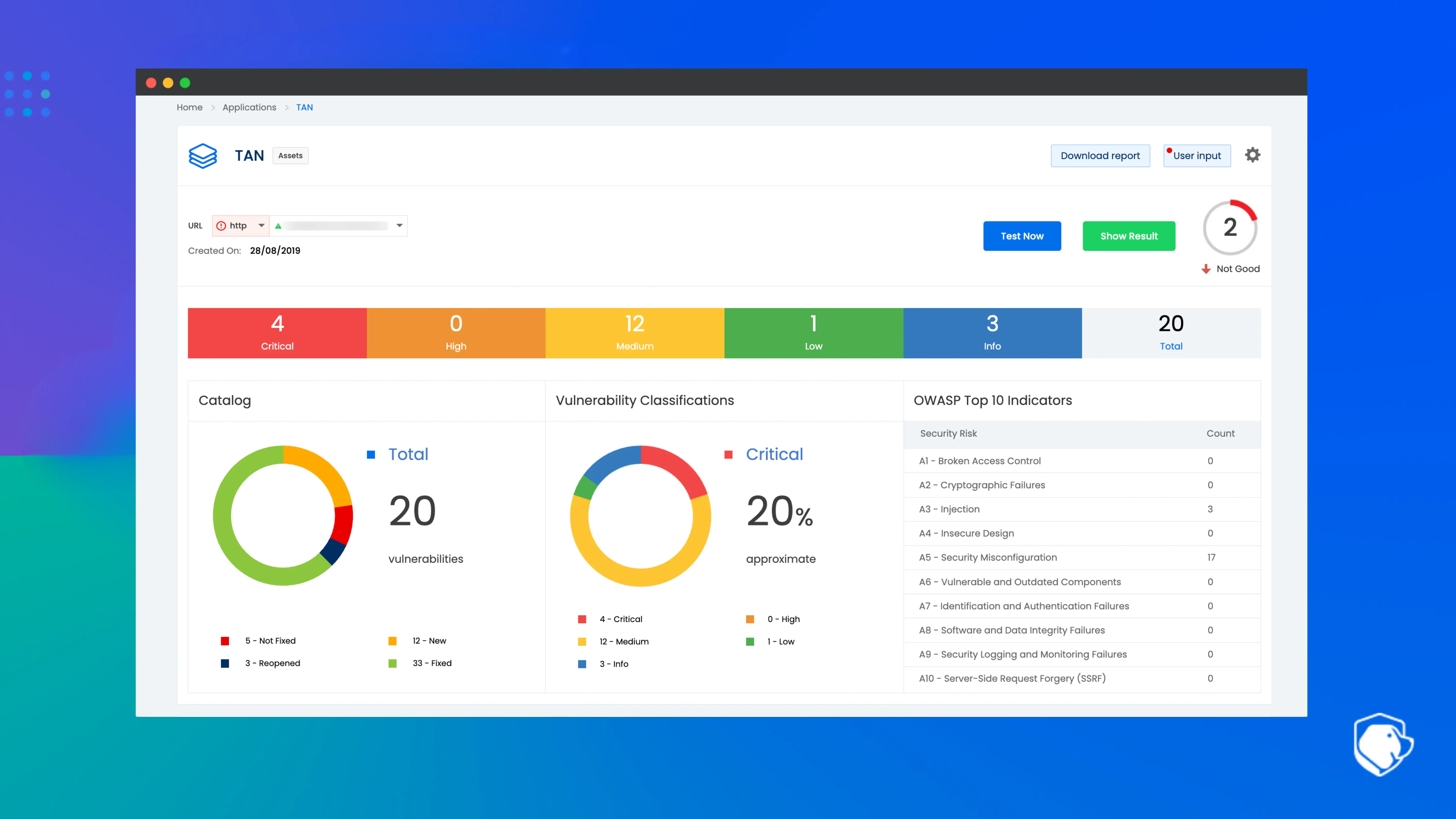
Beagle Security is an agentic AI pentesting platform built around a problem many organizations run into: balancing testing depth, ease of use, and cost without giving up enterprise grade capability.
Acunetix is built around a more traditional scanning approach, while Beagle Security takes a more developer focused, DevSecOps friendly approach that appeals to security and engineering teams equally.
Its strength is agentic AI powered automation, support for modern web technologies including single page applications and GraphQL APIs, and flexibility without the complexity that tends to come with legacy tools.
Why consider Beagle Security in the Burp Suite vs Acunetix conversation?
Advantages:
Fast to start: Minimal learning curve, teams of any skill level can get going quickly
Contextual vulnerability reports: Findings prioritized and mapped to your app logic, with remediation guidance tailored to your tech stack instead of generic suggestions
No lock in on targets: Concurrent test based enterprise pricing instead of per FQDN limits, which gives more flexibility for growing teams and multi app environments
Enterprise-grade features without the price tag
| Capability | What it does |
|---|---|
| AI based login flow navigation | Automatically navigates authenticated flows during testing |
| Business logic understanding | Tests how your application actually behaves, not just known attack patterns |
| Intelligent test case selection | Adapts test cases to your specific application architecture |
| False positive filtering | Cuts down on noise so findings are more likely to be real |
| Real world attack simulation | Built on penetration testing principles rather than static, predefined scans |
Burp Suite vs Acunetix vs Beagle Security: Feature comparison
| Feature | Burp Suite | Acunetix | Beagle Security |
|---|---|---|---|
| API security | Yes | Limited | Full support |
| AI-based login authentication | No | No | Yes |
| CI/CD integration | Yes | Basic | Seamless |
| Developer experience | Complex | Moderate | Smooth & intuitive |
| Reporting & exports | PCI DSS & OWASP Top 10 reports | Available | PCI DSS, HIPAA, OWASP, ISO, and more |
| OWASP mapped reports | Yes | Yes | Yes |
| False positive filtering | Manual | Manual effort | AI-assisted |
| PCI DSS compliance reports | Yes | Yes | Yes |
| HIPAA compliance reports | No | Yes | Yes |
| Scheduled testing | Yes | Yes | Yes |
Burp Suite features
Key Burp Suite features:
Scheduled testing
CI/CD integrations
Scan SPAs
PCI DSS & OWASP Top 10 reports
SSO supported testing
Burp Suite is primarily known for its depth as a manual penetration testing toolkit. It offers some automated scanning, but its real strength is letting security professionals analyze and manipulate web traffic directly, which makes it a common choice for in depth vulnerability discovery. That power comes with a steep learning curve, and it can be resource intensive for large scale scanning.
Acunetix features
Key Acunetix features:
Dynamic Application Security Testing (DAST)
Compliance-focused reporting (PCI DSS, HIPAA, etc.)
Authenticated scan support (cookies, headers)
Limited API scanning (REST, Swagger/Postman)
AcuSensor IAST integration for deeper insight
Basic CI/CD integration
Acunetix is positioned as an “affordable” option in the Invicti Security portfolio, offering comprehensive web application security testing. It includes expected vulnerability detection features, covering OWASP Top 10 vulnerabilities.
Its REST API security testing capabilities exist but may lack the sophistication needed for modern API-first organizations. API access is available, but documentation and support for custom integrations may lag.
While Acunetix offers CI/CD integration with tools like Jenkins and Azure DevOps, the implementation can feel like an afterthought.
Customer support experiences vary. For modern tech stacks like SPAs, GraphQL APIs, and rapidly changing dev environments, Acunetix’s limitations in intelligent crawling and business logic detection is a let-down.
Beagle Security features
Key Beagle Security features:
Agentic AI-powered DAST and business logic testing
Contextual remediation guidance based on tech stack
Full API security support (REST, GraphQL)
Real-world penetration testing simulations
Intelligent test case selection and false positive filtering
Seamless CI/CD integration and DevSecOps alignment
Concurrent test-based pricing for enterprise flexibility
Easy onboarding and intuitive UX
Beagle Security is built for modern development practices. Its AI engine goes beyond predetermined scripts, analyzing an application’s tech stack and generating test cases specific to it.
Automated testing is built around understanding how an attacker might exploit your specific application architecture, which helps it catch business logic flaws traditional scanners tend to miss. API security testing is a particular strength, built for API first organizations and including API discovery.
Beagle Security’s testing adapts to your development cycle, with test case selection that evolves based on what it learns about your applications over time. Its cloud native architecture also removes the need for capacity planning or infrastructure management on your end.
Burp Suite vs Acunetix vs Beagle Security: Pricing comparison
| Platform | Starting price | Free trial |
|---|---|---|
| Burp Suite | Custom quote | No |
| Acunetix | $7000/year for 5 FQDNs | No |
| Beagle Security | Self-serve plans start at $1188/year | 14-day free trial |
*Pricing based on data available from AWS Marketplace for Acunetix.
Burp Suite pricing
Burp Suite pricing is typically custom and depends on the specific edition (e.g., Community, Professional, Enterprise) and the features required. For larger organizations and enterprise-grade scanning, it can be a significant investment, often requiring dedicated security personnel to maximize its capabilities.
Acunetix pricing
Acunetix’s pricing starts at about $7000 and is aimed at mid-market companies, but can increase with additional targets. Pricing is mainly based on the number of FQDNs, which can become restrictive and expensive as an application landscape grows. It does not offer a free trial, making it impossible to evaluate capabilities before committing financially. The total cost of ownership can be higher than initially perceived, especially for managing multiple environments or dynamic applications.
Beagle Security pricing
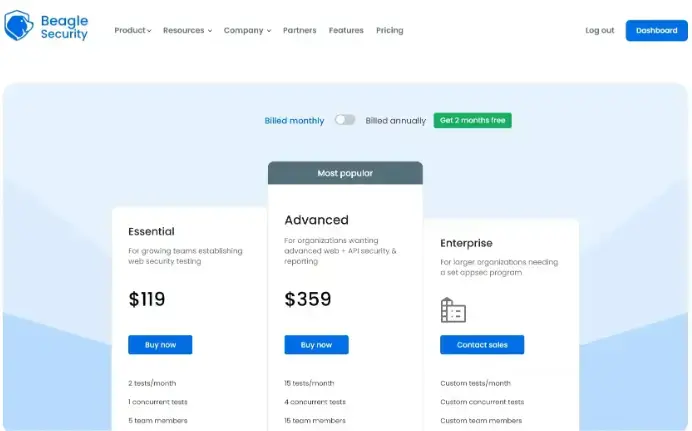
Beagle Security’s pricing is transparent and scales with features and usage rather than arbitrary target limits. It offers annual and monthly plans with MSSP friendly models, and a free trial before you commit. Even at lower tiers, core features like AI automation, business logic testing, and CI/CD integration are included.
Burp Suite vs Acunetix vs Beagle Security: Customer reviews comparison
| Feature | Acunetix | BurpSuite | Beagle Security |
|---|---|---|---|
| Ease of use | 8.5 | 8.8 | 9.5 |
| Ease of setup | 8.6 | 9.3 | 9.6 |
| Ease of admin | 8.5 | 9.2 | 9.3 |
| Quality of support | 7.7 | 8.7 | 9.7 |
| Meets requirements | 8.3 | 9.4 | 9.1 |
*As of latest G2 comparison in July 2026
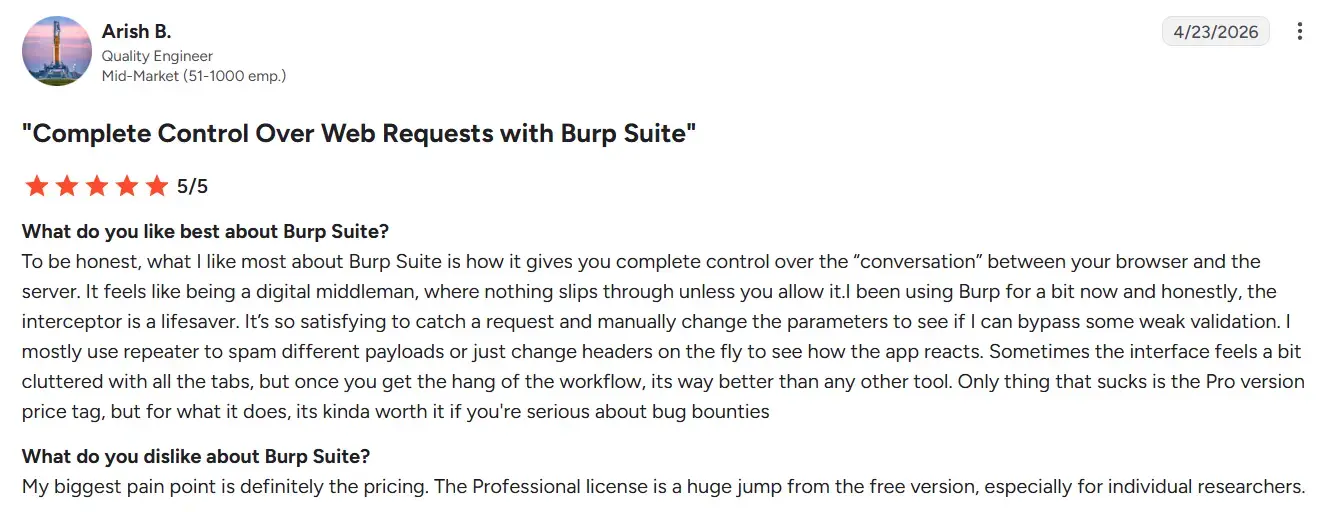
Burp Suite reviews
Users appreciate Burp Suite’s powerful features for detailed manual testing and its flexibility for advanced security professionals.
However, customers commonly complain about the steep learning curve required to master the platform and that it can be resource-intensive, particularly for large-scale or continuous scanning.
Acunetix reviews
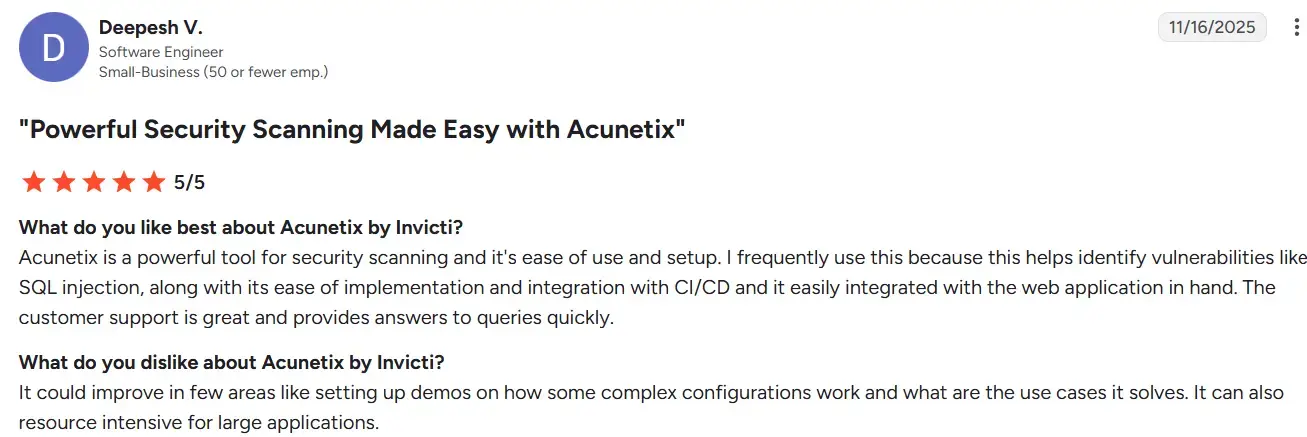
Users commend Acunetix for its accuracy in detecting common vulnerabilities, effective reporting, and powerful automation. Its ability to generate compliance-ready reports and maintain consistent coverage for standard web attack vectors is also appreciated.
While its automation helps maintain security baselines, some users find Acunetix limiting for complex applications or modern testing.
The licensing model is often seen as rigid, leading to increased costs for multiple targets. Authentication workflows, especially multi-step or token-based ones, can require extensive manual configuration.
Customer support feedback is mixed. Its limitations with modern authentication, intelligent crawling, and nuanced business logic detection are noted by security teams working with SPAs, GraphQL APIs, and fast-changing dev environments.
Beagle Security reviews
Beagle Security is praised for its intuitive UI, developer-first reporting, realistic testing, and affordable pricing. Many customers appreciate its AI capabilities and fast, responsive support.
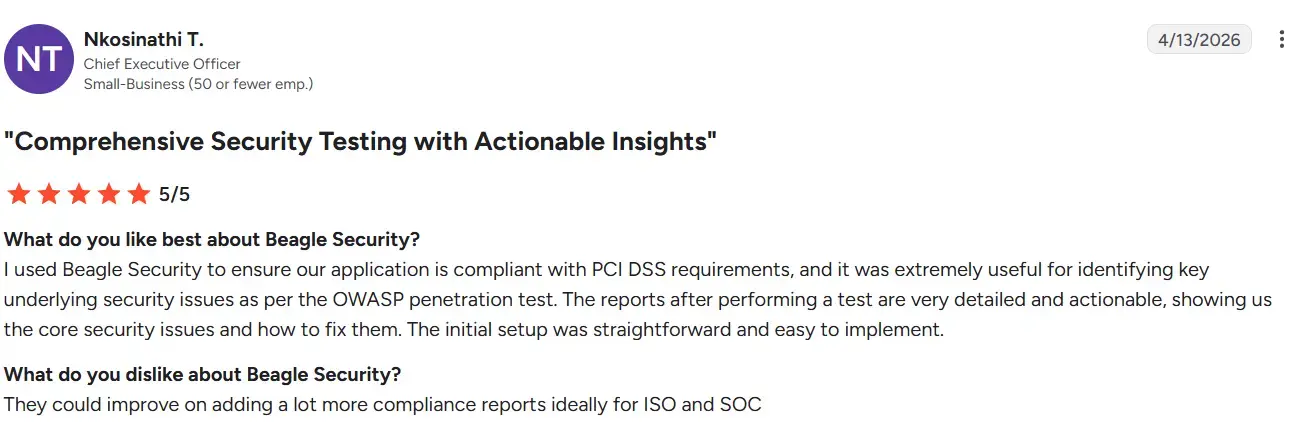
Users consistently highlight the ease of onboarding, configuration, and launching tests. Reports are structured for technical clarity and business context, reducing dependency on security experts for interpretation.
Burp Suite vs Acunetix vs Beagle Security: which is best for you?
The right pick usually comes down to whether you need deep manual control, straightforward scanning for a mid sized team, or modern coverage without per target pricing.
| If you need | Best fit |
|---|---|
| Highly customizable tooling for expert level manual penetration testing | Burp Suite |
| Dedicated security personnel already familiar with complex tools | Burp Suite |
| Deep, hands on vulnerability discovery over automated, continuous scanning | Burp Suite |
| Straightforward scanning for a mid sized team with some room to customize | Acunetix |
| Comfort with a learning curve in exchange for established, compliance focused reporting | Acunetix |
| Enterprise grade capability without enterprise level pricing | Beagle Security |
| Real world penetration testing without managing complex configuration | Beagle Security |
| Pricing that doesn’t lock you into per target or per FQDN limits | Beagle Security |
| Testing coverage for modern web apps, APIs, GraphQL, and complex login flows | Beagle Security |
| Agentic AI driven testing with clear remediation guidance and CI/CD integration | Beagle Security |
Try Beagle Security for free to see how it compares
While Burp Suite and Acunetix offer distinct approaches to web security they often operate within traditional frameworks.
If you’re looking for something that’s actually built for how modern teams work, Beagle Security is the smarter alternative. It combines enterprise-grade capabilities with intuitive design, flexible pricing, and AI-powered testing, giving you the features you need, without the layers you don’t.
That’s why more dev & security teams and MSSPs are switching from bloated, per-app platforms to Beagle Security.
You can start a 14-day free trial or schedule a demo to get started with the Beagle Security platform.
FAQs
What is the difference between Burp Suite and Acunetix?
Burp Suite is a manual testing toolkit with a steep learning curve, built for security professionals who want direct control over testing web traffic. Acunetix is a more automated DAST scanner with compliance focused reporting, built to run with less day to day manual configuration.
How much does Acunetix cost?
Acunetix pricing starts around $7,000 per year for 5 FQDNs, based on AWS Marketplace listings. Pricing scales with the number of targets, and there’s no published flat rate or free trial.
Does Acunetix have a free trial?
No. Acunetix does not offer a free trial, which makes it harder to evaluate the platform’s fit before committing to a paid plan.


![Top ZAP alternatives and competitors [October 2026]](/blog/images/top-zap-alternatives-cover.webp "Top ZAP alternatives and competitors [October 2026]")




![Top 10 penetration testing companies [2026]](/blog/images/top-penetration-testing-companies-cover.webp "Top 10 penetration testing companies [2026]")



![Top vendor application security tools [2026]](/blog/images/top-vendor-application-security-testing-tools-2026-cover.webp "Top vendor application security tools [2026]")



![Top Snyk alternatives & competitors [2026]](/blog/images/top-snyk-alternatives-cover.webp "Top Snyk alternatives & competitors [2026]")