The 6 best OWASP security testing tools in 2026
Web applications and APIs are evolving faster than ever, and so are the threats targeting them. The OWASP Top 10 continues to be the world’s most referenced framework for identifying the most critical web application security risks. But simply knowing the top tools isn’t enough; organizations need reliable security testing tools that can detect vulnerabilities before attackers can exploit them.
In 2026, the security tooling ecosystem spans dynamic analysis tools (DAST), static scanners (SAST), interactive testing (IAST), automated penetration testing engines, and full-fledged offensive security platforms. Each serves a unique purpose within a mature application security program.
This guide breaks down the 6 best OWASP security testing tools in 2026, their strengths, pricing context, and when to use each. Whether you are modernizing your DevSecOps pipeline or selecting tools for compliance, this list will help you make the right choice for your team.
Why OWASP-aligned tools matter more than ever
The OWASP Top 10 highlights vulnerabilities such as injection flaws, broken authentication, API security gaps, insecure design, and software supply-chain issues. Using OWASP-aligned tools ensures:
Consistent detection of common & emerging vulnerabilities
Reliable coverage of modern web technologies
Easier reporting for compliance frameworks
Better integration with SDLC and CI/CD workflows
But not all tools are equal. Some excel at deep manual pentests, others at fast automated scans in CI, and some push the boundaries with AI-driven business-logic testing and authenticated workflow coverage.
Let’s dive into the top tools of 2026.
Comparison table
| Tool | Category | Strengths | Best for |
|---|---|---|---|
| Beagle Security | Agentic AI-driven Penetration testing | Business-logic testing, API coverage, low false positives | Modern DevSecOps teams |
| OWASP ZAP | Free DAST | Flexible, open-source, proxy-based | Budget-friendly setups |
| Burp Suite | Manual + Automated | Deep manual testing, exploit chaining | Pentesters & red teams |
| SonarQube | SAST | Code-level detection | Developer-first teams |
| w3af | DAST / Exploitation | Plugin-heavy, open-source | Researchers |
| Kali Linux | Pentest distro | 600+ tools bundled | Offensive security teams |
The 6 best OWASP security testing tools of 2026
1. Beagle Security
Category: Agentic AI-driven penetration testing
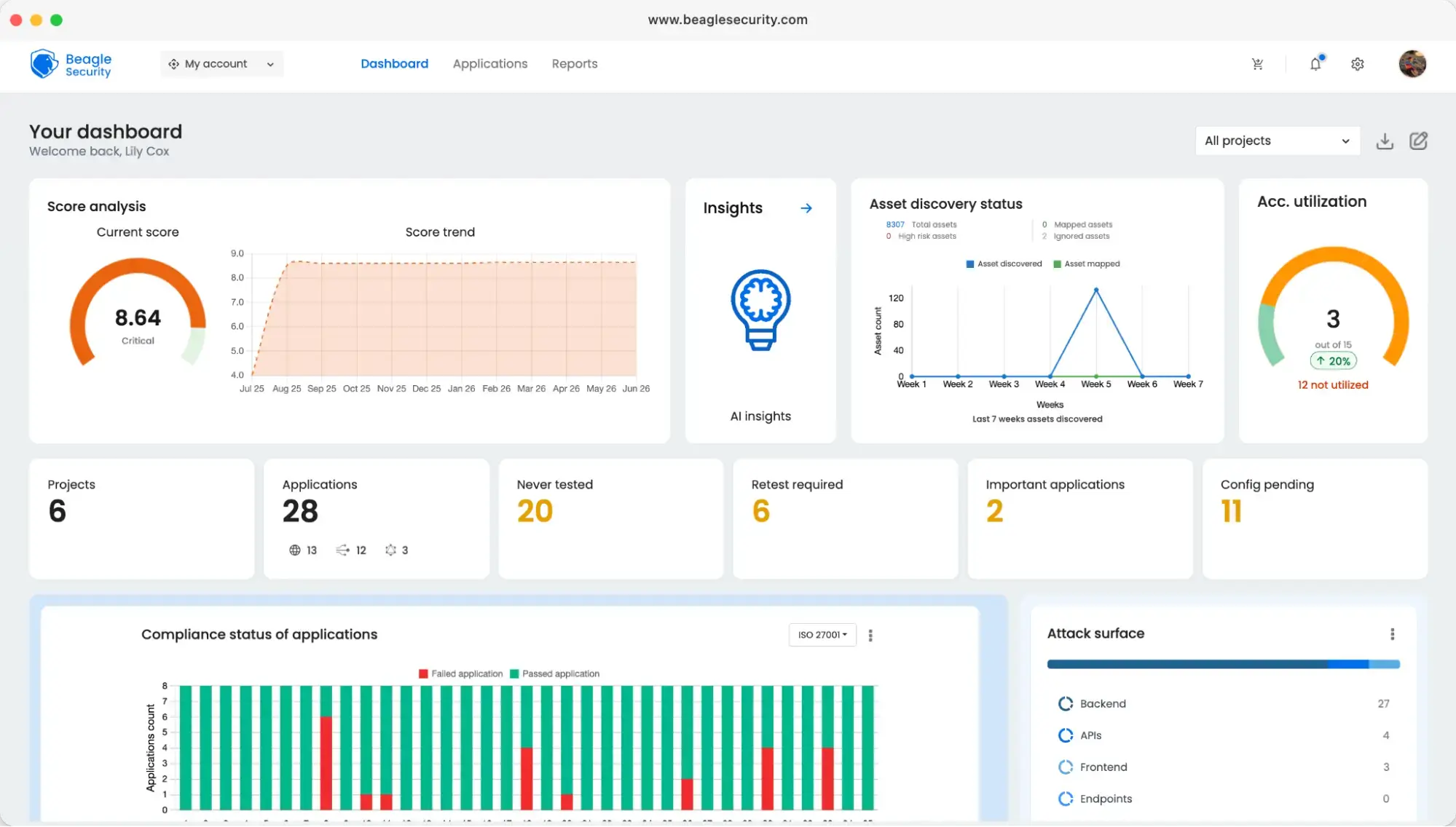
Beagle Security is a modern, agentic AI-driven security testing platform that simulates real world attacks against your web applications and APIs. Rather than relying mainly on pattern matching, it runs authenticated, workflow aware penetration tests that replicate how attackers exploit business logic, broken access control, and API vulnerabilities.
Its workflow recorder supports MFA, cookies, tokens, SSO, magic links, and complex state transitions, which gives it strong coverage against OWASP Top 10 risks. You also get detailed, compliance ready reports, CI/CD integrations, and a low false positive rate compared to signature based scanners.
It fits DevSecOps teams that need continuous, accurate coverage from development through deployment.
Key features:
Authenticated scanning with workflow replay
Business logic vulnerability detection
Advanced API security testing
Lowest false-positive rate among automated tools
CI/CD integrations (GitHub, GitLab, Jenkins, Azure DevOps)
Compliance-ready reporting mapped to OWASP Top 10, PCI DSS, HIPAA
Review & rating:
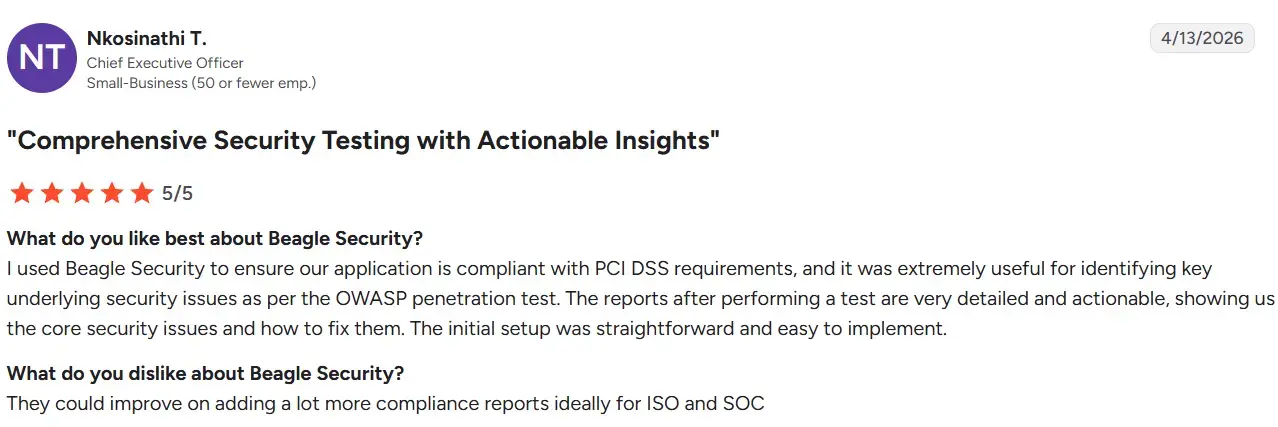
Beagle Security holds a 4.7 out of 5 rating on G2. Reviewers highlight its automation, accuracy, and low false positive rate compared to signature based scanners, along with reports that developers can act on directly.
Why it’s a top choice in 2026
Most tools find surface-level issues. Beagle Security finds the vulnerabilities hidden deep in user journeys.
2. ZAP by Checkmarx
Category: Free DAST / Proxy tool
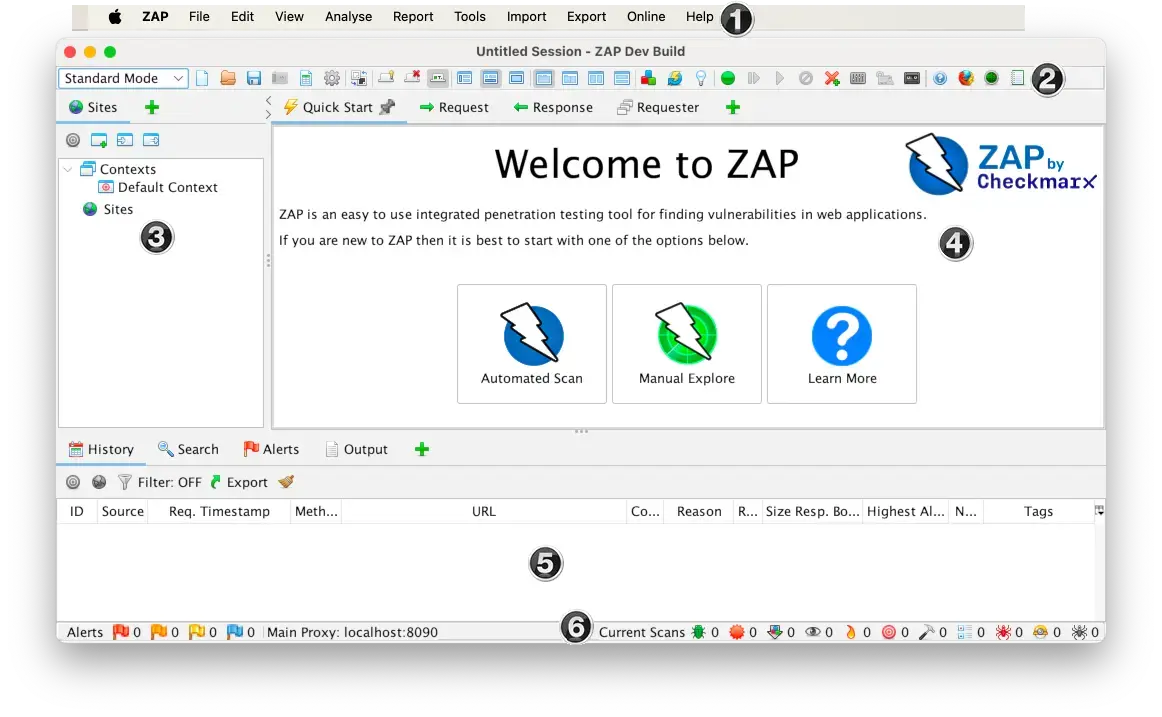
ZAP by Checkmarx is one of the most widely used open source dynamic testing tools, built for both beginners and experienced security testers. It provides an intercepting proxy, spider, AJAX crawler, active scanner, and fuzzing capabilities, letting you test web applications from multiple angles.
ZAP is community driven, frequently updated, and extended through add ons. Its automation framework and API support make it usable in CI/CD environments, though it requires meaningful configuration to reach production level accuracy. ZAP lacks advanced authenticated and business logic testing out of the box, but remains a strong foundation for OWASP Top 10 scanning at no cost.
Key features:
Intercepting proxy, spider, AJAX crawler, and active scanner
Fuzzing capabilities for testing from multiple angles
Automated and manual testing in one tool
CI integration through its automation framework and API support
Actively maintained by a large open source community
Review & rating:
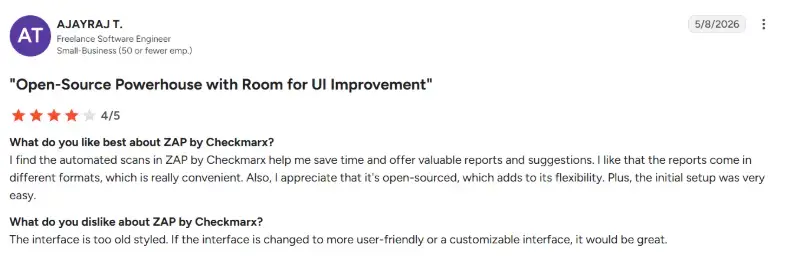
ZAP by Checkmarx holds a 4.7 out of 5 rating on G2, though based on a small sample of around a dozen reviews. Reviewers consistently praise its ease of use and CI/CD integration, while noting that documentation and support could be stronger.
3. Burp Suite
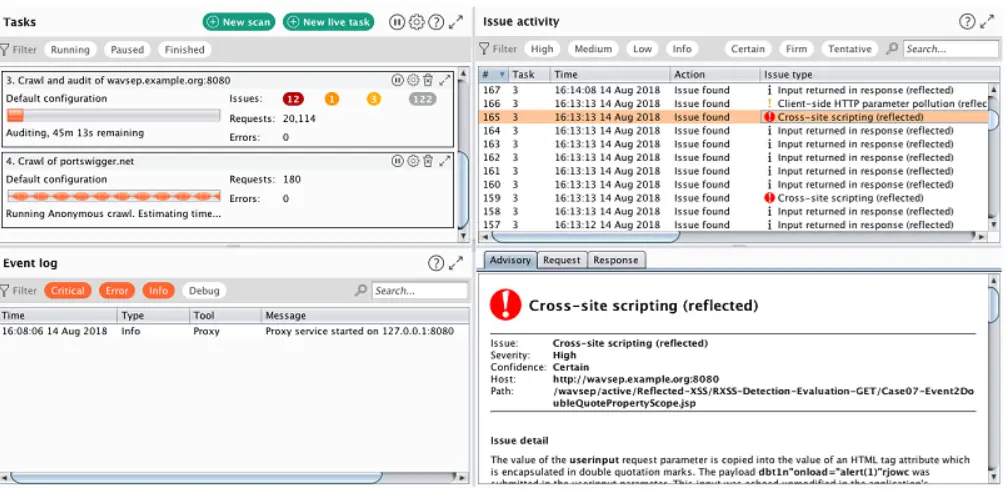
Category: Manual + Automated web security testing
Burp Suite is one of the most widely used tools for manual web application security testing. It includes an intercepting proxy, Repeater, Intruder, Scanner, Sequencer, and Decoder, letting testers analyze, manipulate, and exploit web requests directly.
Burp is strong at uncovering complex or chained vulnerabilities that automated scanners tend to miss, such as privilege escalation, parameter pollution, and logic flaws. The Enterprise edition adds scalable automated scanning, while the Professional version remains a common choice for pentesters and bug bounty hunters. Its learning curve is steeper than most tools on this list, but it gives testers direct control over every request.
Key features:
Intercepting proxy, Repeater, Intruder, Scanner, Sequencer, and Decoder
Deep manual testing and exploit chaining
Extensive plugin ecosystem through the BApp Store
Enterprise edition adds scalable automated scanning
Steeper learning curve than most automated scanners
Review & rating:
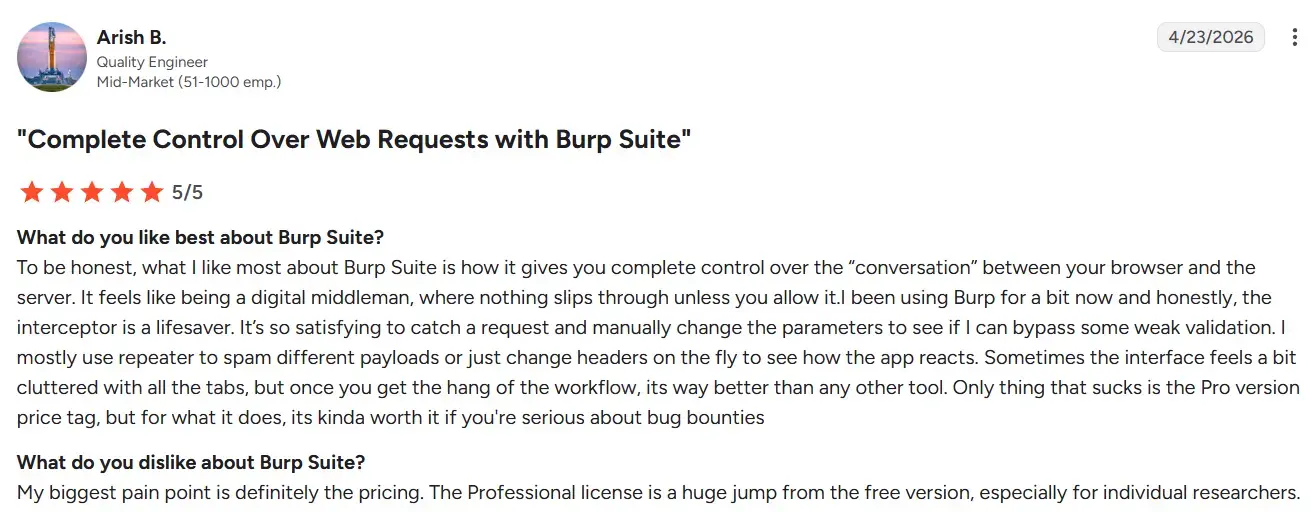
Burp Suite holds a 4.8 out of 5 rating on G2, the highest of any tool in this comparison. Reviewers point to its depth of manual testing control, while some note the Enterprise edition carries real cost alongside a steeper learning curve.
4. SonarQube
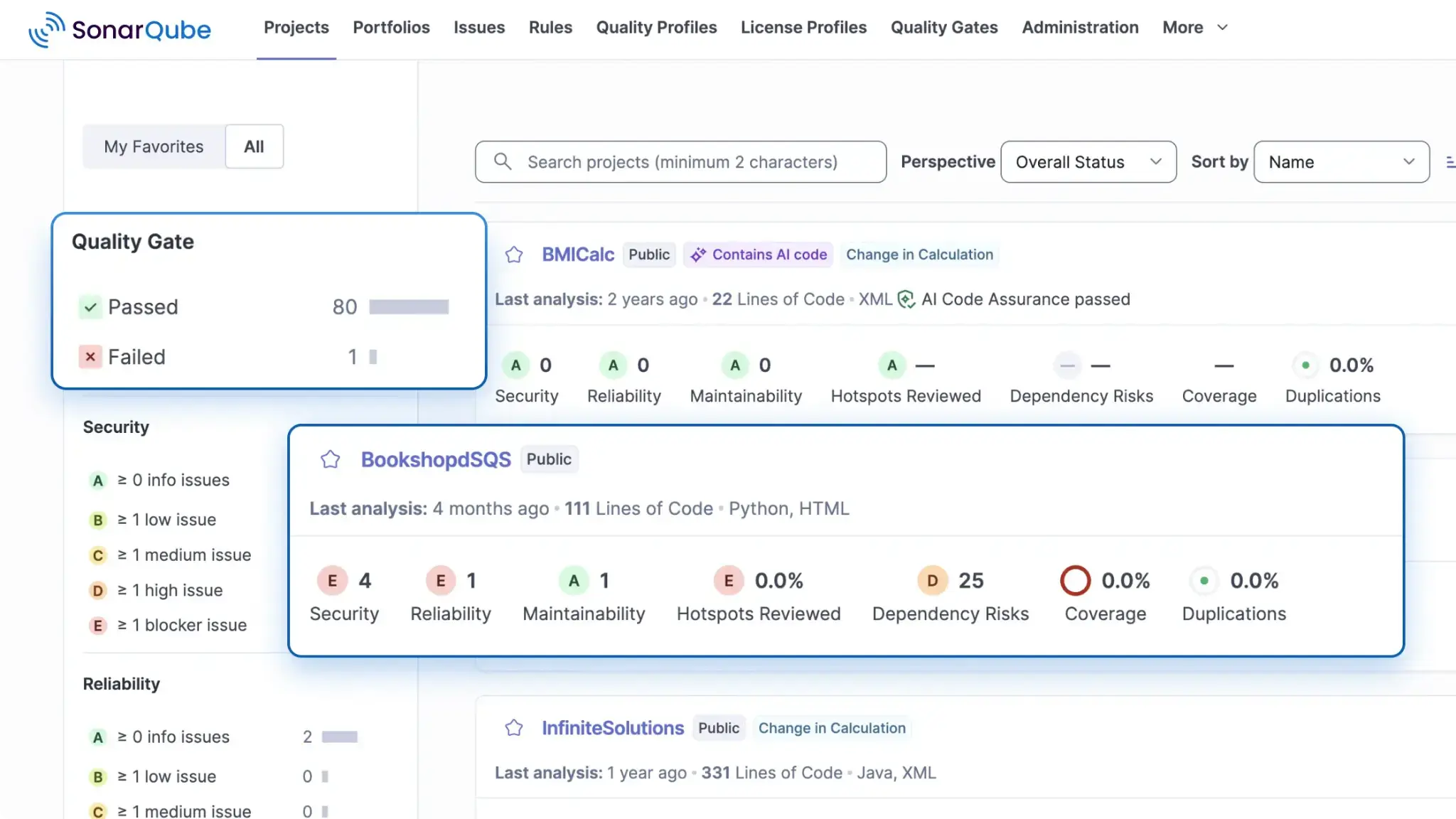
Category: SAST (Static Application Security Testing)
SonarQube is a widely used static code analysis platform that helps developers identify vulnerabilities, bugs, and security hotspots early in development. It supports dozens of programming languages and integrates directly into CI/CD pipelines and IDEs to enforce secure coding standards automatically.
SonarQube maps findings to the OWASP Top 10 and delivers specific remediation steps directly to developers. It improves both code quality and security by catching issues before they reach staging or production. It cannot detect runtime or authentication related weaknesses, but it plays a shift left role in strengthening the security posture of modern software teams.
Key features:
Runs at commit and pull request level
IDE integrations across dozens of languages
Maps findings directly to the OWASP Top 10
Remediation guidance written for developers
Does not detect runtime or authentication related issues
Rating & review:
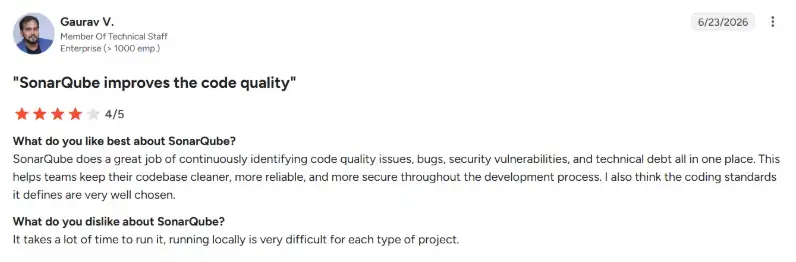
SonarQube holds a 4.4 out of 5 rating on G2 based on over 140 reviews. Users consistently value its code quality analysis and CI/CD integration, with common criticism centered on setup complexity and occasional false positives.
5. w3af (Web application attack & audit framework)
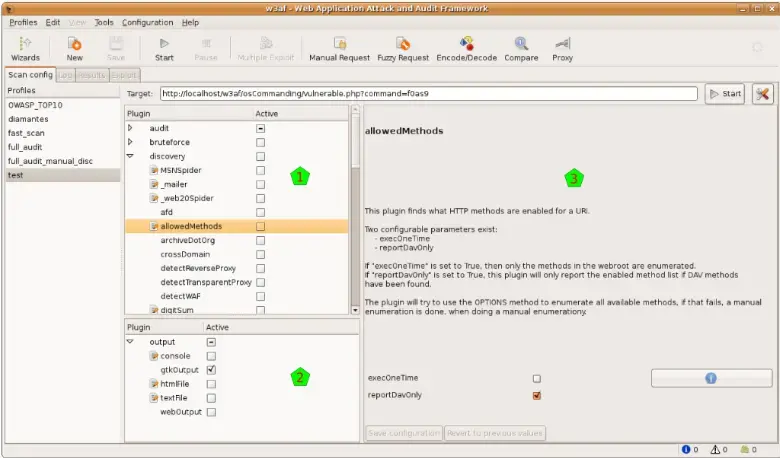
Category: Open-source DAST + Exploitation
w3af is an open source framework built to identify and exploit vulnerabilities in web applications. With over 100 plugins, it covers discovery, injection testing, brute force modules, and exploitation tools. It can run through a simple GUI or a scriptable CLI, which makes it flexible for automation and experimentation.
w3af requires manual configuration and tuning, but it is valued by researchers and smaller teams that want to combine scanning with controlled exploitation. Its community, modular architecture, and open source model make it a solid entry point for learning OWASP focused security testing.
Key features:
Over 100 plugins for discovery, injection testing, and exploitation
CLI and GUI options
Scriptable and automation friendly
Open source and community maintained
Requires manual configuration and tuning for accurate results
Review & rating:
w3af does not maintain a presence on G2 or similar commercial review platforms, since it is a community driven open source project rather than a vendor product. On GitHub, it has accumulated around 4,400 stars, reflecting long standing use in the security community.
6. Kali Linux
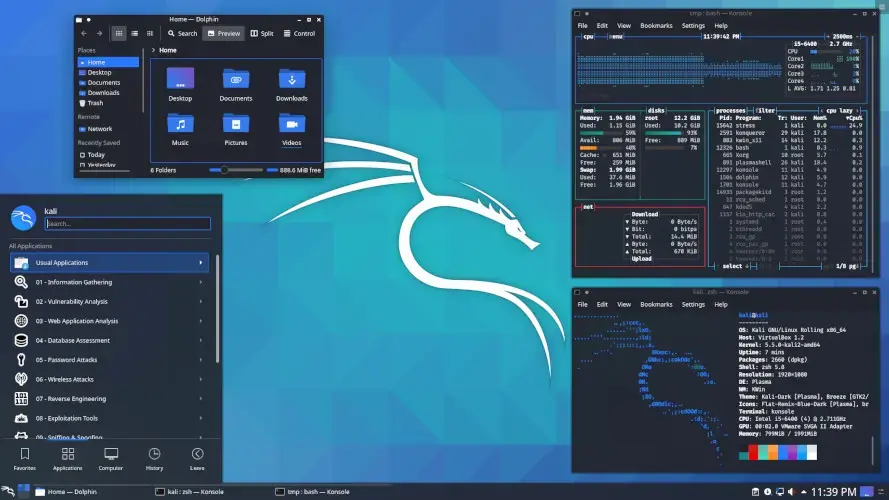
Category: Penetration testing distribution
Best for: Red teams, full pentesting engagements.
Kali Linux is a full penetration testing operating system used by professional red teams, pentesters, and security researchers. It includes more than 600 tools covering web app testing, API exploitation, network scanning, forensics, reverse engineering, and wireless testing. For OWASP related assessments, Kali bundles tools like Burp Suite Community, OWASP ZAP, Nikto, SQLMap, and numerous fuzzers and proxies.
Kali is built for manual, adversarial style testing, giving operators full control over every layer of an assessment. It requires significant expertise and is not built for CI/CD automation, but it remains a strong option for deep, hands-on security testing.
Key features:
600+ bundled tools covering web, API, network, and wireless testing
Includes Burp Suite Community, OWASP ZAP, Nikto, SQLMap, and more
Built for manual, adversarial style testing
Full control over every layer of an assessment
Requires deep security expertise and is not built for CI/CD automation
Review & rating:
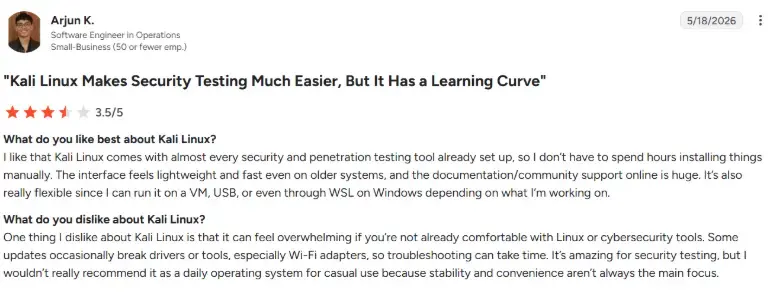
Kali Linux holds a 4.5 out of 5 rating on G2. Users consistently praise its extensive pre-installed tools for penetration testing, along with its customizability and strong community support. Many reviewers also note that the platform can feel overwhelming for beginners, given its complexity and learning curve.
How to choose the best OWASP testing tool
Selecting the best security testing tool depends on your goals, application architecture, and team maturity. Here are the key factors to evaluate before making a decision:
1. Your testing objective
Start with what you actually need to test.
If you want runtime vulnerability detection, choose a DAST tool (e.g., Beagle Security, OWASP ZAP, Netsparker).
If your focus is secure coding and early-stage checks, go with SAST tools like SonarQube.
2. Application coverage requirements
Modern applications are complex, so confirm your tool can handle REST and GraphQL APIs, single page applications, mobile and microservice backends, and multi step or stateful authentication flows. Tools that struggle with these typically miss critical OWASP vulnerabilities.
3. Accuracy and false positives
Not all scanners are equally reliable. Look for solutions with verification mechanisms, smart crawling, or AI-powered validation to reduce noise. Fewer false positives means more time spent fixing real issues instead of triaging alerts.
4. Integration with your workflow
Security testing should fit naturally into your existing processes. Prioritize tools that integrate with:
CI/CD platforms like GitHub, GitLab, Jenkins, and Azure
Collaboration tools such as Jira, Slack, and Teams
Automated DevSecOps pipelines
Seamless integration encourages continuous, consistent testing.
5. Business logic & authenticated testing
Many tools can only scan public pages, but most real vulnerabilities hide behind login flows. Options like Beagle Security stand out because they can test authenticated sessions, business logic paths, and multi-factor protected workflows.
6. Budget & team expertise
Match the tool to your resources and skill set:
Open-source options like ZAP and w3af are great for low budgets but require more tuning.
For a balanced, modern approach with minimal setup overhead, Beagle Security offers strong automated coverage without requiring deep security expertise.
Final thoughts
The best OWASP security testing tool for 2026 depends on your team’s needs but most organisations benefit from a hybrid approach:
SAST for early detection: SonarQube
DAST for runtime and behavioural flaws: Beagle Security
Manual verification: Burp Suite, Kali Linux
If you’re looking for the tool that provides the most modern coverage, especially for web apps with authentication, APIs, and complex workflows, Beagle Security stands out as the strongest all-around OWASP security testing solution in 2026. It balances automation, depth, accuracy, and developer experience in a way that legacy DAST tools cannot match. Start a 14-day advanced trial or explore the interactive demo to see if we’re right for you.
FAQ
What is the best OWASP security testing tool?
It depends on your testing objective. Teams focused on runtime and business logic testing often look at Beagle Security or OWASP ZAP, while teams focused on code level detection typically choose a SAST tool like SonarQube.
What is the difference between DAST and SAST tools?
DAST tools test a running application from the outside, the way an attacker would. SAST tools scan source code directly, catching issues before the application is deployed.
Is OWASP ZAP free to use?
Yes, OWASP ZAP is fully open source and free, though it requires configuration to reduce false positives and does not include advanced business logic testing out of the box.


![Top ZAP alternatives and competitors [October 2026]](/blog/images/top-zap-alternatives-cover.webp "Top ZAP alternatives and competitors [October 2026]")




![Top 10 penetration testing companies [2026]](/blog/images/top-penetration-testing-companies-cover.webp "Top 10 penetration testing companies [2026]")


![Top vendor application security tools [2026]](/blog/images/top-vendor-application-security-testing-tools-2026-cover.webp "Top vendor application security tools [2026]")



![Top Snyk alternatives & competitors [2026]](/blog/images/top-snyk-alternatives-cover.webp "Top Snyk alternatives & competitors [2026]")