OpenVAS vs Nessus: Which is the best choice for you? [2025]
![OpenVAS vs Nessus: Which is the best choice for you? [2025]](/blog/images/openvas-vs-nessus-which-is-the-best-choice-for-you-2025.webp "OpenVAS vs Nessus: Which is the best choice for you? [2025]")
Vulnerability scanning remains one of the most critical pillars of any cybersecurity strategy. As organizations grow their digital infrastructure across cloud workloads, on-prem systems, APIs, and internet-facing applications, the attack surface expands rapidly. Regular vulnerability assessments help security teams identify weaknesses before attackers exploit them, reduce exposure to known CVEs, and meet regulatory and customer security expectations.
Two tools that frequently come up in vulnerability management discussions are OpenVAS and Nessus. Both are widely used, mature scanners, but they are built with different philosophies and target different types of teams. OpenVAS is best known as an open-source solution with deep configurability, while Nessus has become a commercial industry standard focused on scale, performance, and compliance readiness.
This blog breaks down OpenVAS vs Nessus in detail and also introduces Beagle Security as an alternative web and API penetration testing platform for teams that need application-focused, modern security testing beyond traditional infrastructure scanning.
Overview of OpenVAS and Nessus
OpenVAS is an open-source vulnerability scanner maintained by Greenbone as part of the Greenbone Vulnerability Management framework. It relies on a large collection of vulnerability tests, often referred to as Network Vulnerability Tests, which are maintained by the community and Greenbone. OpenVAS is commonly adopted by security professionals, researchers, and smaller teams that want flexibility and full control over their scanning environment.
Nessus, developed by Tenable, is a commercial vulnerability scanner used extensively in enterprise environments. It provides broad vulnerability coverage, frequent plugin updates, and built-in compliance and configuration auditing. Nessus is designed to deliver fast results with minimal setup, making it suitable for organizations that need consistent scanning across large and complex environments.
While both tools aim to identify vulnerabilities, they differ significantly in usability, scalability, maintenance effort, and the type of security problems they are best suited to solve.
OpenVAS vs Nessus at a glance
| Area | OpenVAS | Nessus |
|---|---|---|
| Ownership model | Open source | Commercial |
| Vendor | Greenbone | Tenable |
| Primary focus | Network and host vulnerability scanning | Enterprise vulnerability scanning and compliance |
| Deployment | Self-hosted or managed | On-premises or cloud |
| Setup effort | Moderate to high | Low to moderate |
| Updates | Community and optional commercial feeds | Frequent commercial plugin updates |
| Reporting | Basic to moderate | Advanced and audit-ready |
| Support | Community | Commercial support available |
| Best suited for | Budget-conscious, technical teams | Enterprises, compliance-driven teams |
An alternative web and API penetration testing platform for comparison: Beagle Security
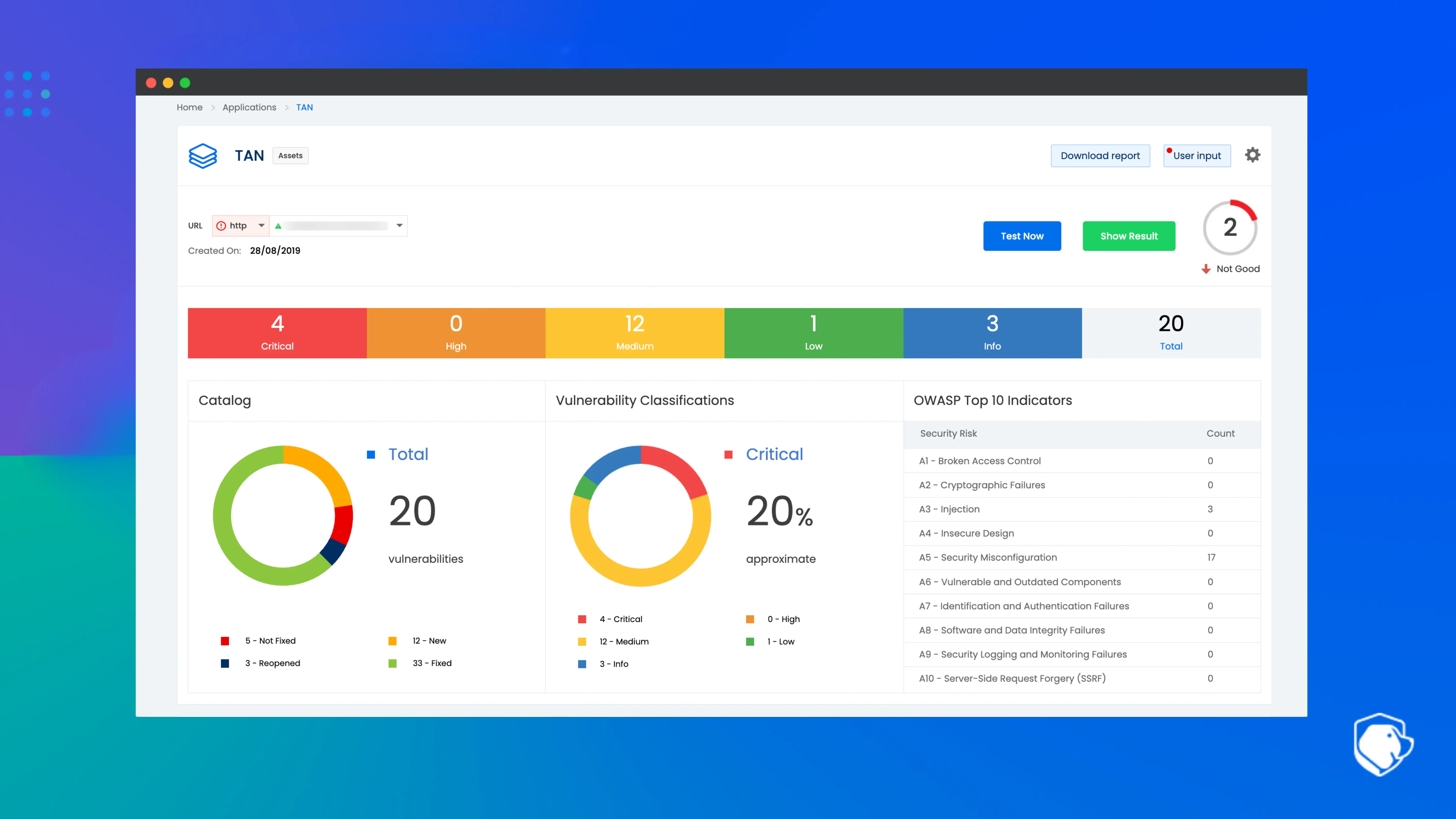
While OpenVAS and Nessus are primarily infrastructure-centric vulnerability scanners, many modern security risks originate at the application and API layer. Authentication flows, business logic flaws, broken authorization, and API misuse are often outside the core focus of traditional network scanners.
Beagle Security is positioned differently. It is an automated web and API penetration testing platform designed to simulate real-world attacks against applications and APIs. Instead of focusing only on missing patches or insecure services, Beagle Security emphasizes how an attacker would actually exploit vulnerabilities in running applications.
This makes Beagle Security a complementary or alternative option for teams that want deeper application-layer coverage alongside or instead of infrastructure scanning.
Why Beagle Security might be a better fit for modern teams
Modern development teams ship code continuously. Applications change weekly or even daily, APIs evolve rapidly, and authentication mechanisms are often complex. In this environment, traditional vulnerability scanners can miss critical issues because they are not designed to understand application workflows or API logic.
Beagle Security is often a better fit for modern teams because it:
Focuses on web and API attack simulation rather than passive scanning
Handles authenticated scans and complex login flows
Produces contextual findings that developers can act on quickly
Integrates cleanly into CI/CD pipelines for continuous testing
For organizations where application security is a priority, Beagle Security addresses gaps that OpenVAS and Nessus are not primarily designed to cover.
OpenVAS vs Nessus vs Beagle Security: Feature comparison
| Feature | Beagle Security | OpenVAS | Nessus |
|---|---|---|---|
| Web application scanning | Advanced | Limited | Limited |
| API security testing | Yes | No | Limited |
| Authenticated testing | Advanced | Basic options | Yes |
| Business logic testing | Yes | No | No |
| CI/CD integration | Strong | Limited | Moderate |
| Reporting for developers | Strong | Basic | Moderate |
| Proof of exploitability | Yes | No | No |
| Network vulnerability scanning | Limited | Yes | Yes |
OpenVAS vulnerability scanning features
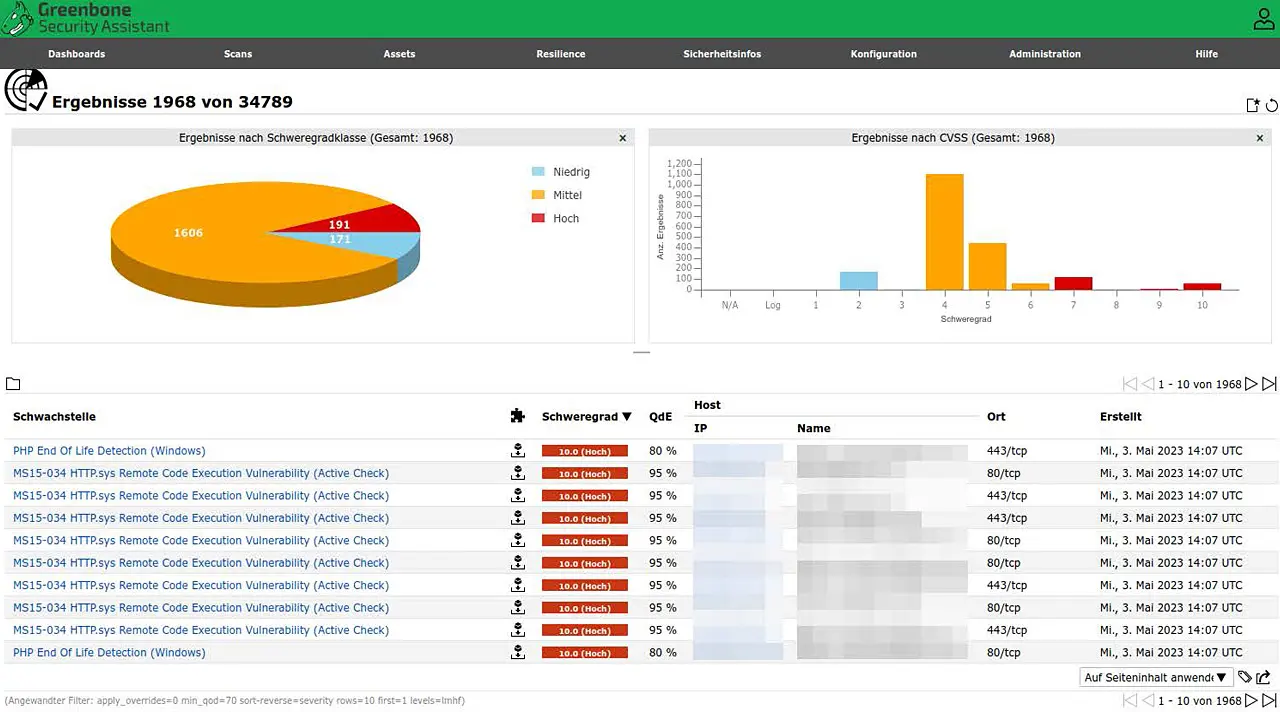
OpenVAS provides a wide range of network-level vulnerability checks across operating systems, services, and common software stacks. It supports credentialed and non-credentialed scans, allowing deeper inspection when valid credentials are provided.
Key features include:
Detection of known CVEs across hosts and services
Support for custom scan configurations
Open and transparent vulnerability tests
Integration with the broader Greenbone ecosystem
However, OpenVAS requires ongoing maintenance. Users are responsible for managing updates, tuning scans, and scaling infrastructure as scan scope increases. Reporting is largely technical, which can make it harder to communicate risk to non-security stakeholders.
Nessus vulnerability scanning features
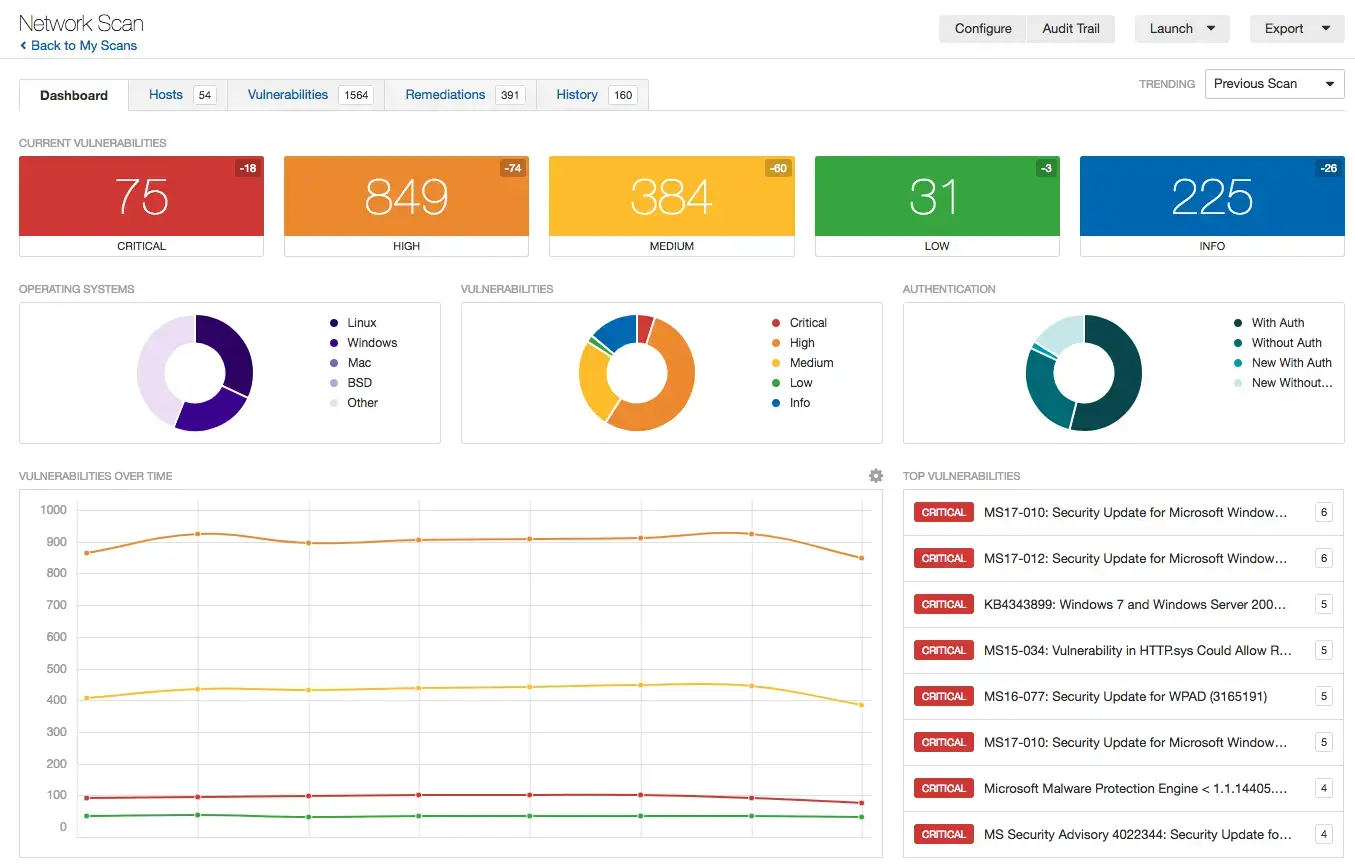
Nessus is designed for efficiency and breadth. It offers one of the largest vulnerability plugin libraries in the industry, covering operating systems, network devices, databases, cloud services, and misconfigurations.
Key features include:
Rapid vulnerability detection using updated plugins
Configuration and compliance audits
Credentialed scanning for deeper visibility
High-quality reports with remediation guidance
Nessus excels in environments where speed, scale, and compliance are priorities. Its main limitation is that it focuses more on identifying known weaknesses than simulating real-world exploitation, especially at the application layer.
Beagle Security features
Beagle Security approaches security testing from an attacker’s perspective, focusing on how vulnerabilities can actually be exploited in live applications and APIs.
Key features include:
Automated web and API penetration testing
Support for REST and GraphQL APIs
Intelligent handling of authentication and sessions
Context-rich reports with proof of exploitability
Retesting workflows and CI/CD integration
Unlike OpenVAS and Nessus, Beagle Security is purpose-built for application security teams and developers who need fast, actionable feedback on real security risks in production or staging environments.
OpenVAS vs Nessus vs Beagle Security: Pricing comparison
Pricing is often a deciding factor when choosing a vulnerability or penetration testing solution, but it should be evaluated alongside operational effort, scalability, and the type of risks each tool addresses. OpenVAS, Nessus, and Beagle Security follow very different pricing and licensing models, reflecting their intended audiences and use cases.
OpenVAS is attractive from a licensing perspective, but the operational cost of maintaining and scaling it should not be underestimated. Nessus requires a paid license but reduces operational overhead. Beagle Security shifts the cost model toward application-centric risk reduction rather than asset inventory scanning.
| Tool | Pricing model | What you pay for | Example published costs |
|---|---|---|---|
| OpenVAS | Free and commercial feeds | Vulnerability feeds and support | Free (community); paid feeds available |
| Nessus | Commercial license | Number of assets and support | ~$3,390/year for single-license Nessus Professional |
| Beagle Security | Subscription-based | Web apps and API penetration tests | Essential from ~$119/month or higher tiers |
OpenVAS pricing
OpenVAS is available as part of the Greenbone Vulnerability Management framework and offers a free, open-source edition that includes community-maintained vulnerability tests. This makes it appealing for organizations with limited budgets, security labs, and learning environments.
However, organizations that need faster vulnerability updates, enterprise support, or better performance often opt for Greenbone’s paid feeds and enterprise subscriptions. While the licensing cost may remain lower than commercial scanners, teams should factor in infrastructure costs, maintenance time, and internal expertise required to operate OpenVAS at scale.
Nessus pricing
Nessus follows a commercial, per-asset licensing model. Pricing typically depends on the number of assets scanned and whether the organization uses Nessus Essentials, Nessus Professional, or enterprise offerings bundled with Tenable’s broader platform.
While Nessus represents a higher upfront cost compared to open-source tools, it reduces operational overhead through easier setup, faster scans, and regularly updated plugins. For many enterprises, the pricing is justified by the time saved and the depth of vulnerability and compliance coverage provided.
Beagle Security pricing
Beagle Security offers tiered plans for web and API penetration testing, with entry level pricing starting around $119 per month and higher tiers for advanced features and enterprise usage. A free trial is available for evaluation.
This model is often more predictable for product teams and SaaS companies, especially those shipping frequently. Instead of paying to scan every host, teams pay for continuous, automated penetration testing that focuses on real attack paths in applications and APIs.
OpenVAS vs Nessus vs Beagle Security: Customer reviews comparison
| Aspect | OpenVAS | Nessus | Beagle Security |
|---|---|---|---|
| Ease of use | Moderate to difficult | Easy | Easy |
| Setup experience | Manual and time-intensive | Quick | Quick |
| Accuracy | Good with tuning | High | High with context |
| Reporting clarity | Low for non-technical users | High | Very high |
| Common praise | Free and customizable | Reliable and scalable | Actionable and developer-friendly |
| Common criticism | Maintenance overhead | Licensing cost | Focused mainly on apps and APIs |
OpenVAS reviews
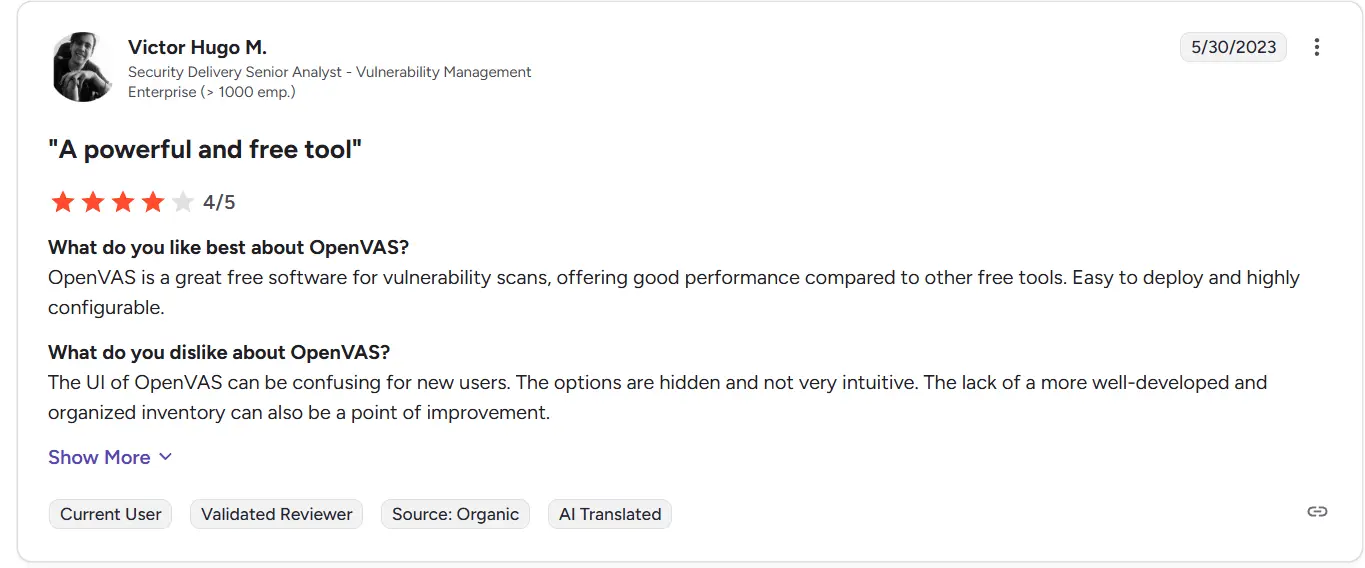
G2 rating: 4.2 / 5
OpenVAS is frequently praised for being free, transparent, and flexible. Security professionals appreciate its open-source nature and the ability to customize scans deeply, especially in environments where full control over vulnerability logic is important.
Common feedback themes include:
Strong technical depth and coverage
High learning curve for new users
Manual effort required for setup, tuning, and maintenance
Limited reporting for non-technical stakeholders
OpenVAS tends to receive positive feedback from experienced security engineers and researchers. However, G2 reviewers often note that it can be challenging for smaller teams without dedicated security resources, particularly when scaling scans or communicating findings to management.
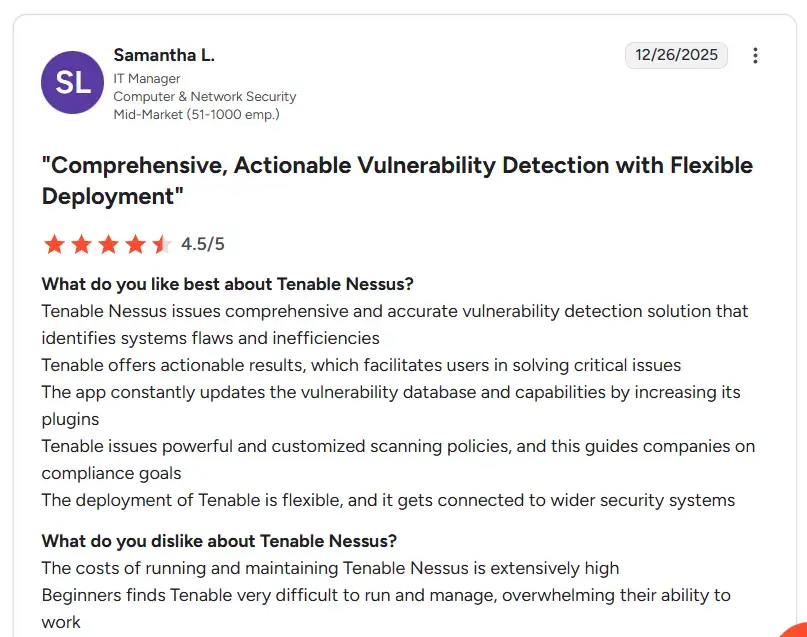
Nessus reviews
G2 rating: 4.5 / 5
Nessus consistently receives strong reviews for reliability, scan coverage, and ease of use. Users frequently highlight how quickly they can deploy Nessus and begin identifying vulnerabilities across large environments with minimal configuration.
Common feedback themes include:
Fast and scalable scanning performance
Extensive and frequently updated vulnerability coverage
Useful compliance and audit-oriented reporting
Licensing costs increasing as asset counts grow
Nessus is widely trusted in enterprise and regulated environments. G2 reviews often position it as a dependable industry standard, particularly for organizations that prioritize compliance, consistency, and operational efficiency.
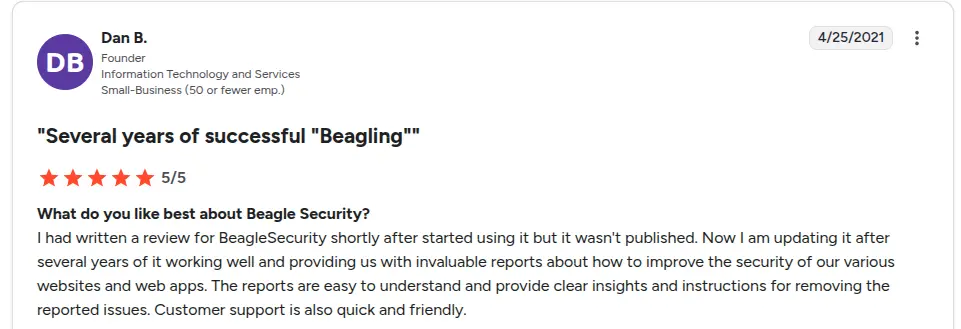
Beagle Security reviews
G2 rating: 4.7 / 5
Beagle Security reviews frequently emphasize ease of use, clarity of reports, and developer-friendly findings. Users highlight how the platform helps bridge the gap between security and development teams by focusing on exploitability rather than raw vulnerability volume.
Common feedback themes include:
Actionable, contextual vulnerability reports
Strong web and API penetration testing capabilities
Smooth CI/CD integration for continuous testing
Reduced noise compared to traditional vulnerability scanners
Beagle Security tends to resonate most with SaaS teams, startups, and product-driven organizations. On G2, it is often praised for helping teams fix real security issues faster, especially in modern application and API-driven environments.
OpenVAS vs Nessus vs Beagle Security: Which is best for you?
The best tool depends on your security goals, team maturity, and the type of assets you are protecting.
Choose OpenVAS if:
You need a free or open-source solution
You have strong in-house security expertise
You are comfortable managing and tuning scanners manually
Choose Nessus if:
You operate a large or regulated environment
Compliance and audit readiness are critical
You want fast results with minimal configuration
Choose Beagle Security if:
Your primary risk lies in web applications and APIs
You want automated penetration testing, not just vulnerability listings
You need developer-friendly reports and continuous testing
Many mature security programs use a combination of these tools to achieve full coverage, using infrastructure scanners for baseline hygiene and application-focused platforms for validating real-world exploitability.
Try Beagle Security for free to see how it compares to Nessus and OpenVAS
Traditional vulnerability scanners such as Nessus and OpenVAS are excellent at identifying missing patches, outdated services, and known CVEs across hosts and networks. However, they are not designed to understand how modern web applications and APIs behave at runtime. Issues like broken authentication flows, insecure authorization checks, API abuse, and business logic flaws often remain invisible to infrastructure-centric scanners.
Beagle Security approaches testing from a different angle. Its automated penetration testing engine simulates real attacker behavior against live web applications and APIs, including authenticated user flows and multi-step interactions. This allows teams to uncover vulnerabilities that only appear when an application is actually running and handling real requests.
For organizations evaluating Nessus or OpenVAS as part of a broader security program, the Beagle Security free trial offers a practical way to see how application-focused testing complements traditional vulnerability scanning. It helps security and development teams understand real-world risk, prioritize fixes that matter, and move beyond vulnerability lists toward actionable security outcomes.
With the free trial, teams can:
Run automated penetration tests against their own web applications or APIs
Validate whether vulnerabilities are truly exploitable, not just theoretically present
Review context-rich reports with clear reproduction steps and remediation guidance
Test how easily Beagle fits into existing CI/CD pipelines and development workflows
Final thoughts
OpenVAS and Nessus are both capable vulnerability scanners, but they are optimized for different use cases. OpenVAS offers flexibility and transparency for teams with strong technical expertise and limited budgets. Nessus delivers speed, scale, and compliance readiness for enterprise security programs.
However, neither tool fully addresses the growing risks at the application and API layer. For organizations building modern, API-driven products, platforms like Beagle Security provide deeper insight into real-world attack paths and developer-friendly remediation guidance.
In practice, many mature security programs use a combination of tools: infrastructure scanners like OpenVAS or Nessus for baseline hygiene, and application-focused penetration testing platforms like Beagle Security for validating real exploitability where it matters most.


![Top ZAP alternatives and competitors [October 2026]](/blog/images/top-zap-alternatives-cover.webp "Top ZAP alternatives and competitors [October 2026]")




![Top 10 penetration testing companies [2026]](/blog/images/top-penetration-testing-companies-cover.webp "Top 10 penetration testing companies [2026]")


![Top vendor application security tools [2026]](/blog/images/top-vendor-application-security-testing-tools-2026-cover.webp "Top vendor application security tools [2026]")



![Top Snyk alternatives & competitors [2026]](/blog/images/top-snyk-alternatives-cover.webp "Top Snyk alternatives & competitors [2026]")