Complete guide to OWASP DevSecOps maturity model (DSOMM)

The rise of modern software delivery has pushed organizations toward faster development cycles, cloud-native architectures, agile workflows, and automation-driven pipelines. But as deployment speed increases, so does the complexity of maintaining security. To help organizations mature their security posture without slowing innovation, OWASP introduced the OWASP DevSecOps maturity model (DSOMM) a structured framework designed to evaluate, improve, and operationalize security across the entire DevOps lifecycle.
In this comprehensive guide, we’ll explore what the OWASP DevSecOps maturity model is, why it matters, and how organizations can apply it. We’ll also look at its key dimensions, maturity levels, and implementation steps, along with how Beagle Security supports DevSecOps maturity modernization.
What is the OWASP DevSecOps maturity model (DSOMM)?
The OWASP DevSecOps maturity model (DSOMM) is a detailed, multi-layered framework created by OWASP to help teams evaluate and enhance the security integration within their software development lifecycle (SDLC). It provides a practical, standards-aligned roadmap that guides organizations from basic, ad-hoc security practices to fully automated, continuous, and scalable DevSecOps maturity.
At its core, DSOMM focuses on:
Introducing security early and consistently
Automating security across DevOps workflows
Eliminating security bottlenecks
Standardizing best practices across teams
Creating feedback loops between development, security, and operations
The OWASP DevSecOps maturity model ensures that as businesses scale, security remains integrated, consistent, and aligned with rapid delivery demands.
Key dimensions of DSOMM
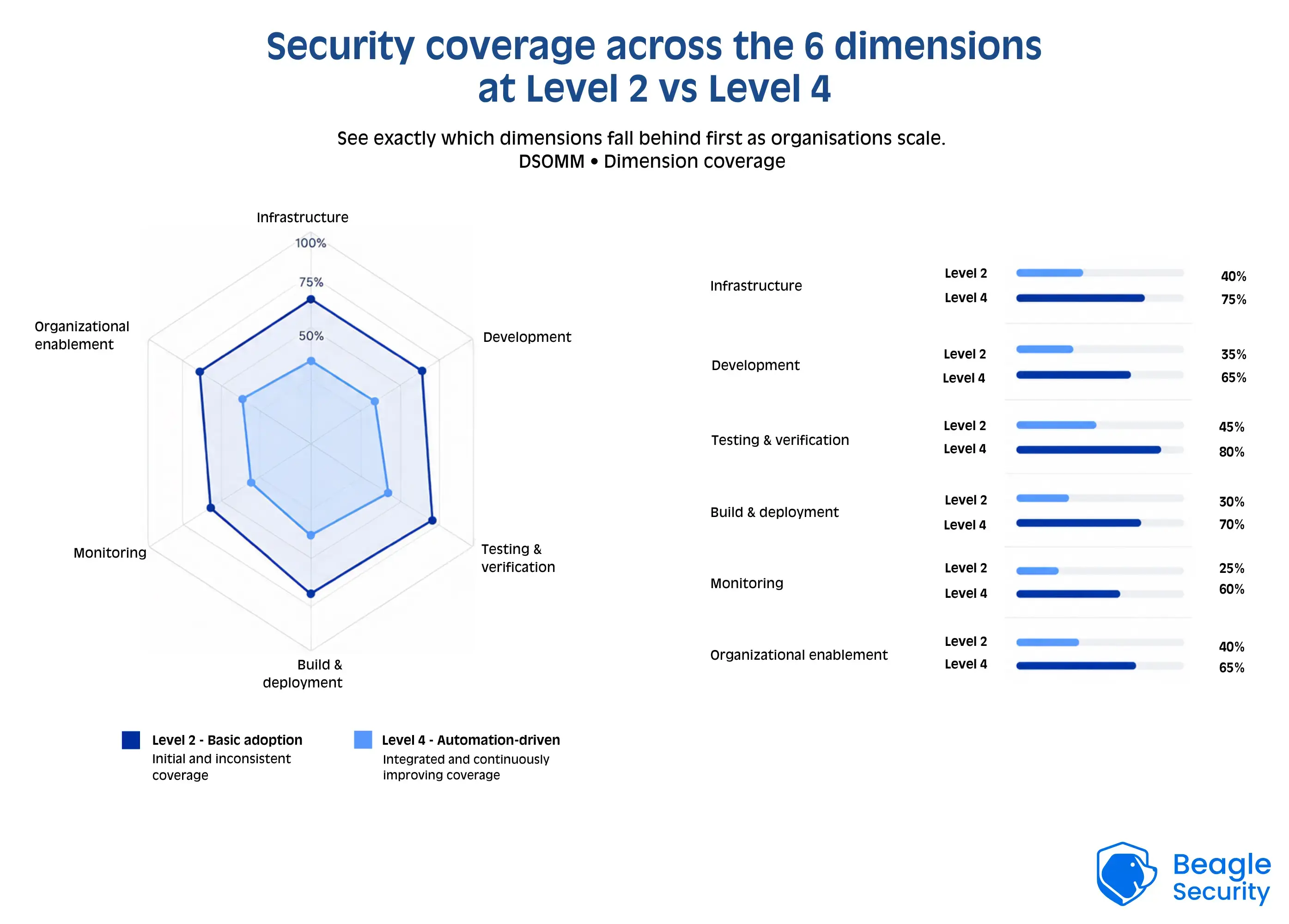
The OWASP DevSecOps maturity model (DSOMM) is structured around six key dimensions, each representing critical areas where security must be embedded. These categories allow teams to evaluate their existing capabilities and plan improvements based on strategic priorities.
Infrastructure
The infrastructure dimension focuses on secure provisioning, configuration, and maintenance of underlying environments.
Key areas include:
Infrastructure-as-Code (IaC) security
Secrets management
Configuration hardening
Container and Kubernetes security
Cloud posture management
Environment isolation and access least privilege
Development
This dimension emphasizes secure coding practices and developer-centric security controls.
Key areas include:
Secure coding standards
Developer training
IDE-level security plugins
Dependency and package management security
Threat modeling in early development
Code review guidelines and consistency
Code review guidelines and consistency
Testing and verification
Testing and verification represent the broadest dimension in the OWASP DevSecOps maturity model, covering all the ways organizations validate their application security posture.
Key areas include:
Automated SAST, DAST, IAST
API security testing
Automated penetration testing tools
Fuzzing
Security test cases integrated into CI pipelines
Continuous scanning for open-source vulnerabilities
Build and deployment
This dimension focuses on embedding secure controls into CI/CD pipelines to ensure every artifact is trusted and every deployment follows best practices.
Key areas include:
Signed builds and artifact integrity
Supply chain security checks
Vulnerability gating in pipelines
Secure pipeline configuration
Environment promotion policies
Configuration-as-Code scanning
Monitoring and measurement
Monitoring and measurement ensure continuous visibility and feedback loops across teams.
Key areas include:
Runtime threat detection
Security telemetry
Alerting and anomaly detection
Feedback from production to development
Risk scoring and dashboards
Compliance monitoring and audit logs
Organizational enablement
The OWASP DevSecOps maturity model emphasizes people and processes as much as tools.
Key areas include:
Security training at all levels
Defined governance structures
Incident response readiness
Security champions programs
Cross-team collaboration
Policy enforcement consistency
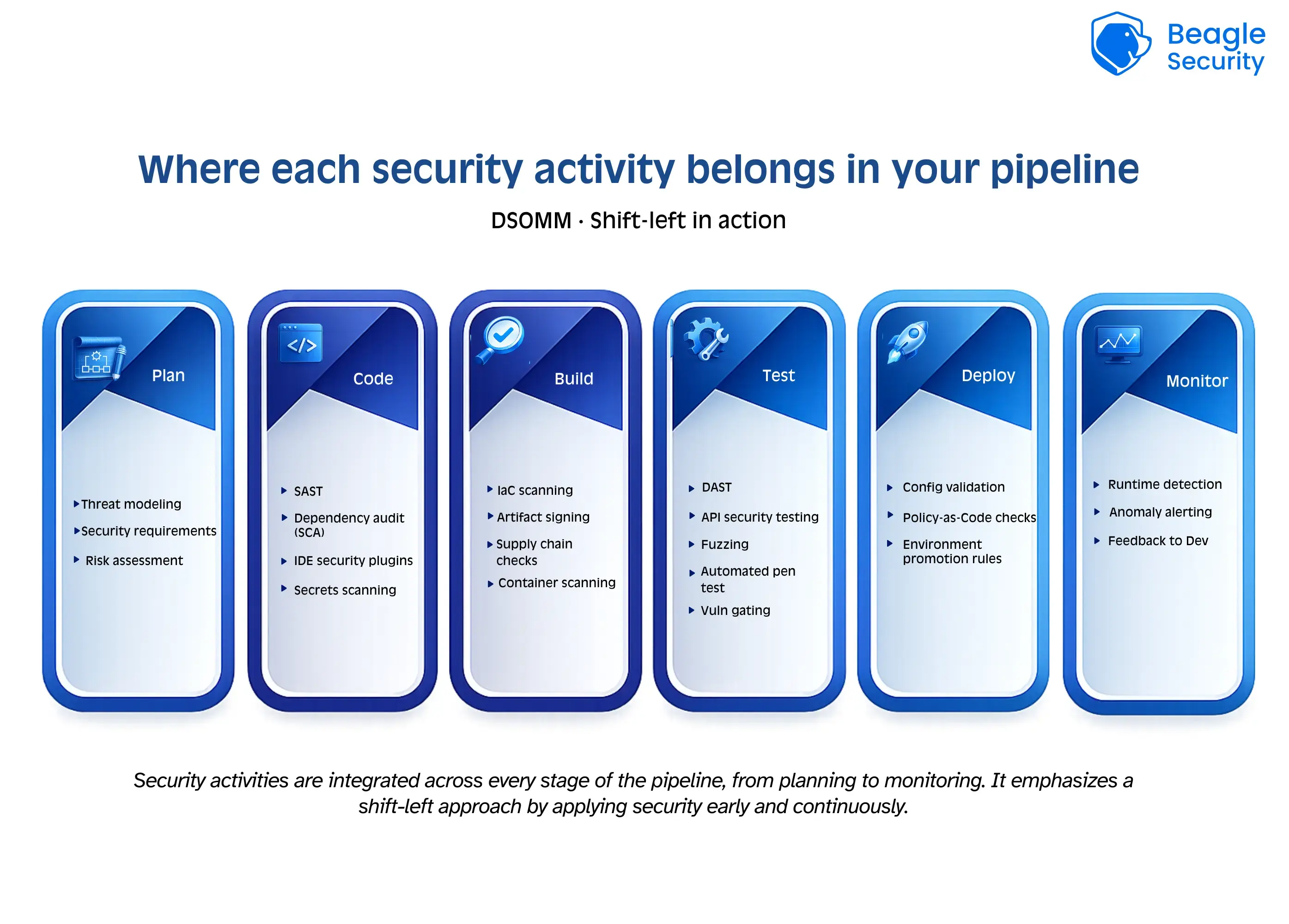
DSOMM maturity levels (stage-by-stage overview)
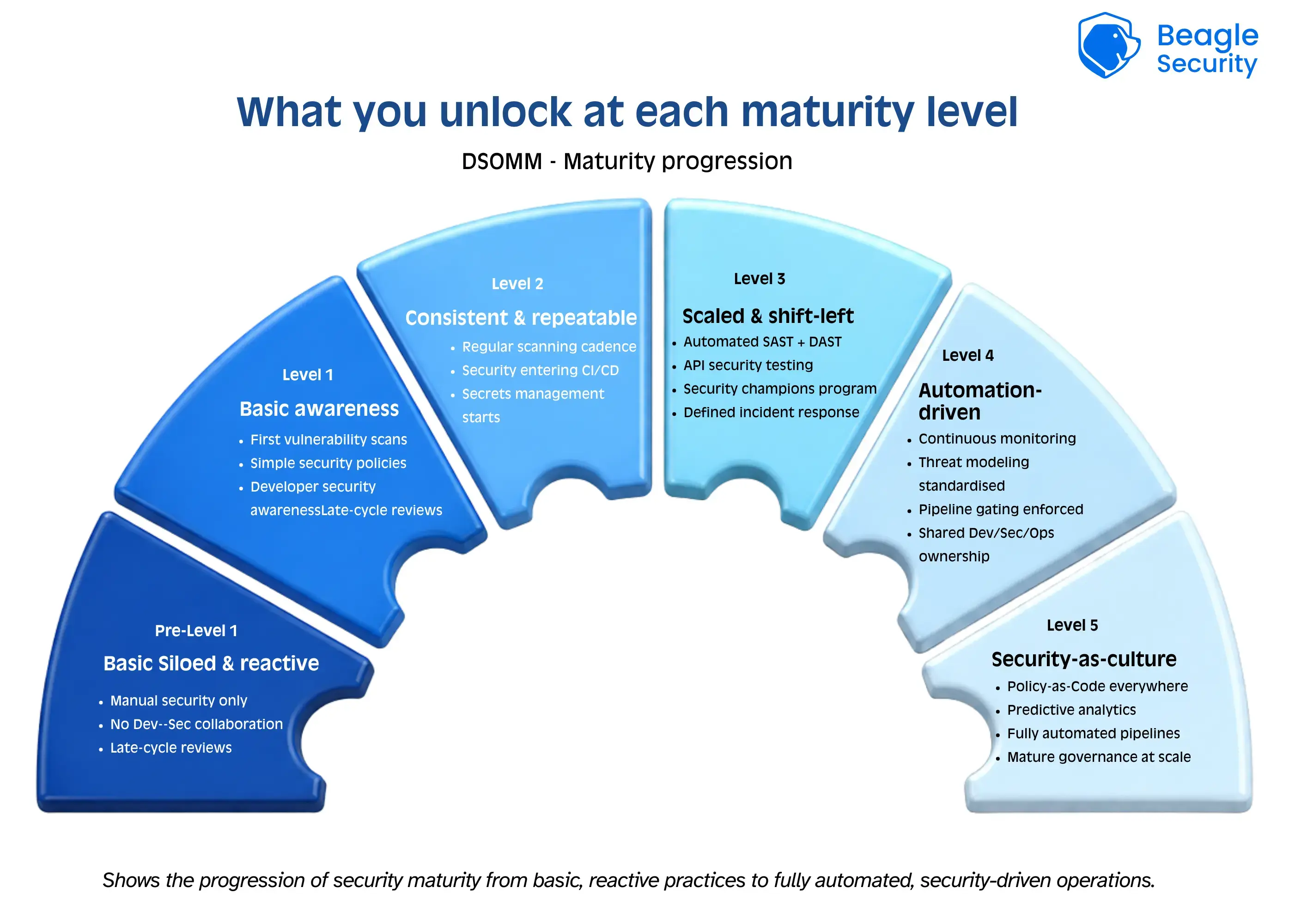
The OWASP DevSecOps maturity model (DSOMM) outlines a progression of maturity levels, helping organizations understand where they currently stand and where they need to go next.
Initial stage: Siloed teams and reactive security (pre-level 1)
In the initial stage of the OWASP DevSecOps maturity model, security operates in complete isolation. A dedicated security team handles all security responsibilities while developers rarely contribute to, or participate in, security tasks. Most processes are manual, security reviews take place late in the release cycle, and visibility into vulnerabilities is minimal. As a result, friction between security and development is high, and security issues are addressed reactively rather than proactively.
Level 1: Basic understanding of security practices
At Level 1, organizations begin to formalize the foundations of their security program. Teams develop a basic awareness of secure practices, introduce initial vulnerability scanning, and start documenting simple policies. Automation remains limited and DevOps adoption is still emerging, but this level marks the transition from purely reactive security to an early understanding of structured security processes.
Level 2: Adoption of basic security practices
Reaching Level 2 reflects a shift toward consistent and repeatable security activities. Security scanning becomes regular, initial tests start integrating into CI/CD workflows, and organizations establish well-defined security guidelines. Basic infrastructure-as-code scanning and secrets-management practices are introduced, creating a more standardized approach to addressing common risks during development and deployment.
Level 3: High adoption of security practices
At Level 3, organizations adopt scalable security practices and integrate them deeply into development. Automated security testing runs across multiple pipeline stages, shift-left practices become part of day-to-day development work, and API security testing is automated to keep up with modern architectures. Incident response processes are well-defined, and many teams begin establishing a security-champions program to strengthen collaboration and decentralize security ownership.
Level 4: Very high adoption of security practices
Level 4 represents a mature DevSecOps environment where automation drives most security activities. Continuous monitoring is in place, threat modeling is standardized across teams, and build and deployment pipelines enforce strict gating policies to prevent insecure releases. Collaboration between development, operations, and security becomes significantly stronger, with shared accountability and improved communication channels.
Level 5: Advanced deployment at scale
Level 5 is the peak of the OWASP DevSecOps maturity model, where security becomes a natural and fully embedded part of the organization’s engineering culture. Policy-as-Code and security-as-code practices guide every decision, CI/CD pipelines are fully automated and resilient, and runtime security insights seamlessly feed back into development. Teams leverage predictive analytics to prevent potential vulnerabilities and benefit from mature, automated governance that ensures compliance at scale.
Benefits of using the OWASP DevSecOps maturity model
Security posture: By adopting the OWASP DevSecOps maturity model (DSOMM), security gets integrated into every stage of the SDLC, reducing vulnerabilities early and ensuring applications are secure by design rather than through late-stage fixes.
Team collaboration: DSOMM dissolves silos by encouraging shared responsibility across development, security, and operations. This leads to smoother communication, faster problem-solving, and unified ownership of security outcomes.
Faster releases: Automation removes manual security bottlenecks, allowing teams to release updates quickly without skipping essential checks. Security becomes continuous instead of a last-minute hurdle.
Measurable improvement: The model provides clear maturity levels, helping organizations assess where they stand, track progress, and prioritize improvements in a structured, strategic way.
Lower costs: Shifting security left prevents expensive production fixes. Detecting issues during development reduces remediation costs and minimizes the financial impact of security incidents.
Stronger compliance: Standardized processes, automated checks, and clear audit trails make it easier to meet frameworks like SOC 2, PCI DSS, HIPAA, and GDPR, reducing regulatory risk.
Increased automation: DSOMM promotes automation across scanning, gating, testing, and monitoring. This consistency improves reliability and helps teams scale securely with growing application demands.
Fewer incidents: Proactive testing and continuous monitoring reduce the number of vulnerabilities reaching production, lowering the chances of outages or security breaches.
Confident deployments: With built-in security guardrails, teams can ship features rapidly while maintaining trust and reducing risk, accelerating innovation without compromise.
How to implement DSOMM in your organization
Implementing the OWASP DevSecOps maturity model involves a structured approach for long-term success.
Step 1: Assess your current maturity
Evaluate existing security controls
Review workflows across infrastructure, development, CI/CD, and monitoring
Conduct interviews with development, DevOps, and security leaders
Identify gaps in automation and policy consistency
Step 2: Identify gaps in each DSOMM dimension
Map existing practices to DSOMM dimensions
Highlight areas with minimal or zero automation
Document inconsistencies between teams
Identify misalignments between tools and processes
Step 3: Prioritize remediation efforts
Focus on the highest-risk gaps first
Align improvements with business priorities
Determine quick wins vs long-term initiatives
Build realistic timelines for maturity progression
Step 4: Introduce automation and guardrails
Automate scanning (SAST, DAST, SCA) in pipelines
Adopt IaC scanning and secrets management tooling
Enable automated gating for high-risk vulnerabilities
Create secure build configurations using policy-as-code
Step 5: Create a continuous improvement loop
Use monitoring tools to feed insights back into development
Review DevSecOps maturity quarterly
Measure KPIs such as MTTR, vulnerability volume, and automation coverage
Iterate and refine processes as teams grow
Step 6: Embed DSOMM into your DevSecOps culture
Train teams on secure practices
Adopt security champions programs
Celebrate improvements and milestones
Encourage developer ownership of security
Standardize playbooks and runbooks
Maturing your DevSecOps with Beagle Security
Beagle Security plays a powerful role in helping teams accelerate through the OWASP DevSecOps maturity model (DSOMM) by automating API and application security testing across development and CI/CD workflows.
Key benefits include:
AI-driven automated API penetration testing
CI/CD-native security automation
GraphQL, REST, and authentication-aware scanning
Continuous security visibility
Actionable remediation guidance for developers
Zero-maintenance, developer-friendly workflows
Beagle Security also offers:
A 14-day free trial for hands-on evaluation
A free interactive demo for teams exploring DevSecOps improvement
This makes Beagle Security an ideal tool for organizations looking to accelerate their DSOMM maturity journey without slowing delivery velocity.








![Top 10 SDLC tools [2025]](/blog/images/blog-banner-three-cover.webp "Top 10 SDLC tools [2025]")