Product security: A complete guide for 2025
As digital products continue to evolve, so do the threats targeting them. Modern applications are no longer isolated systems; they interact with distributed services, cloud infrastructure, open-source components, and third-party APIs. This interconnected landscape increases efficiency and accelerates innovation, but it also introduces complex security challenges. Organizations today must ensure that their products are protected not just at launch, but throughout their entire lifecycle.
Product security has emerged as a critical discipline for engineering and security teams building and scaling digital products. It focuses on identifying risks, hardening product architecture, validating supply chain dependencies, detecting vulnerabilities, and responding effectively to security incidents.
In 2025, with rising software supply chain attacks, automated exploitation tools, and increased regulatory scrutiny, product security is no longer a specialized concern. It is a foundational business requirement.
What is product security?
Product security refers to the strategies, practices, tools, and controls implemented throughout the development and operational lifecycle of a product to ensure it remains secure against evolving cyber threats.
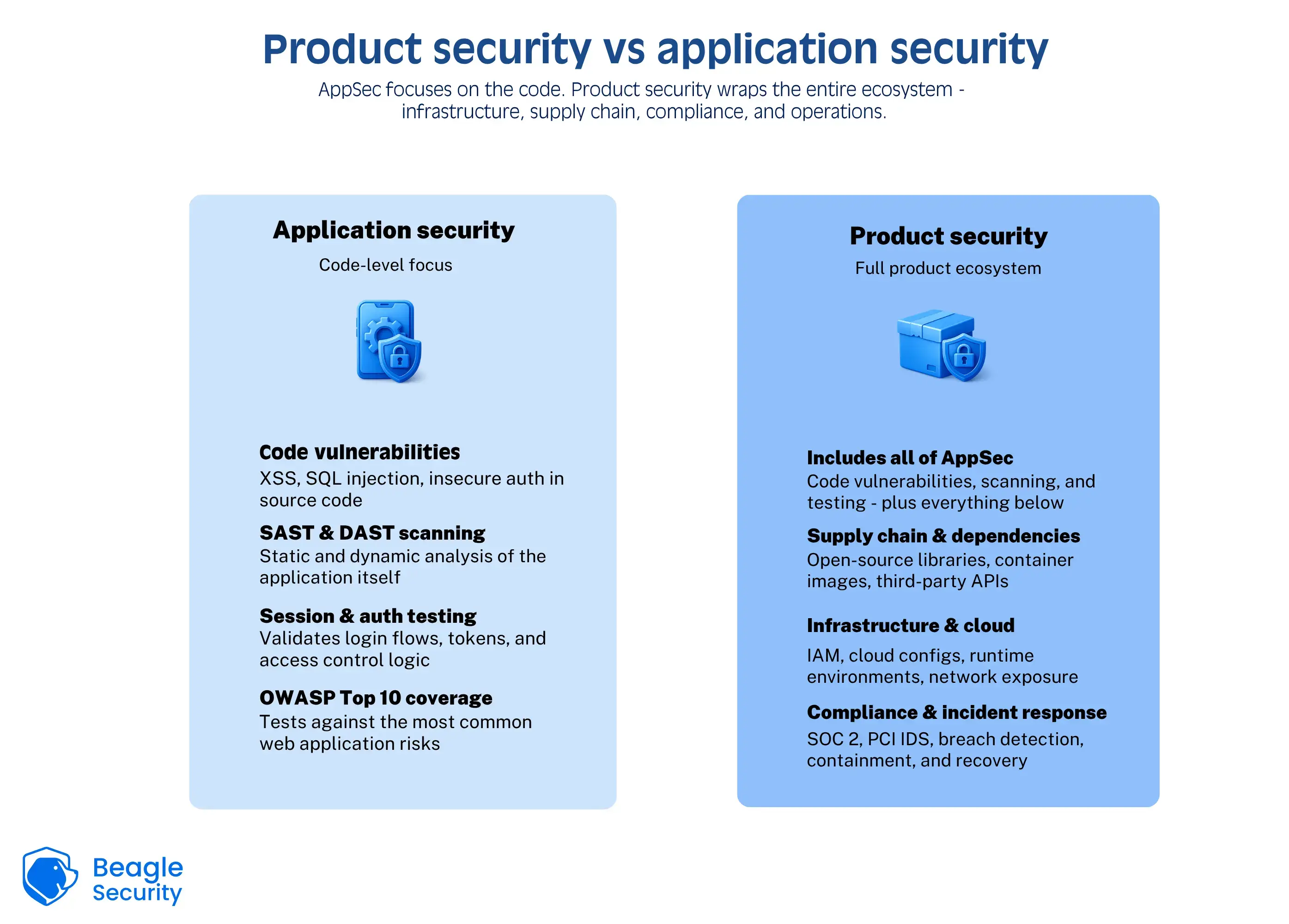
It is broader than traditional application security because it considers not only code vulnerabilities, but also infrastructure, user environments, access controls, third-party dependencies, and maintenance workflows. The goal of product security is to ensure a product is secure by design, secure in deployment, and secure in use, continuously.
Key aspects of product security
Integrating security into the SDLC
Integrating security throughout the Software Development Life Cycle ensures vulnerabilities are caught early and corrected before they reach production environments.
This process begins at design with threat modeling, continues into development through secure coding guidelines and automated scanning, and carries into testing and deployment with continuous validation. Development workflows benefit from shift-left security because security and engineering teams collaborate earlier, reducing rework and high-cost fixes later.
This means developers receive immediate feedback when introducing insecure patterns, build pipelines automatically block code that violates policy, and security review processes are standardized. Teams who adopt SDLC-integrated product security report faster delivery cycles, fewer production incidents, and higher overall reliability.
Supply chain security
Modern products rely heavily on external dependencies: open-source frameworks, container images, CI/CD automation scripts, cloud providers, and commercial software libraries. Each of these represents a potential entry point for attackers. Supply chain security focuses on evaluating and verifying the security of these third-party components.
This includes:
Verifying software integrity through signing and checksum validation
Maintaining a Software Bill of Materials
Running Software Composition Analysis
Reviewing vendor security practices
Incidents like SolarWinds and Log4Shell demonstrate how attackers leverage upstream dependencies to compromise many downstream systems. A mature product security program must continuously track third-party risk and respond rapidly to emerging dependency vulnerabilities.
Continuous security testing
Security testing cannot be a one-time milestone. Every time code changes, infrastructure is updated, or new integrations are added, the product’s risk profile shifts. Continuous security testing ensures that vulnerabilities are discovered as they arise, not months later.
Continuous testing typically includes:
Automated DAST scanning for runtime weaknesses
Manual and automated penetration testing
Business logic attack simulations
Runtime monitoring and anomaly detection
Embedding testing into CI/CD pipelines ensures that security becomes part of the release process rather than a blocker.
Vulnerability management
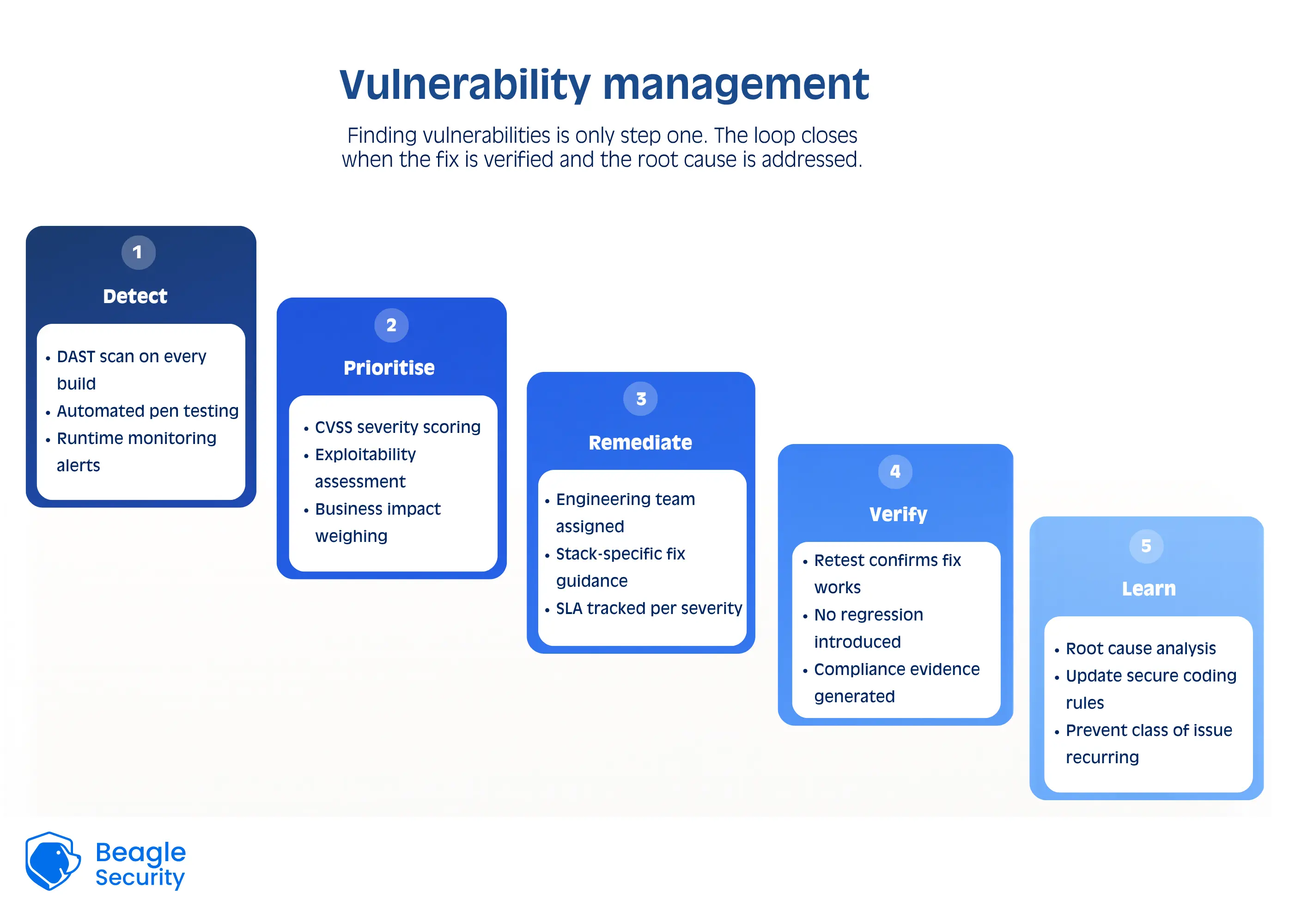
Once vulnerabilities are identified, they must be prioritized and addressed based on severity, exploitability, and business impact. Vulnerability management covers the full lifecycle of tracking, triaging, remediating, and verifying fixes.
Effective programs include:
CVSS-based severity scoring
Ownership workflows assigned to engineering teams
Root cause analysis to prevent recurring issues
Retesting to validate remediation
Organizations with structured vulnerability management experience faster remediation times and fewer recurring issues.
Compliance
Compliance ensures a product aligns with required regulatory frameworks such as SOC 2, ISO 27001, PCI DSS, HIPAA, and GDPR. Compliance is often perceived as documentation-driven, but in strong security programs, compliance reflects actual technical maturity.
Compliance-driven product security includes:
Access control enforcement
Logging and audit trails
Encryption requirements
Data handling and retention standards
Strong compliance increases trust and reduces legal and operational risks.
Incident response
Even well-secured products encounter security incidents. The determining factor in risk impact is how quickly and effectively an organization responds. Incident response involves detecting suspicious behavior, containing threats, analyzing root causes, communicating with stakeholders, and improving controls moving forward.
The goal is resilience and reduced recovery time.
How to build a product security framework
A practical product security framework aligns security activities with each stage of the product lifecycle:
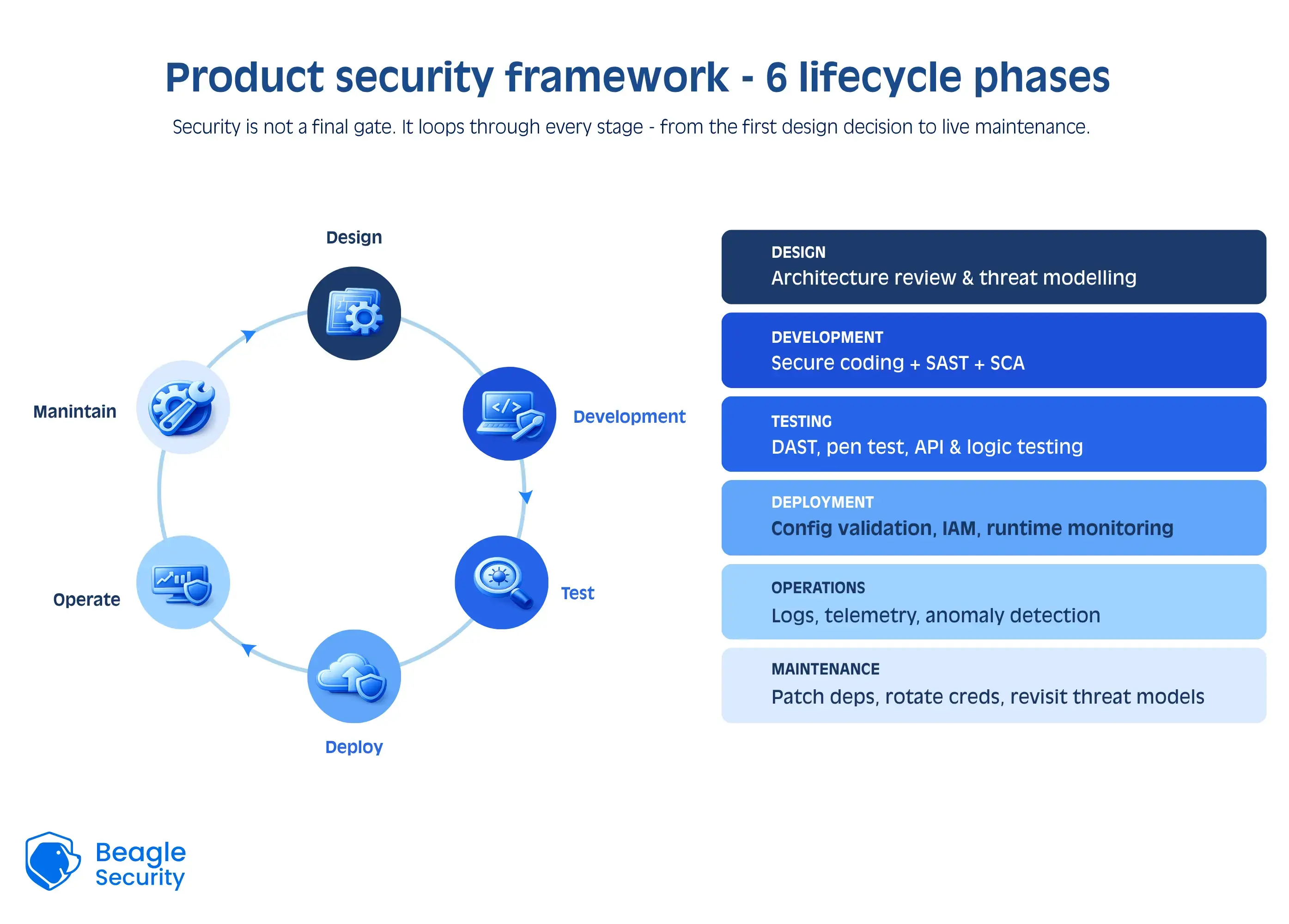
Design phase: Perform architecture reviews and threat modeling to identify high-risk areas.
Development phase: Implement secure coding standards and integrate SAST and SCA into developer workflows.
Testing phase: Conduct DAST scans, penetration testing, API testing, and logic abuse testing.
Deployment phase: Validate configurations, enforce IAM least-privilege, and enable runtime monitoring.
Operational phase: Maintain observability through logs, telemetry, anomaly detection, and active monitoring.
Maintenance phase: Patch dependencies, rotate credentials, revisit threat models, and improve based on incidents.
The framework should not be static. It should evolve with new threats, architecture changes, and scaling needs.
What are some product security tools to adopt?
DAST (Recommended: Beagle Security)
Beagle Security provides continuous automated penetration testing that simulates real-world attack patterns on web applications and APIs. It uncovers runtime vulnerabilities such as authentication weaknesses, insecure session management, and business logic flaws. It integrates directly into CI/CD workflows and offers developer-friendly remediation guidance.
SAST (Recommended: Semgrep)
Semgrep analyzes source code to identify insecure patterns and coding errors. It enables teams to create and enforce custom security rules at commit time. It offers high speed and flexibility and fits naturally into developer workflows.
Threat intelligence platforms (Recommended: SentinelOne)
SentinelOne delivers AI-driven threat analysis and automated response across endpoints, workloads, and cloud services. It provides context-rich intelligence to support proactive defense decisions.
Cloud security tools (Recommended: Orca Security)
Orca Security scans cloud environments without agents, identifying misconfigurations, excessive access permissions, and insecure workloads across AWS, GCP, and Azure.
WAF (Recommended: Cloudflare)
Cloudflare’s Web Application Firewall protects against common web application attacks such as SQL Injection and XSS, while also improving performance through global edge delivery.
Final thoughts
Product security is now an essential discipline for organizations innovating in digital-first markets. Threats are evolving rapidly and attackers are increasingly targeting distributed environments and supply chains. Organizations that succeed in 2025 will be those that treat security as a continuous lifecycle practice integrated into development rather than a final gate before release.
By shifting security earlier, testing continuously, managing vulnerabilities with discipline, monitoring runtime environments, validating dependencies, and preparing for incidents, organizations build products that are both innovative and resilient.
Product security is not only about protecting systems. It is about safeguarding user trust, brand reputation, and long-term business growth.
FAQ
What is the role of product security?
To ensure products remain secure throughout their lifecycle by preventing, detecting, and responding to security threats.
What is the difference between product security vs application security?
Application security focuses on code-level vulnerabilities, while product security covers the full ecosystem including architecture, infrastructure, dependencies, compliance, and incident response.


![Top ZAP alternatives and competitors [October 2026]](/blog/images/top-zap-alternatives-cover.webp "Top ZAP alternatives and competitors [October 2026]")




![Top 10 penetration testing companies [2026]](/blog/images/top-penetration-testing-companies-cover.webp "Top 10 penetration testing companies [2026]")


![Top vendor application security tools [2026]](/blog/images/top-vendor-application-security-testing-tools-2026-cover.webp "Top vendor application security tools [2026]")



![Top Snyk alternatives & competitors [2026]](/blog/images/top-snyk-alternatives-cover.webp "Top Snyk alternatives & competitors [2026]")