Application security model: frameworks, principles, and real-world implementation

Applications today are becoming increasingly complex, distributed, and interconnected. As organizations adopt cloud-native architectures, microservices, AI-generated code, and faster CI/CD processes, application security becomes harder to manage through traditional approaches alone.
To address this, many organizations rely on an application security model, a structured framework that integrates security throughout the software development lifecycle.
In this guide, we’ll look at what an application security model is, why it matters, how organizations implement it, and the frameworks and tools that support it. Whether you’re developing enterprise applications or customer-facing products, an effective AppSec model helps teams build and maintain secure applications at scale.
What is an application security model?
An application security model is a structured approach to securing software throughout its lifecycle. It defines the controls, processes, and practices an organization uses to manage security risks while applications are being developed, tested, deployed, and maintained.
Without a defined model, security efforts can become inconsistent. One team might follow secure coding practices closely, while another relies heavily on testing at the end of development. An application security model helps bring those efforts together under a common approach.
A strong model typically covers:
Security design principles
Risk and threat analysis
Secure coding and development practices
Standards and regulatory requirements
Architecture and API protection
Testing and continuous validation
Runtime defenses
Vulnerability management and incident response
The goal is not to add more processes for the sake of it. It is to make security part of how applications are built and maintained. Over time, that gives teams a clearer way to handle security requirements and apply the same practices across different projects and development teams.
Why an application security model matters
A formal application security model provides structure in an increasingly chaotic threat landscape. Several real-world drivers make it essential:
Increasing attack surface
Applications today rarely operate in isolation. APIs, third-party services, SaaS integrations, and distributed components all introduce additional entry points.
That creates opportunities for attackers as well. Forgotten endpoints, shadow APIs, orphaned services, and overly broad permissions are often easier targets than the main application itself.
Cloud-native + distributed systems
Cloud-native architectures solve a lot of operational problems, but they also introduce new security considerations.
Containers, Kubernetes environments, serverless functions, and event-driven systems can be difficult to secure consistently, especially when services are constantly being deployed, updated, or replaced. Managing identities, permissions, and communication between services becomes a significant part of application security.
Software supply chain risk
Most development teams depend heavily on third-party code. Open-source libraries and packages make development faster, but they also expand the organization’s risk exposure. Vulnerabilities such as Log4Shell and dependency confusion attacks show how quickly a weakness in a widely used dependency can affect thousands of applications.
AI generated code & security drift
AI-assisted development is helping teams write and ship code faster. However, that speed comes with trade-offs.
Generated code can introduce insecure patterns, outdated dependencies, or implementation decisions that do not match the original architecture. Over time, those small differences add up and create a gap between how the application was designed and how it actually behaves.
Regulatory & compliance drivers
Security is not only a technical concern but also a compliance requirement. Frameworks such as SOC 2, ISO 27001, PCI DSS, GDPR, HIPAA, and NIST all require organizations to demonstrate some level of security governance and control. An application security model provides a structured way to meet those expectations and apply security practices consistently across teams.
Components of a modern application security model
A mature application security model incorporates eight core components that extend across architecture, coding, testing, and operations.
Security design principles
Security design principles form the foundation of an application security model. They influence how systems are designed long before testing or vulnerability management come into the picture.
Least privilege: Every user, service, and process should have only the permissions it needs, nothing more.
Separation of duties: Critical processes require distributed responsibility to prevent fraud, misuse, or privilege escalation.
Defense in depth: Layer multiple security controls so that if one fails, others still protect the system.
Fail securely: Systems must fail in a restrictive state, not an open or permissive one.
Secure defaults: Security should be enabled by default. Insecure shortcuts must require explicit opt-in.
Complete mediation: Every access request should be validated; no implicit trust or cached decisions should bypass security.
Attack surface minimization: Remove unused services, ports, APIs, or libraries to reduce exploitation opportunities.
These principles are often simple in theory. Applying them consistently across applications, infrastructure, and development teams is where the real challenge begins.
Risk assessment & threat modeling
One of the easiest ways to improve security is to look for problems before the application is built rather than after it goes live.
That is the purpose of threat modeling. It helps teams think through how an application could be attacked, which parts are most exposed, and where additional controls might be needed.
Several frameworks are commonly used for this:
STRIDE focuses on six categories of threats: Spoofing, Tampering, Repudiation, Information Disclosure, Denial of Service, and Elevation of Privilege. It is often used to systematically examine different parts of an application and identify potential weaknesses.
DREAD is a risk-rating model that evaluates threats based on factors such as Damage, Reproducibility, Exploitability, Affected Users, and Discoverability. It helps teams compare risks and prioritize remediation efforts.
OWASP Threat Modeling provides a broader process for analyzing assets, entry points, trust boundaries, abuse cases, and possible mitigations. Many organizations use it as a practical framework for application security reviews.
Another important part of the process is identifying trust boundaries and misuse cases. Understanding where users, systems, or services interact helps reveal areas where attackers may attempt to gain unauthorized access or manipulate data.
Threat modeling is not about predicting every possible attack. It gives teams a structured way to identify likely risks early, when changes are easier and less expensive to make.
Security requirements & standards
Most organizations do not build their application security programs from scratch. Instead, they rely on established frameworks and standards that provide guidance on what secure development should look like and how security controls should be evaluated.
OWASP ASVS (Application Security Verification Standard) is one of the most widely used application security standards. It provides a detailed set of requirements that teams can use to define, verify, and assess application security controls.
NIST SSDF (Secure Software Development Framework) focuses on secure software development practices throughout the software development lifecycle. It is widely used as a reference for building and improving secure development processes.
ISO/IEC 27034 takes a broader governance approach and provides guidance on integrating application security into organizational security programs.
Organizations also need controls that are specific to their applications. Depending on the environment, that may include API rate limiting, input validation, identity and access management (IAM) controls, and protections against business logic abuse.
The goal of these standards is not simply compliance. They give development and security teams a common reference point when defining security requirements and evaluating whether those requirements are being met.
Secure architecture
Security becomes much harder to add later if the architecture itself was not designed with it in mind. Decisions made early, such as how services communicate, how users are authenticated, or where sensitive data is stored, can have a lasting impact on an application’s security posture.
Some of the key areas that shape a secure architecture include:
AppSec architecture layers: Application logic, data, APIs, identity, network, and runtime protections.
API & microservices security models: Authentication, authorization, service mesh security, API gateways, and request validation.
Identity & access management model: SSO, MFA, RBAC/ABAC, token security, OAuth/OIDC best practices.
Data protection model: Encryption in transit and at rest, tokenization, key management, and privacy-by-design principles.
Architecture decisions do not eliminate vulnerabilities entirely, but they can make many common attack paths much harder to exploit. That’s why secure architecture is usually treated as a core part of an application security model rather than a separate activity.
Secure development practices
Even the best security architecture can be undermined by insecure development practices.
That is why application security has become closely tied to day-to-day engineering work. Security is no longer something handled only during testing or before release. Many of the controls that prevent vulnerabilities are applied much earlier in the development process.
Some common examples and practices include:
Security training for developers
Reusable secure coding patterns
Secure frameworks and vetted libraries
IDE-integrated security plugins
Code review standards
Secrets management patterns
Dependency hygiene and patching practices
On their own, none of these practices guarantee a secure application. Together, they help reduce common mistakes, improve code quality, and make security part of the normal development workflow instead of a separate activity that happens later.
Application security testing model
No single testing method catches every type of vulnerability. A source code scanner might identify insecure coding patterns, while a running application could still contain authentication issues, business logic flaws, or API weaknesses that never appear during static analysis. That is why most application security models rely on multiple testing approaches rather than a single tool or technique.
A mature testing model includes:
Dynamic analysis security testing (DAST)
Interactive application security testing (IAST)
Software composition analysis (SCA)
API security testing
Fuzzing and business logic validation
Penetration testing (manual or automated)
Runtime protection & monitoring
Applications change, new attack techniques emerge, and configuration mistakes can still make their way into production. Runtime protections help identify suspicious activity and reduce the impact of attacks while the application is actively running.
Core elements include:
RASP (Runtime Application Self-Protection)
WAAP (Web Application and API Protection)
Bot detection & anomaly analysis
API abuse detection
SIEM & observability integrations
Behavioral analytics
Secrets scanning in runtime
Logging and risk scoring
These controls provide visibility into how applications behave in real environments and can help detect threats that were not identified earlier in the software lifecycle.
Vulnerability management & incident response
Finding vulnerabilities is only part of the process. Teams also need a way to prioritize, remediate, and verify issues once they are identified. That is where vulnerability management and incident response fit into an application security model.
Key areas here include:
Automated vulnerability triage
Patch prioritization
SLA-based remediation
Incident detection and escalation workflows
Postmortem and root-cause analysis
Threat intelligence integration
Continuous asset inventory
Remediation validation and retesting
Not every vulnerability carries the same level of risk. Some require immediate attention, while others can be addressed during planned development cycles. Having a defined process helps teams make those decisions consistently instead of reacting to issues on a case-by-case basis.

OWASP ASVS as the foundation of a strong application security model
The OWASP Application Security Verification Standard (ASVS) is widely used to define and assess application security requirements.
Rather than focusing on a single area, ASVS covers a broad range of security controls, including authentication, access control, data protection, error handling, business logic, and API security. This gives organizations a structured way to evaluate whether the security controls in an application are actually working as intended.
Many teams use ASVS as a reference point when building their application security model. Depending on the sensitivity of the application and any compliance requirements, security controls can be mapped to different ASVS levels, ranging from Level 1 to Level 3.
Using a recognized framework like ASVS also makes it easier to create consistent security requirements across projects instead of defining them from scratch each time.
Learn more about how to use the OWASP ASVS to secure your web application here.
Types of application security models
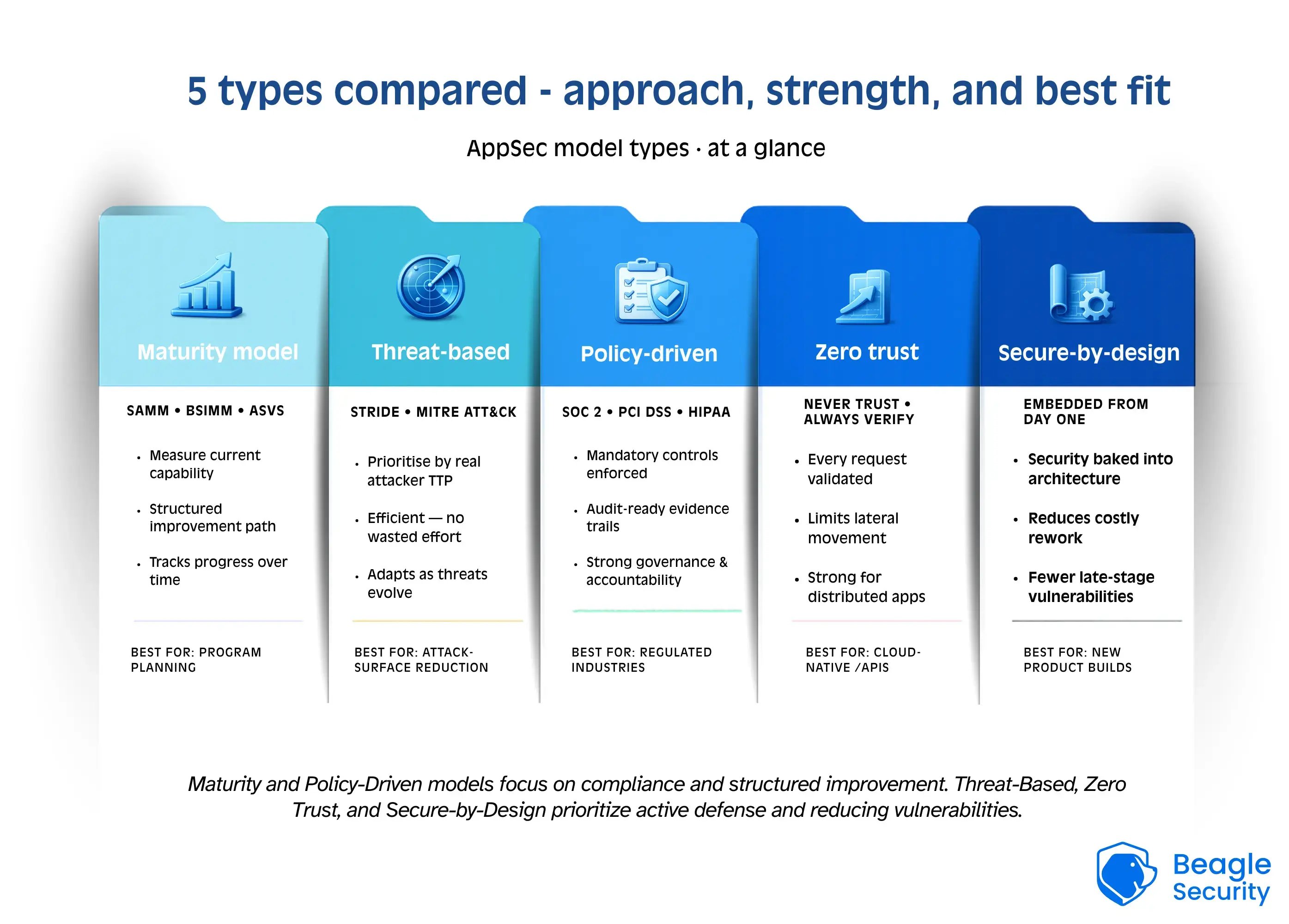
Maturity models (SAMM, BSIMM, ASVS based)
Improving application security is difficult if you don’t know where you currently stand.
That is the problem maturity models are designed to solve. Frameworks such as SAMM, BSIMM, and ASVS based models help organizations assess their existing security practices and identify areas that need improvement. Some teams use them when building an application security program for the first time, while others use them to measure progress and track how their security capabilities evolve over time.
Threat based security models
A company running an e-commerce platform will likely have different concerns than a healthcare provider or a financial institution. Threat-based models account for that by focusing on the attacks an organization is most likely to encounter and the assets that are most valuable to protect. This allows security efforts to be prioritized based on real-world risk rather than a generic checklist of controls.
Policy driven security models
For many organizations, security is influenced as much by compliance requirements as it is by technical risk. A policy-driven model uses internal policies, industry regulations, and security standards to define how applications should be built and maintained. Controls such as encryption requirements, access restrictions, secure coding standards, and audit logging are often enforced through formal policies that apply across development teams.
Zero trust application security model
Traditional security models often assumed that users or systems inside the network could be trusted by default. Zero trust takes the opposite approach. Every request, API call, and process must be verified before access is granted. Strong authentication, continuous validation, and tightly controlled permissions help limit unauthorized access and reduce the risk of lateral movement within an environment.
Secure by design model
Some of the most effective security decisions happen long before an application reaches production. A secure-by-design approach introduces security during architecture and development rather than relying primarily on testing later in the lifecycle. Practices such as threat modeling, secure defaults, least-privilege access, and early security reviews help reduce vulnerabilities before they become embedded in the application.
Tools & techniques for implementing application security model
An application security model is only useful if teams can put it into practice. That usually means combining processes with the right set of security tools. Different tools solve different problems, which is why most organizations rely on a mix of testing, monitoring, and automation throughout the software lifecycle.
Static analysis tools (SAST)
Many vulnerabilities can be identified before an application is ever run. Static analysis tools examine source code, bytecode, or binaries and look for insecure coding patterns, hardcoded secrets, input validation issues, and other common weaknesses. Because these tools can run directly in development environments or CI pipelines, developers often receive feedback while they are still working on the code.
Dynamic testing (DAST)
Some security issues only become visible once an application is running. DAST tools interact with live applications in much the same way an attacker would. They test inputs, endpoints, authentication flows, and application behavior to identify vulnerabilities such as injection flaws, security misconfigurations, and broken access controls. This makes DAST a useful complement to static analysis rather than a replacement for it.
Software composition analysis (SCA)
Modern applications depend heavily on third-party code. Open-source libraries, packages, and frameworks can speed up development, but they also introduce risk. SCA tools help teams understand what components they are using and whether those components contain known vulnerabilities, outdated dependencies, or licensing concerns that need attention.
Cloud native AppSec tooling
Cloud-native environments bring their own security challenges. Containers, Kubernetes clusters, Infrastructure as Code templates, and cloud services all need visibility and validation. Tools in this category often include container scanners, IaC analyzers, Kubernetes security checks, Cloud Security Posture Management (CSPM) platforms, and API security controls designed for distributed environments.
CI/CD integration tools
Security checks are increasingly being built directly into development pipelines. Rather than waiting until the end of a release cycle, teams can automate tasks such as SAST, SCA, DAST, secret detection, and policy enforcement as part of the build and deployment process. The goal is to catch issues early without creating unnecessary delays for developers.
Runtime security
Not every issue is discovered during development or testing. Runtime security tools focus on applications that are already in production. Technologies such as RASP, WAAP, and EDR/XDR help monitor application behavior, detect suspicious activity, and identify attacks as they happen. They provide an additional layer of visibility for threats that slip past earlier controls.
Final thoughts
Application security is rarely solved by a single tool, framework, or security review.
It comes from having a consistent approach. Security requirements, architecture decisions, development practices, testing, monitoring, and remediation all play a role. When those pieces work together, security becomes part of the software lifecycle instead of a separate activity that happens before release.
The exact model will look different from one organization to another. A startup building a SaaS product will have different priorities than a large enterprise operating under strict compliance requirements. What matters is having a structure that fits the way your teams build and maintain software.
Frameworks such as ASVS, NIST SSDF, and ISO 27034 can provide guidance, while security testing and monitoring tools help teams put those principles into practice. Over time, that combination makes it easier to identify risks early, respond to issues consistently, and improve security as applications evolve.
FAQs
How do you build an application security model?
Building an application security model typically starts with identifying security requirements, assessing risks, defining security controls, and integrating security into the software development lifecycle. Most organizations combine secure design principles, threat modeling, security testing, vulnerability management, and incident response into a single, repeatable process.
Which framework is best for application security?
There is no single framework that fits every organization. OWASP ASVS is widely used for application-level security requirements, NIST SSDF focuses on secure software development practices, and ISO 27034 provides broader application security guidance. Many organizations use a combination of these frameworks based on their security and compliance needs.
Why is security testing important in an application security model?
Security testing helps verify that security controls are working as intended. Techniques such as SAST, DAST, IAST, SCA, API security testing, and penetration testing identify vulnerabilities that may not be visible during normal development and code review activities.
How often should an application security model be reviewed?
An application security model should be reviewed regularly, especially after significant architectural changes, cloud migrations, compliance updates, or major security incidents. Many organizations perform formal reviews annually while continuously refining security controls as applications evolve.


![Top ZAP alternatives and competitors [October 2026]](/blog/images/top-zap-alternatives-cover.webp "Top ZAP alternatives and competitors [October 2026]")




![Top 10 penetration testing companies [2026]](/blog/images/top-penetration-testing-companies-cover.webp "Top 10 penetration testing companies [2026]")




![Top vendor application security tools [2026]](/blog/images/top-vendor-application-security-testing-tools-2026-cover.webp "Top vendor application security tools [2026]")



![Top Snyk alternatives & competitors [2026]](/blog/images/top-snyk-alternatives-cover.webp "Top Snyk alternatives & competitors [2026]")