Software security audit: Objectives, types and best practices

Modern software is never truly finished. New features are released, dependencies are updated, cloud infrastructure changes, APIs are added, and third-party services become part of the application. With every change comes the possibility of introducing a new security weakness.
The challenge isn’t that organizations don’t care about security, it’s that keeping up with an ever-changing application landscape is difficult. A misconfiguration, an outdated component, or a vulnerability that slips through testing can become an entry point for attackers if it isn’t identified and addressed in time.
That’s where a software security audit comes in. Rather than focusing on a single vulnerability or one part of the application, a security audit provides a structured review of your software’s security posture. It examines areas such as security controls, application configurations, code, infrastructure, and operational practices to identify weaknesses before they can be exploited.
For modern organizations, software security audits are no longer a one-time exercise or a compliance checkbox. They’re an important part of maintaining secure applications, meeting regulatory requirements, and building confidence that your software can withstand evolving security threats.
What is a software security audit?
A software security audit is a systematic evaluation of an application’s security posture. It examines source code, configurations, third-party dependencies, infrastructure, and operational processes to identify vulnerabilities and security weaknesses.
The audit evaluates how different parts of an application work together from a security perspective and whether the existing security controls are effective. It typically combines automated security testing with manual validation to provide a comprehensive assessment of the application’s security.
The findings help organizations understand their current security posture, prioritize remediation efforts, and demonstrate compliance with internal security policies and regulatory requirements.
What is the purpose of a software security audit?
The primary objectives of a software security audit are to evaluate risk and improve resilience.
A well-structured software security audit helps organizations understand how secure their applications truly are, identify gaps in controls, and prevent costly breaches. It serves as both a diagnostic and strategic improvement process.
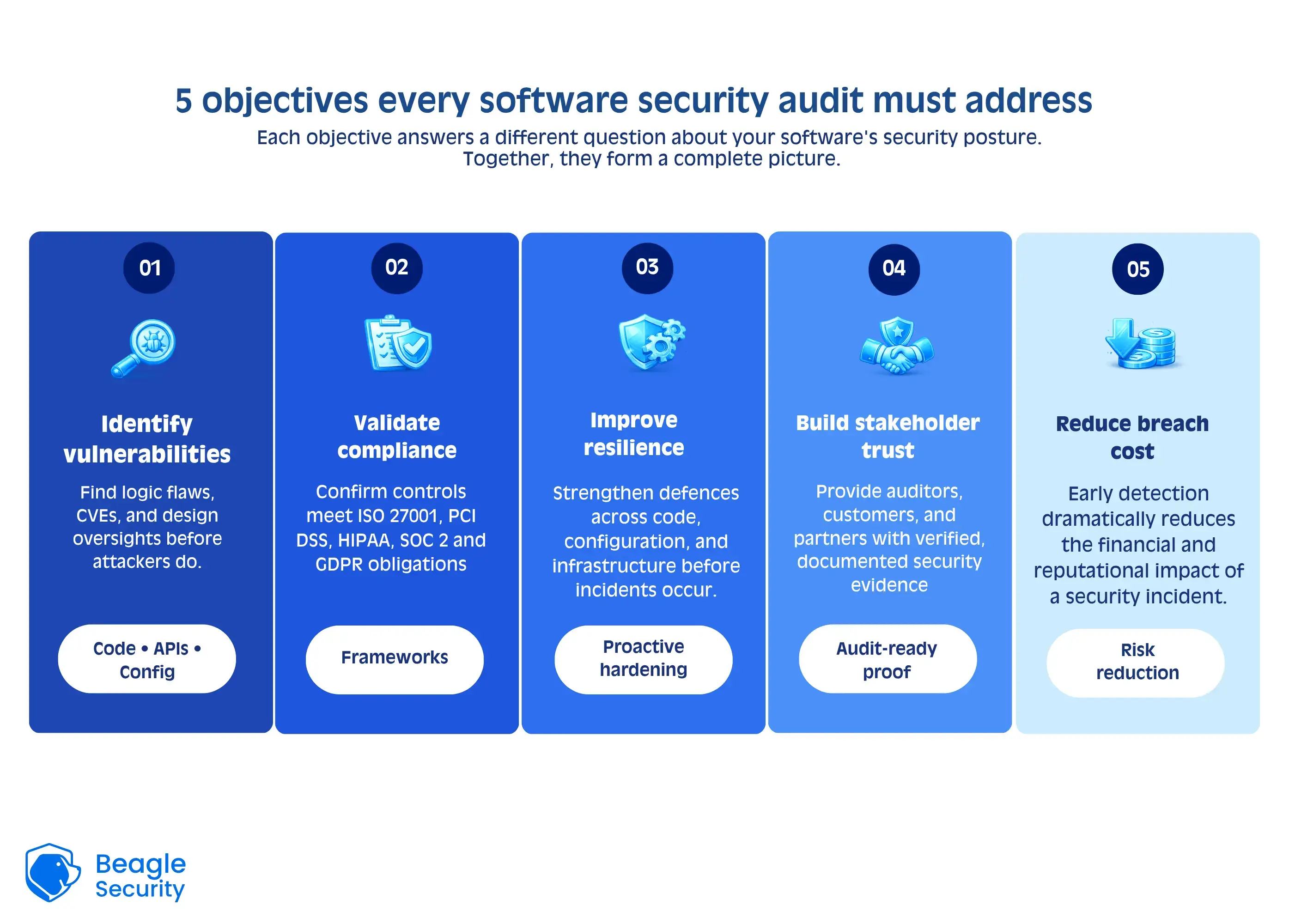
A software security audit should:
Identify and mitigate security risks before attackers exploit them.
Validate compliance with regulatory and industry standards.
Discover vulnerabilities in software components, code, and infrastructure.
Assess overall security posture and maturity.
Demonstrate trust and assurance to customers and stakeholders.
Reduce long-term costs associated with incident response and data breaches.
What are the different types of software security audits?
Software security audits come in several forms, each focusing on different parts of the software environment. No single audit type is sufficient on its own, which is why organizations often use a combination of approaches to gain a full understanding of security readiness. Some audits examine code quality and design, others assess real-world attack exposure, and some validate compliance and governance.
For a deeper breakdown of tools that support these audit types, refer to our detailed guide on top software security audit tools.
Below are the primary categories of software security audits used in modern development and deployment environments.
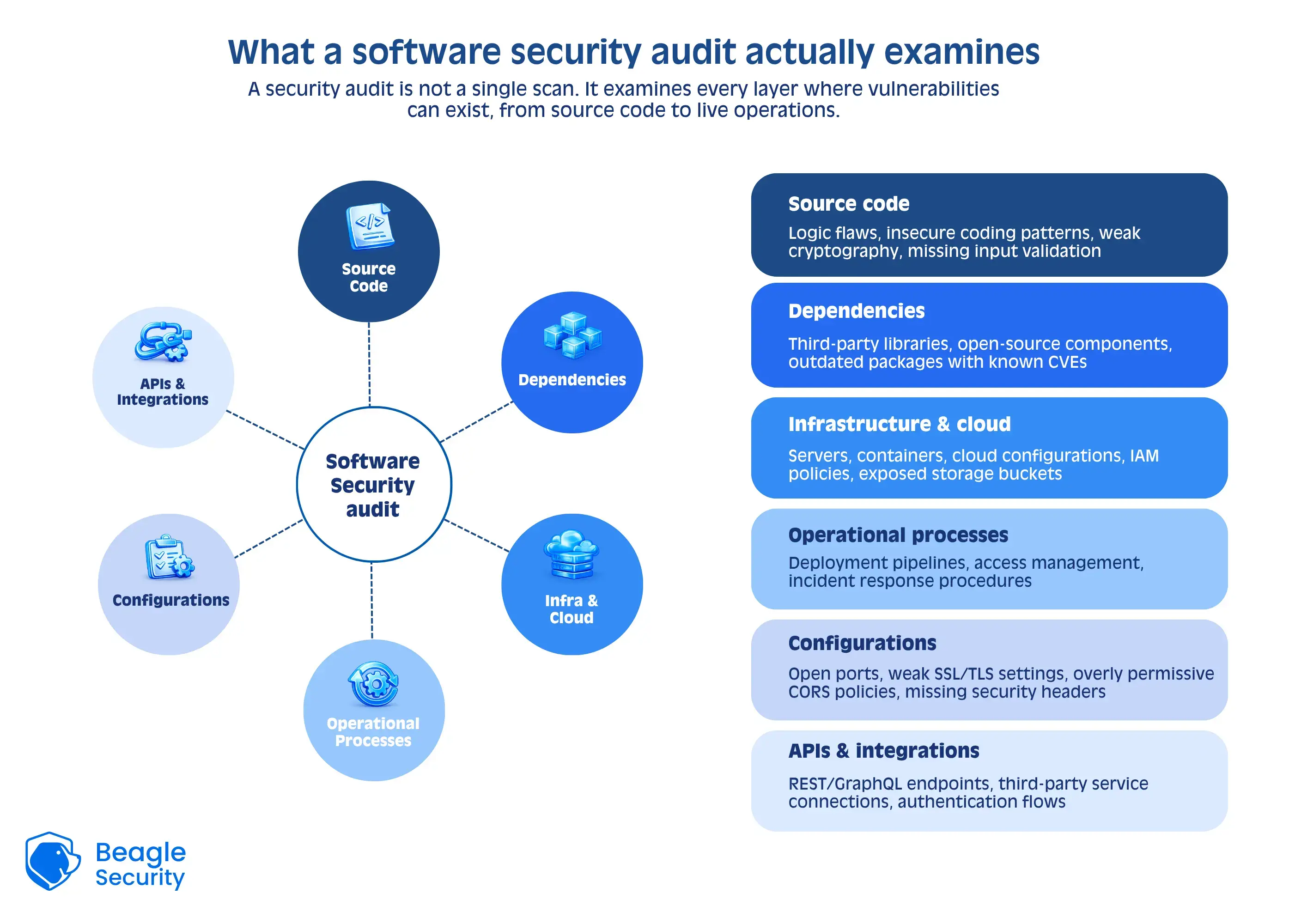
Code review (static analysis)
This audit type reviews the application’s source code without executing it. Static Application Security Testing (SAST) tools and manual code inspection help identify insecure coding practices, logic flaws, insufficient input validation, weak cryptography, and other vulnerabilities. Code review is most effective early in development, enabling development teams to fix issues before they propagate into production environments.
Configuration and infrastructure review
Applications operate within networks, servers, cloud environments, and containerized platforms. A configuration audit evaluates these surrounding components to ensure they are securely configured. Common findings include overly permissive IAM roles, open TCP ports, publicly exposed storage buckets, and weak SSL configurations. This audit type is critical for cloud-native environments where configuration errors frequently lead to security incidents.
Penetration testing (dynamic analysis)
Penetration testing examines how the running application behaves against real-world attack techniques. Instead of reviewing code, testers interact with the live environment to exploit security weaknesses, privilege escalation paths, authentication errors, and business logic flaws. Penetration testing provides insight into how attackers might compromise the application and what impacts such exploitation could have.
Dependency and library audit
Modern software heavily relies on open-source libraries and third-party packages. Software Composition Analysis (SCA) tools examine these dependencies to identify known CVEs, outdated libraries, and supply chain risks. A dependency audit helps prevent attackers from exploiting publicly documented vulnerabilities buried inside layers of library dependencies.
Compliance and policy audit
Compliance audits verify whether application security controls align with regulatory standards such as SOC 2, ISO 27001, PCI DSS, and HIPAA, along with internal governance policies. These audits involve reviewing documentation, access controls, encryption standards, change management processes, and incident response procedures to ensure the organization can produce required audit artifacts when needed.
Software security audit checklist
A software security audit is most effective when structured and clearly scoped. The checklist below provides a framework that organizations can use to stay organized throughout the audit lifecycle.
Before the checklist, it is important to understand that the audit process benefits greatly from clear objectives, collaboration between development and security teams, and consistent documentation practices.
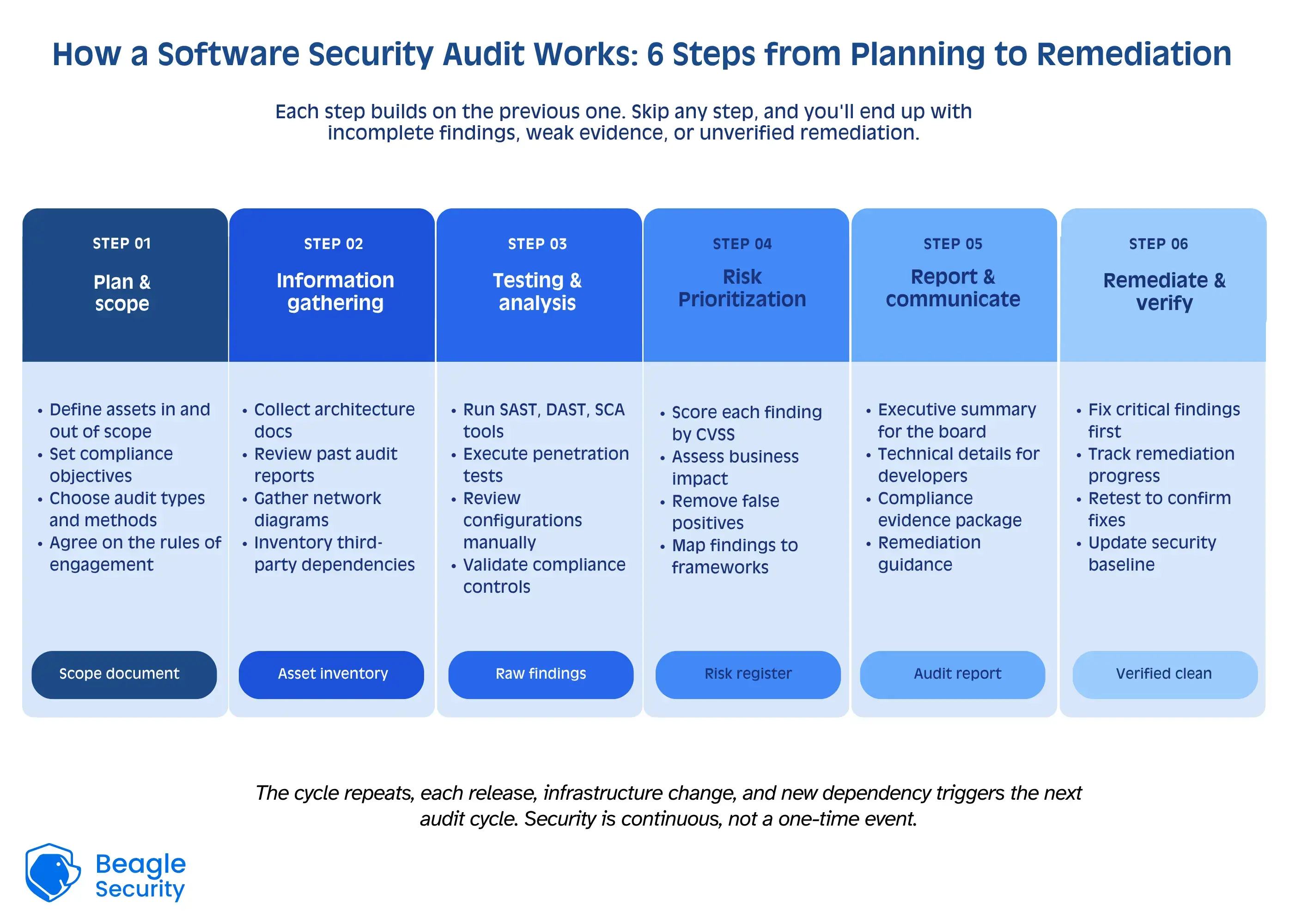
Pre-audit preparation:
Define scope and objectives.
Identify critical assets and data flow paths.
Select appropriate audit types based on application architecture.
Gather relevant documentation and environment details.
Establish timeline and stakeholder responsibilities.
During audit:
Execute code scanning and review procedures.
Assess application configurations and infrastructure components.
Conduct penetration testing activities in the running environment.
Review operational processes and security documentation.
Interview key technical and security personnel.
Post-audit actions:
Prioritize identified vulnerabilities using CVSS or similar scoring systems.
Develop a remediation and mitigation roadmap.
Determine which risks require acceptance vs elimination.
Communicate findings to both technical and non-technical stakeholders.
Schedule retests to verify effective remediation.
Ongoing maintenance:
Implement continuous monitoring and security testing practices.
Establish regular audit cycles based on system updates and risk levels.
Reassess scope as application features evolve.
Track progress through centralized reporting and dashboards.
Best practices for software security audit
This section expands on how organizations can plan, execute, and integrate security audits into ongoing workflows.
Planning and scoping
Establish clear goals that define what success looks like.
Bring together security teams, developers, and business leadership early.
Choose audit types based on technology stack and maturity level.
Allocate realistic timelines and ensure stakeholders have availability.
Execution excellence
Combine automated scanning with manual testing for accuracy.
Test in environments that mirror production as closely as possible.
Keep detailed documentation of all findings and decisions.
Maintain traceability of evidence and verification steps.
Communicate status updates throughout the process to reduce surprises.
Vendor selection (if outsourcing)
Verify analyst certifications and specialization experience.
Ensure transparency in methodology and reporting structure.
Request sample reports to evaluate depth and clarity.
Confirm availability of remediation assistance and retesting.
Integration with development
Adopt a shift-left security mindset to catch issues earlier.
Integrate automated testing into CI/CD pipelines.
Provide developers with security education and feedback loops.
Adapt policies to support both security and delivery speed.
Reporting and communication
Prepare an executive summary tailored to business leadership.
Include actionable steps and technical detail for development teams.
Map findings to compliance frameworks where applicable.
Use dashboards or reporting tools to track remediation over time.
Final thoughts
A software security audit is more than a compliance requirement. It is a strategic investment in the long-term reliability and trustworthiness of the applications that power your business. Security risks evolve continuously, and new features, integrations, and code changes can introduce vulnerabilities unexpectedly.
This means that even software that was secure at one point in time can become exposed if security practices are not maintained. Regular audits help ensure that security controls are adapting in step with development progress and environmental changes.
Organizations benefit most when audits are embedded into the development lifecycle rather than treated as isolated checkpoints.
By integrating continuous security testing and adopting a shift-left approach, teams can identify weaknesses earlier when they are faster and less expensive to fix. This also helps reduce friction between development and security teams by making risk awareness part of everyday workflows.
Prioritizing software security audits demonstrates accountability to customers, partners, and regulatory bodies while reducing the likelihood of expensive security incidents.
When supported by strong documentation, clear communication, and proactive remediation, audit processes contribute directly to improved resilience and operational confidence.
Building a culture where security is considered foundational rather than optional is ultimately the most effective way to sustain secure software over time.
FAQ
Why is a software security audit important?
A software security audit helps organizations identify vulnerabilities early, reduce the risk of cyberattacks, protect sensitive data, meet regulatory requirements, and improve the overall resilience of software applications.
What happens after a software security audit?
After the audit, organizations receive a report detailing identified vulnerabilities, risk levels, affected assets, remediation recommendations, and prioritized actions. Teams then fix the issues and often perform a follow-up assessment to verify that vulnerabilities have been successfully addressed.
How often should you perform a software security audit?\
Organizations should perform software security audits at least annually and also after major application updates. High risk applications benefit from continuous security testing integrated into the SDLC and DevSecOps pipelines.
What industries benefit most from software security audits?
Industries handling sensitive information benefit significantly, including healthcare, finance, e-commerce, SaaS, education, government, telecommunications, and manufacturing.


![Top ZAP alternatives and competitors [October 2026]](/blog/images/top-zap-alternatives-cover.webp "Top ZAP alternatives and competitors [October 2026]")




![Top 10 penetration testing companies [2026]](/blog/images/top-penetration-testing-companies-cover.webp "Top 10 penetration testing companies [2026]")



![Top vendor application security tools [2026]](/blog/images/top-vendor-application-security-testing-tools-2026-cover.webp "Top vendor application security tools [2026]")




![Top Snyk alternatives & competitors [2026]](/blog/images/top-snyk-alternatives-cover.webp "Top Snyk alternatives & competitors [2026]")