How to outsource penetration testing the right way in 2026

Most organizations understand they need penetration testing. Fewer have the internal expertise, headcount, or time to do it consistently. A single qualified penetration tester is expensive to hire and harder to retain. A full internal red team is out of reach for most businesses outside of large enterprises.
Outsourcing solves the access problem. You get certified professionals, specialized tooling, and an external perspective on your defenses without building the function from scratch. The risk is in doing it poorly: vague scope, weak deliverables, and vendors who produce reports that look thorough but drive no real remediation.
This guide covers how to outsource penetration testing effectively in 2026: what to prepare before you engage a vendor, how to evaluate the right partner, what deliverables to expect, and where automated platforms like Beagle Security fit into the picture.
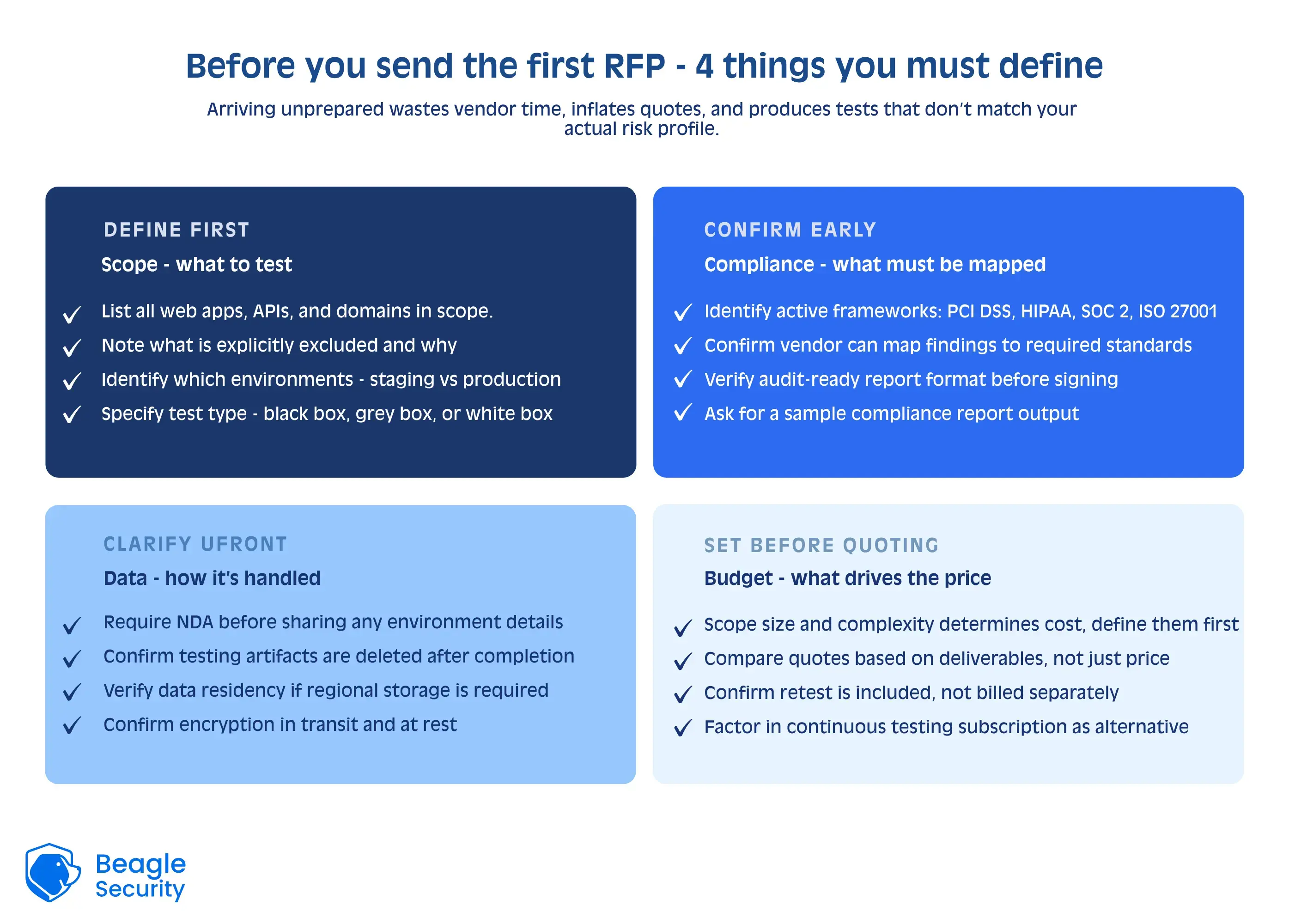
Quick checklist on outsourcing penetration testing
| Checklist item | What to confirm | Status |
|---|---|---|
| Define scope and assets | Identify what needs testing: web applications, APIs, mobile apps, internal networks, or cloud. Document the business objective behind the test. | |
| Choose the right methodology | Black box, gray box, or white box. Align to your security maturity and testing objective. | |
| Evaluate vendor credentials | Look for OSCP, CEH, GPEN, or CREST. Request sample reports and check references. | |
| Set compliance expectations | Confirm the vendor maps findings to PCI DSS, HIPAA, SOC 2, or ISO 27001 before the engagement starts. | |
| Clarify data handling | Confirm encryption, signed NDA, artifact deletion post-engagement, and data residency requirements. | |
| Budget realistically | Typical range is $5,000–$25,000. Evaluate on deliverables and expertise, not price alone. | |
| Define deliverables upfront | Ask for a sample report covering executive summary, findings, severity ratings, PoC, and remediation guidance. | |
| Plan for retesting | Confirm follow-up testing is included to verify vulnerabilities are actually fixed after remediation. | |
| Agree on communication cadence | Set a cadence for progress updates before the project begins to surface critical findings early. | |
| Review legal and insurance | Verify the vendor holds cyber liability insurance and meets your legal and regulatory requirements. |
Benefits of outsourcing penetration testing
Access to specialized expertise : Outsourced penetration testing teams have experience across multiple industries and technologies. Their exposure to diverse attack methods helps them uncover vulnerabilities that internal teams may overlook.
Cost efficiency : Maintaining an internal red team can be costly. Outsourcing allows organizations to access skilled professionals and advanced tools only when needed, reducing ongoing expenses.
Independent assessment : A third-party perspective provides unbiased insights. External testers can identify blind spots in your defenses and help validate your internal security efforts.
Faster delivery : Outsourced testing firms follow streamlined processes that allow them to deliver results within weeks. They often combine automation with manual validation to achieve speed without sacrificing accuracy.
Scalability and flexibility : Outsourcing makes it easy to scale testing based on your organization’s needs. Whether you require annual testing or continuous validation across multiple applications, an external provider can adjust to your requirements.
Access to advanced tools : Reputable providers use modern tools, automation frameworks, and real-world threat intelligence to identify vulnerabilities faster and with higher precision.
Compliance assurance : Engaging an external vendor provides documented proof of due diligence for auditors. Their standardized reporting formats align with frameworks such as PCI DSS, HIPAA, and ISO 27001.
When to outsource penetration testing vs keep it in-house
Outsourcing penetration testing is not always the right choice for every scenario. Some organizations benefit from having an internal security testing function, while others rely entirely on external vendors. In many cases, a hybrid approach works best.
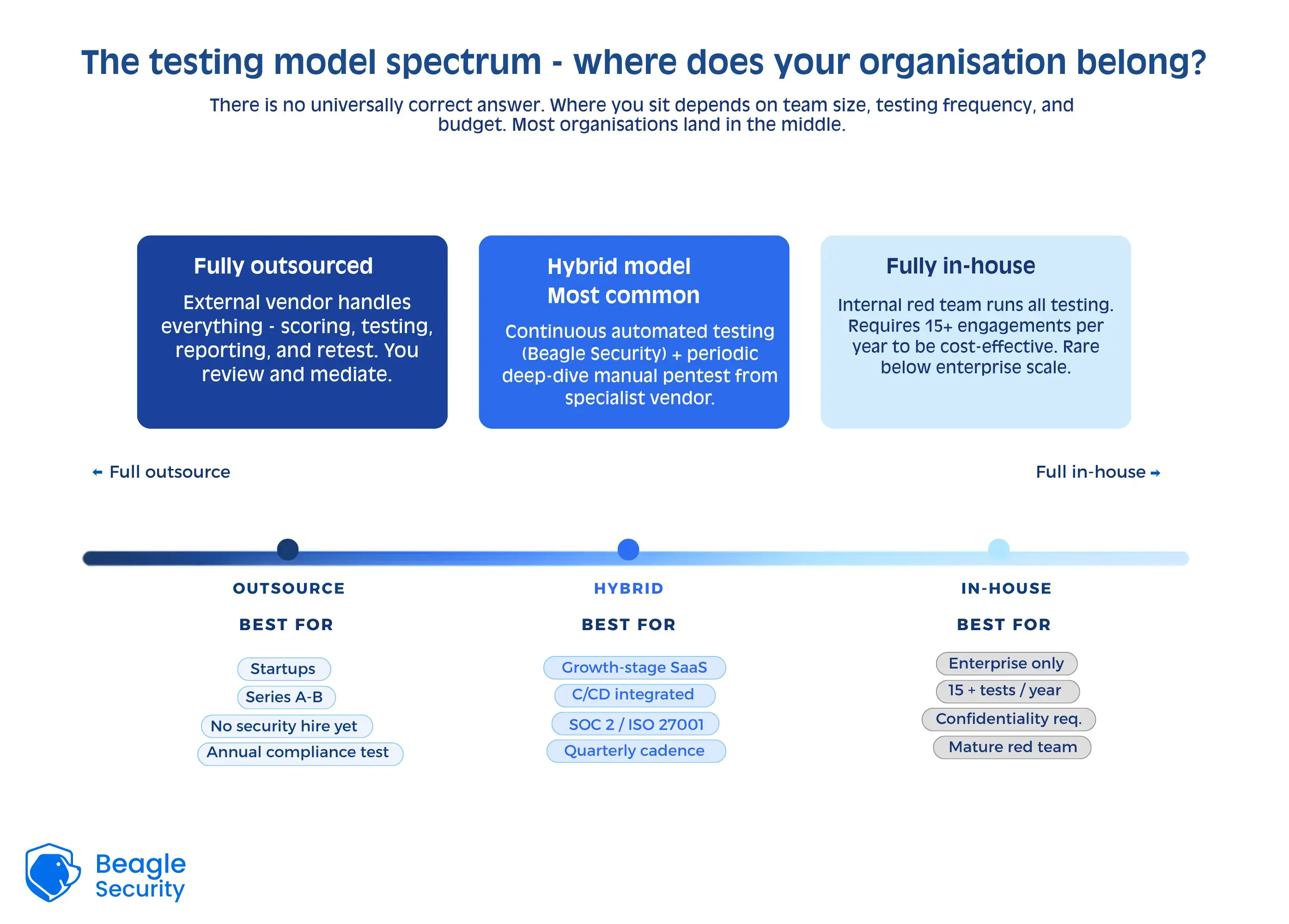
| Scenario | Recommendation | Rationale |
|---|---|---|
| Annual compliance audits | Outsource | Third-party reports satisfy most regulatory and audit requirements. |
| Vendor onboarding or M&A due diligence | Outsource | Independent validation ensures an objective assessment of external systems. |
| Pre-production application testing | Hybrid | Combine internal static code analysis with outsourced dynamic testing. |
| Continuous CI/CD pipeline testing | In-house or automated platform | Use tools like Beagle Security for continuous testing integrated with development workflows. |
| Limited internal resources | Outsource | A cost-effective alternative to hiring full-time testers. |
| Highly sensitive data systems | In-house | Retain full control over testing and data access for critical infrastructure. |
| Incident response readiness validation | Hybrid | Combine internal detection teams with external offensive testing for realism. |
Reporting and deliverable expectations from an outsourced penetration test
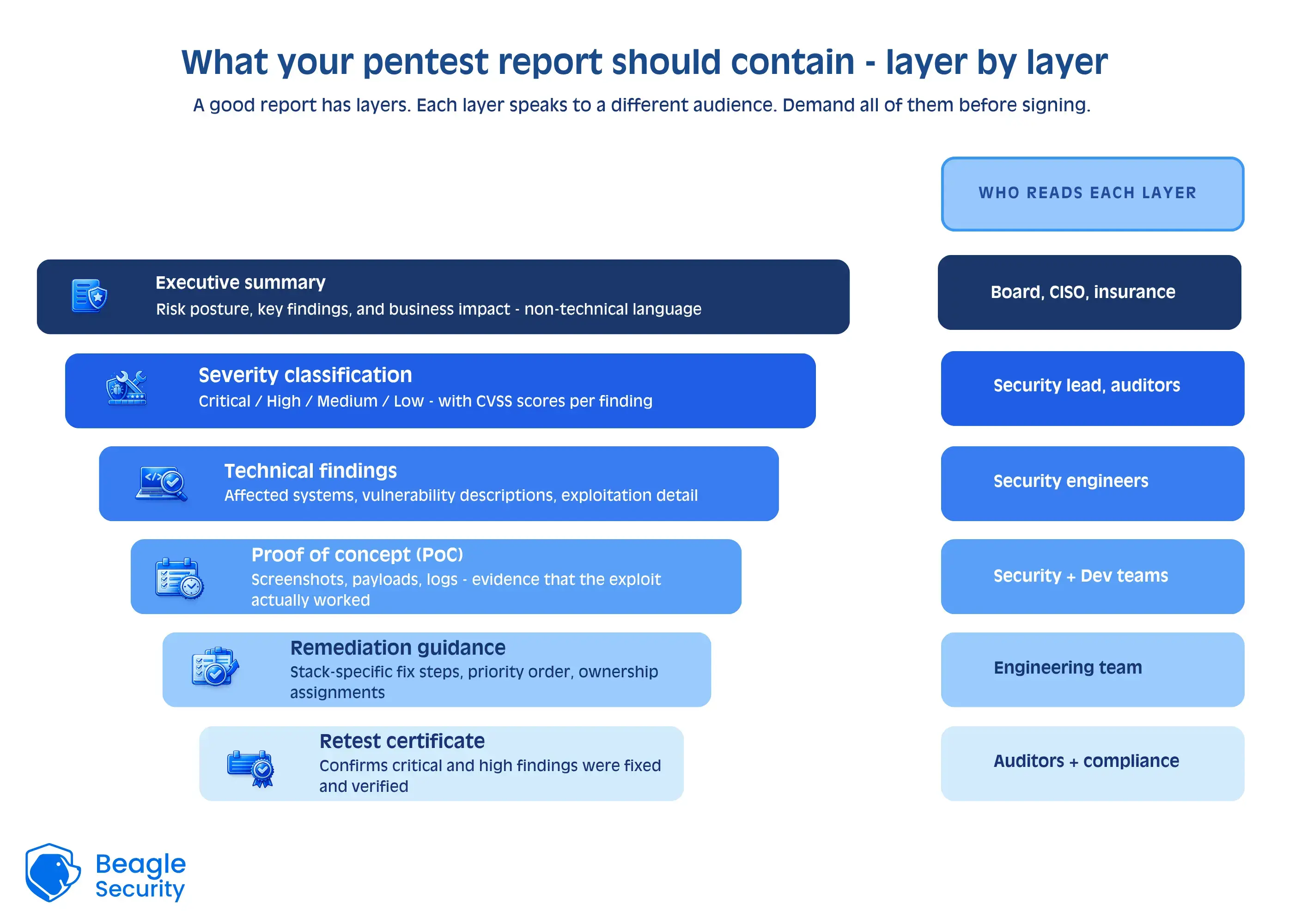
Executive summary : A concise overview of the engagement, highlighting key findings, risk levels, and overall security posture in business-friendly language.
Technical findings : Detailed descriptions of each vulnerability, including affected systems, potential impact, and evidence of exploitation.
Severity categorization : Vulnerabilities are prioritized as critical, high, medium, or low, allowing organizations to focus on the most serious risks first.
Proof of concept (PoC): Clear evidence such as screenshots, payloads, or logs that demonstrate successful exploitation and validates the vulnerability.
Remediation guidance : Actionable steps and best practices to fix each issue, ideally referencing industry standards like OWASP or NIST.
Compliance mapping : Reports should align findings with relevant frameworks such as PCI DSS, HIPAA, and ISO 27001 for audit readiness.
Retest confirmation : A follow-up assessment that verifies whether previously identified vulnerabilities have been remediated.
Attack narrative : A description of how an attacker could chain multiple vulnerabilities to achieve greater impact, helping stakeholders understand risk severity.
Stakeholder debriefing : Many vendors include an executive presentation or walkthrough session to explain findings and remediation priorities.
How Beagle Security can help
Beagle Security offers an innovative, agentic AI approach to outsourcing penetration testing. Its platform uses artificial intelligence to simulate real-world attacks on web applications and APIs, helping teams identify vulnerabilities before they become threats.
- Automated and hybrid testing: Beagle Security blends automated testing with human validation to deliver reliable and accurate vulnerability detection.
- CI/CD integration: The platform integrates seamlessly with development pipelines like GitHub Actions, GitLab, and Jenkins, enabling continuous security validation.
- Transparent pricing :
- Essential plan: $119 per month for 2 tests, 1 concurrent test, and up to 5 users
- Advanced plan: $359 per month for 15 tests, 4 concurrent tests, and up to 15 users
- Enterprise plan: Custom pricing designed for large organizations
- Compliance-ready reports: Each assessment is aligned with OWASP Top 10, PCI DSS, HIPAA, and ISO 27001 standards, ensuring audit readiness.
- Data protection and sovereignty: Beagle Security supports regional data storage and privacy requirements, ensuring compliance with international data protection laws.
Beagle Security is ideal for startups, SMBs, and fast-moving development teams that need continuous penetration testing without the delays, costs, and overhead associated with traditional consultants. It allows organizations to identify vulnerabilities faster, reduce false positives, and maintain a stronger security posture throughout the software development lifecycle.
Final thoughts
Outsourcing penetration testing in 2026 is not only about finding vulnerabilities but about building long-term resilience. Cybersecurity threats evolve daily, and external testing helps organizations validate their defenses from a real attacker’s perspective.
To outsource penetration testing effectively, organizations must approach the process strategically. Define your goals, establish scope, evaluate vendor expertise, and demand transparency in methodology and reporting. View outsourced penetration testing as an extension of your security team rather than a one-time engagement.
By combining external expertise with continuous testing tools like Beagle Security, businesses can achieve both security depth and operational efficiency. The result is a proactive, cost-effective, and scalable security testing program that keeps pace with modern development and regulatory demands.
FAQs
How much does outsourced penetration testing cost?
Most engagements fall between $5,000 and $25,000 depending on scope, methodology, and the complexity of the systems being tested. Black box web application tests at the lower end of that range are common for smaller organizations. Large-scale infrastructure or red team engagements at the higher end reflect the additional time and expertise required. For teams that need continuous testing between annual engagements, automated platforms like Beagle Security start at $119/month and cover ongoing application and API testing without per-engagement fees.
How long does a penetration test take?
A focused web application penetration test typically takes one to three weeks from kickoff to final report. Larger scope engagements covering infrastructure, APIs, and internal networks can run four to six weeks. Retesting after remediation adds additional time, which is worth factoring into your project timeline before you start.
What is the difference between a vulnerability scan and a penetration test?
A vulnerability scan identifies known weaknesses by comparing your systems against a database of signatures. It is automated, fast, and broad. A penetration test goes further: a tester actively attempts to exploit findings, chains vulnerabilities together, and assesses real-world impact. Scans tell you what might be vulnerable. Penetration tests tell you what can actually be compromised and how.


![Top ZAP alternatives and competitors [October 2026]](/blog/images/top-zap-alternatives-cover.webp "Top ZAP alternatives and competitors [October 2026]")




![Top 10 penetration testing companies [2026]](/blog/images/top-penetration-testing-companies-cover.webp "Top 10 penetration testing companies [2026]")




![Top vendor application security tools [2026]](/blog/images/top-vendor-application-security-testing-tools-2026-cover.webp "Top vendor application security tools [2026]")



![Top Snyk alternatives & competitors [2026]](/blog/images/top-snyk-alternatives-cover.webp "Top Snyk alternatives & competitors [2026]")