
Fintech applications sit at the intersection of financial data, regulatory obligation, and constant iteration. That combination creates a specific kind of risk profile that generic security testing was never designed to address.
Sensitive account data, real-time transaction flows, and complex API integrations mean the attack surface is categorically different from a standard web application. Vulnerabilities here do not just expose user records, they can result in direct financial loss, regulatory penalties, and the kind of trust damage that is difficult to recover from.
This guide breaks down what fintech penetration testing actually covers, what you should expect to pay, and how to evaluate a provider against the real complexity of your stack.
Why fintech applications need a different approach to pentesting
Fintech applications handle account balances, transaction histories, fund transfers, KYC flows, and payment instrument data. The sensitivity of that data raises the stakes on every vulnerability. A misconfigured access control rule is not just a compliance finding, it is a potential path to direct financial loss.
A generic scanner can identify an outdated library or a missing security header. It cannot reason about whether your transaction approval flow can be manipulated to bypass a spending limit, or whether your account linking logic exposes access to a third-party account through an insecure OAuth callback.
Most fintech logic lives in APIs. Open banking mandates, payment rails, and embedded finance architectures push sensitive data across service boundaries through REST and GraphQL interfaces. Testing these surfaces requires understanding authorization scope and the semantics of financial operations, not just whether inputs are sanitized.
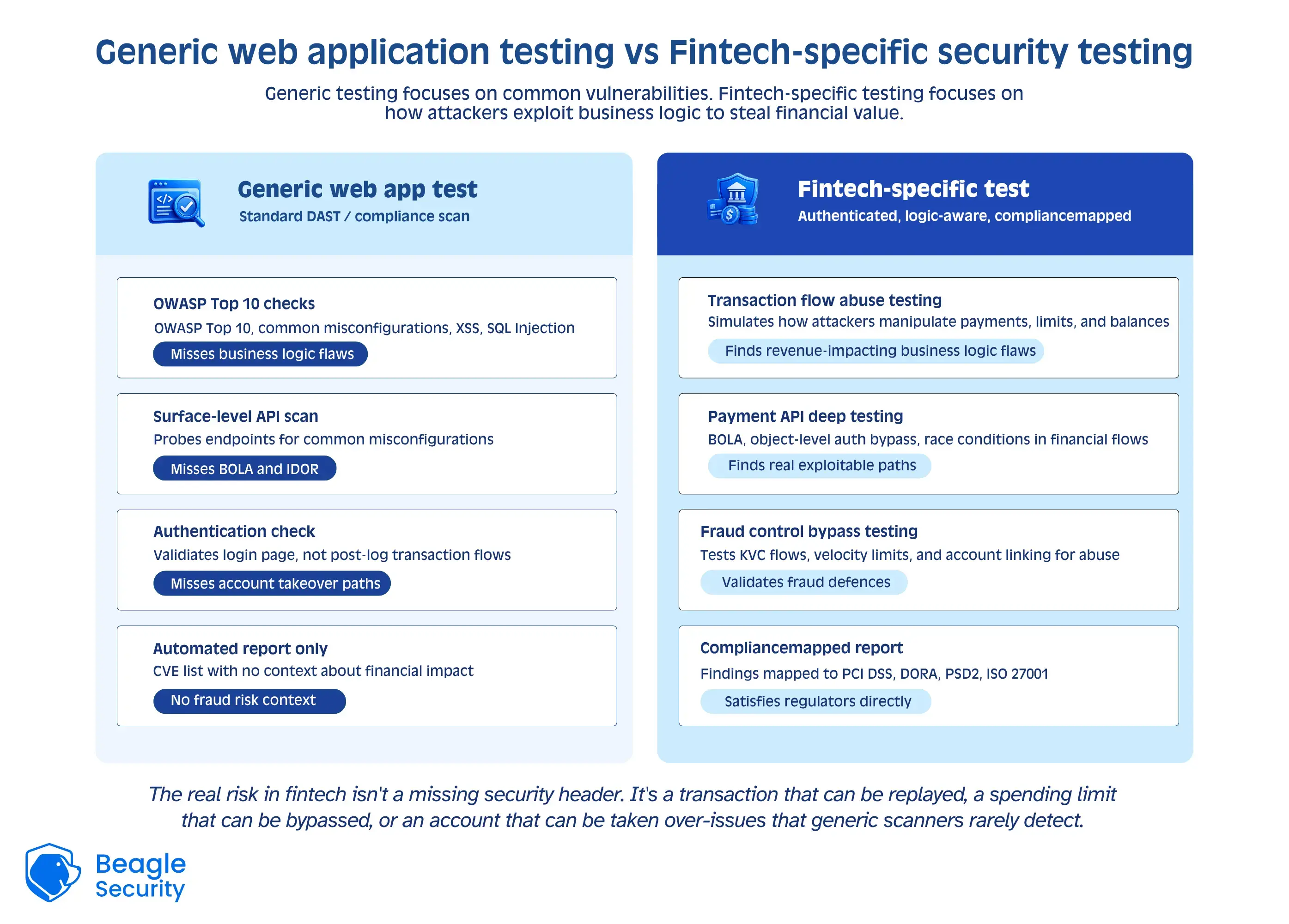
Regulatory exposure compounds the risk further. PCI DSS, SOC 2, DORA, and regional data protection frameworks each have requirements that intersect with application security. A penetration test that only surfaces OWASP Top 10 findings may not provide the evidence an auditor or compliance team needs.
What fintech penetration testing should cover
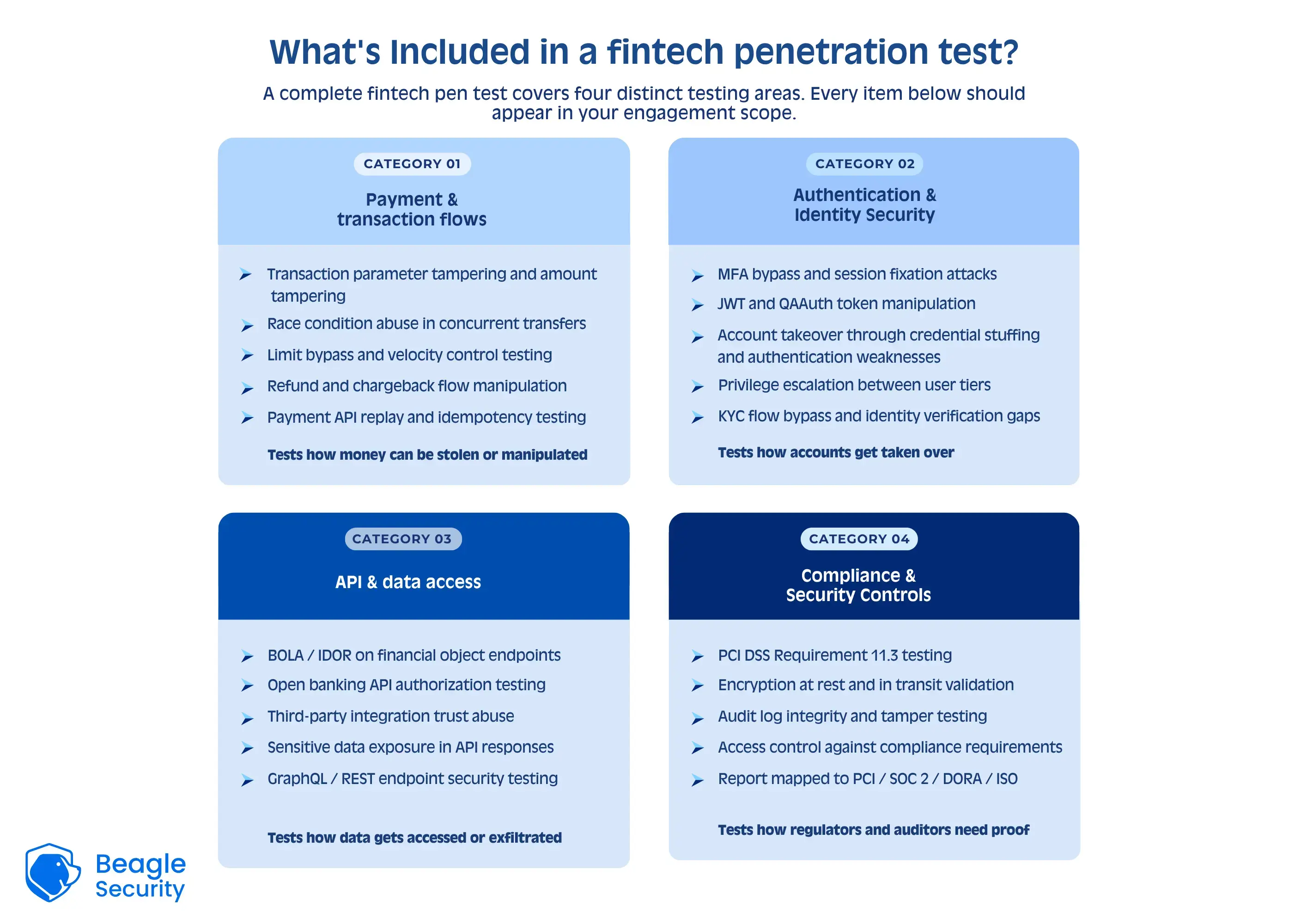
A credible fintech penetration test goes beyond surface-level scanning and covers every layer where financial logic, user data, and access control intersect.
Web application testing
The foundation is testing the full web application surface: authentication mechanisms, session management, access control logic, input validation, and error handling. For fintech, this includes high-risk areas like password reset flows, MFA bypass vectors, and account lockout behavior.
Admin panels deserve particular attention. In many fintech platforms, internal tooling carries elevated privileges and receives less scrutiny than customer-facing surfaces. Misconfigurations here can expose bulk transaction data, override user controls, or bypass fraud detection.
REST and GraphQL API testing
APIs are where most fintech logic lives. REST API testing should cover broken object-level authorization (BOLA), mass assignment, rate limiting gaps, and improper handling of JWT tokens or API keys.
GraphQL introduces its own surface area. Introspection endpoints left exposed in production, deeply nested queries that can cause denial of service, and field-level authorization gaps are all common findings. A tester who is not familiar with GraphQL-specific attack patterns will miss a significant portion of the risk.
Authenticated flow testing
Penetration testing that only runs unauthenticated scans misses the majority of fintech-specific risk. Testing must cover authenticated flows across multiple privilege levels: standard users, premium users, business accounts, and admin roles.
Account login and identity management are the entry points. This means evaluating MFA implementation, account recovery flows, session token handling, and whether identity verification steps can be skipped or manipulated through parameter tampering.
Transaction flows carry the highest business risk. Testing covers the end-to-end process of moving money or initiating a payment whether approval steps can be bypassed, amounts manipulated, or confirmation logic circumvented through request modification.
Admin panels are high-value targets. Internal tooling often carries elevated privileges and receives less security scrutiny than customer-facing surfaces. Compromise here can expose bulk transaction data, override user-level controls, or disable fraud detection entirely.
Business logic flaws
This is where fintech penetration testing diverges most sharply from commodity scanning. Business logic flaws cannot be detected by a vulnerability signature. They require a tester to understand how the application is supposed to behave, and then probe systematically for ways to make it behave differently.
Examples include: balance manipulation through concurrent requests, payment bypass by altering request parameters, insufficient validation of transfer amounts, fee avoidance by manipulating promotional logic, and transaction replay attacks. These flaws can be invisible to automated tooling while being highly exploitable in production.
Third-party integration testing
Fintech ecosystems are highly interconnected, and every external dependency is a potential attack vector. Testing should cover how your application communicates with payment gateways, banking partners, and data aggregators evaluating whether transaction data is handed off securely, whether API channels to financial institutions are properly authenticated, and whether imported or exported financial data is validated before it is trusted.
The other half of this is how your application handles unexpected behavior from third parties. Malformed responses, expired tokens, and downtime from an external service should not create exploitable conditions in your application. If your payment processor returns an unexpected status code, your application logic should not silently approve a transaction.
What fintech penetration testing costs
Pricing in the penetration testing market varies widely, and the variance reflects real differences in depth, methodology, and expertise rather than just margin.
Manual penetration testing for a fintech web application typically ranges from $5,000 to $30,000. When the scope includes APIs which it should for most fintech platforms costs generally increase with complexity, and regulated industries like fintech often demand deeper testing and audit-ready documentation, pushing engagements toward the higher end or beyond. Specialist firms with financial services experience and certified testers command a premium, with complex platform engagements running $20,000 to $100,000 depending on scope.
Automated penetration testing platforms generally fall between $2,000 and $10,000, structured as subscription fees rather than per-engagement pricing. This makes costs more predictable and easier to scale across multiple products or teams. Most platforms offer a trial entry point with no configuration required, which lets your team evaluate coverage before committing to a paid tier.
Hybrid approaches using automation for continuous coverage while reserving manual effort for complex logic flaws and chained exploits are widely considered the most practical setup for fintech. Gray box testing, where testers are given limited credentials to evaluate both external and internal risk, is a common formal structure for this and typically requires more setup and technical involvement than black-box approaches. Expect to budget $10,000 to $35,000 for a structured hybrid engagement.
When evaluating cost, the more important question is what you are getting for the price.
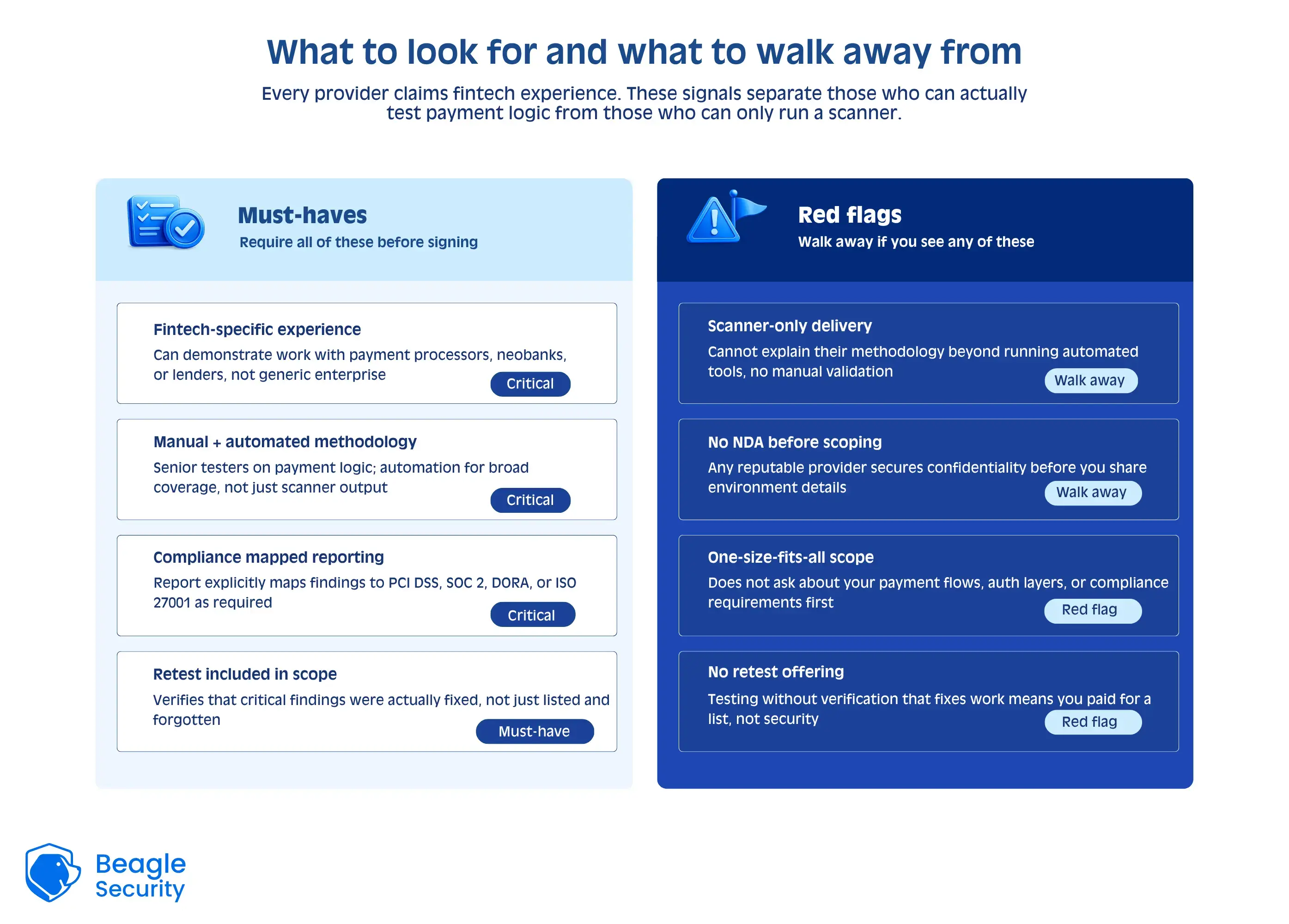
Key factors to probe: Does the scope include authenticated testing? Does the provider understand GraphQL and modern API architectures? Will findings map to your compliance requirements? Is there a clear remediation workflow, or will you receive a PDF report and nothing else?
Opaque pricing is itself a signal. Providers who can articulate scope, methodology, and deliverables clearly before you sign a contract are more likely to deliver a test that reflects the actual risk profile of your application.
How Beagle Security approaches fintech pentesting
Beagle Security is built for teams who ship continuously and cannot wait weeks for a manual engagement to close before deploying.
Business logic flaws are tested as a core part of the scope, not an afterthought. Scenario recording lets you capture complex user workflows and multi-step transactions using a browser plugin, so the platform tests the actual paths a user takes through a payment flow, account linking sequence, or fund transfer, and probes for ways those flows can be manipulated.
API coverage extends to both REST and GraphQL, which matters for fintech platforms built on open banking rails or embedded finance architectures. Broken authorization, parameter tampering, and field-level access control gaps across API surfaces are part of the standard test scope.
For compliance, findings map directly to PCI DSS, SOC 2, and OWASP with CVSS scores and proof-of-concept detail included. This reduces the work required to translate a pentest report into audit evidence, a recurring overhead for regulated fintech teams.
Beagle Security integrates into CI/CD pipelines, so security testing runs as part of your deployment process rather than as a periodic exercise disconnected from development. This matters for fintech teams where the cost of shipping a vulnerability into production is higher than the cost of finding it in staging.
Start your 14-day free trial or explore the interactive demo to see if Beagle Security is the right fit for your fintech stack.
FAQs
How often should fintech applications be pentested?
Automated testing should run on every significant deployment. Manual or hybrid testing should occur at major release milestones, when architecture changes, or when compliance obligations require it. Annual testing alone is not sufficient for a fintech environment where the application changes continuously.
How is FinTech penetration testing different from regular penetration testing?
Fintech penetration testing goes deeper into authenticated flows, business logic, and API security than a standard web application test. It also accounts for regulatory requirements like PCI DSS and SOC 2, which shape both the scope of testing and the format of the report. The stakes are higher too, a logic flaw in a payment flow has direct financial consequences, not just data exposure.
Can agentic AI penetration testing handle complex fintech application stacks?
Modern agentic AI penetration testing platforms like Beagle security go well beyond basic scanning. Authenticated testing, REST and GraphQL API coverage, and business logic scenario recording are all capabilities available in platforms built for complex application stacks.


![Top ZAP alternatives and competitors [October 2026]](/blog/images/top-zap-alternatives-cover.webp "Top ZAP alternatives and competitors [October 2026]")




![Top 10 penetration testing companies [2026]](/blog/images/top-penetration-testing-companies-cover.webp "Top 10 penetration testing companies [2026]")




![Top vendor application security tools [2026]](/blog/images/top-vendor-application-security-testing-tools-2026-cover.webp "Top vendor application security tools [2026]")




![Top Snyk alternatives & competitors [2026]](/blog/images/top-snyk-alternatives-cover.webp "Top Snyk alternatives & competitors [2026]")