Understanding cybersecurity due diligence

Cybersecurity is now a critical factor in mergers and acquisitions, especially as businesses increasingly rely on cloud infrastructure and SaaS ecosystems. A strong security posture directly impacts valuation, liabilities, and integration strategies, making cybersecurity due diligence essential for private equity firms, corporate development teams, and financial decision-makers.
Investment analysts, CFOs, and M&A teams face the challenge of identifying significant security risks early to influence negotiations and differentiating between fixable issues and critical weaknesses that could jeopardize a deal. This guide offers a strategic framework for M&A cybersecurity due diligence, emphasizing application security maturity, operational readiness, and key red flags affecting deal outcomes.
What is cybersecurity due diligence?
Cybersecurity due diligence involves assessing the security stance, vulnerabilities, and operational risks of a company being acquired during a merger and acquisition process. This evaluation checks if the target’s existing controls, processes, and technologies are robust enough to thwart breaches, comply with regulations, and maintain business operations after the acquisition. Ultimately, it ensures that any hidden security issues do not turn into financial burdens for the acquiring company.
The value of M&A cybersecurity due diligence
Before entering an acquisition, investors need clarity on how secure, resilient, and compliant the target truly is. Effective M&A cybersecurity due diligence helps deal teams uncover hidden risks, validate technical maturity, and ensure the business can scale safely under new ownership. Cybersecurity evaluation is now a critical pillar of modern M&A strategy because it:
Protects deal value: Uncovers hidden vulnerabilities, past breaches, or unresolved technical debt that could translate into high remediation costs or post-deal instability.
Quantifies security maturity: Helps investors understand whether the target’s engineering and security practices can support long-term product reliability and customer trust.
Reduces regulatory exposure: Validates whether the organization actually meets compliance obligations (SOC 2, ISO 27001, GDPR, HIPAA) and identifies gaps that could lead to penalties.
Prevents reputational risk: Identifies potential breach vectors such as exposed APIs, weak authentication, or poor cloud hygiene before they impact the acquiring brand.
Strengthens negotiation leverage: Provides objective, evidence-backed risk scoring that supports price adjustments or conditional remediation terms.
Ensures safe integration: Confirms that the target’s technology can be integrated into the acquiring company without introducing systemic security risks or unpredictable costs.
Key areas examined in a cybersecurity due diligence assessment
A thorough cybersecurity due diligence assessment focuses on the systems, processes, and controls that determine the target’s overall security resilience. This helps deal teams quickly identify strong areas, weak links, and issues that may require further investigation. Key areas include:
Application & API security: Analysis of DAST/SAST results, exposed endpoints, authentication design, and the overall maturity of secure development processes.
Cloud & infrastructure configuration: Evaluation of IAM roles, logging coverage, network segmentation, and misconfigurations that may expose assets to public access.
Identity & access management: Review of MFA enforcement, access governance, privilege allocation, and potential presence of shared or orphaned accounts.
Data protection: Verification of encryption standards, data handling practices, retention policies, and the reliability of backup and recovery procedures.
Incident response maturity: Assessment of breach history, historical remediation practices, and the presence of repeatable, well-governed incident workflows.
Vendor & supply chain risk: Review of third-party APIs, SaaS dependencies, and outsourced services that could introduce vulnerabilities.
Compliance status: Validation of the target’s alignment with frameworks like SOC 2, ISO 27001, GDPR, and HIPAA, not just certifications, but actual operational controls.
Network & endpoint hygiene: Insights into patch cadence, device security hardening, and the presence of outdated or unsupported systems.
Cybersecurity due diligence checklist
Below is a structured, M&A-ready checklist designed to help deal teams evaluate the security maturity of acquisition targets quickly and objectively.
| Assessment area | What to verify | Red flags | Why it matters |
|---|---|---|---|
| Application security | Automated DAST/SAST results, API security, authentication mechanisms | Critical CVEs, exposed APIs, weak authentication | Impacts customer data safety and product reliability |
| Cloud security | IAM roles, policies, logging, misconfiguration scans | Open ports, unrestricted IAM permissions, missing logs | Cloud misconfigurations are the leading cause of modern breaches |
| Infrastructure & network | Segmentation, firewall rules, patch cadence | Legacy tech, flat networks, unsupported OS | Increases likelihood of lateral movement and ransomware risk |
| Data protection | Encryption, key management, backups | Unencrypted sensitive data, weak key storage | Directly tied to compliance and breach impact severity |
| Identity & access management | MFA, RBAC, service account governance | Shared accounts, missing MFA, privilege sprawl | Primary vector for account takeover and internal misuse |
| Incident response | IR plan, detection tooling, historical incident logs | Lack of procedures, poor visibility, unresolved incidents | Suggests hidden liabilities and unpreparedness |
| Vendor risk | Third-party assessments, API dependencies | High-risk vendors, no vendor reviews | Expands attack surface and compliance burden |
| Compliance & governance | SOC 2, ISO 27001, GDPR, HIPAA posture | Unverifiable certifications or major controls gaps | Affects customer trust and market eligibility |
| DevSecOps & SDLC | CI/CD security, code review, secrets management | Hardcoded secrets, no security controls in pipeline | Signifies operational immaturity and long-term remediation cost |
Using the Beagle Security platform for cybersecurity due diligence
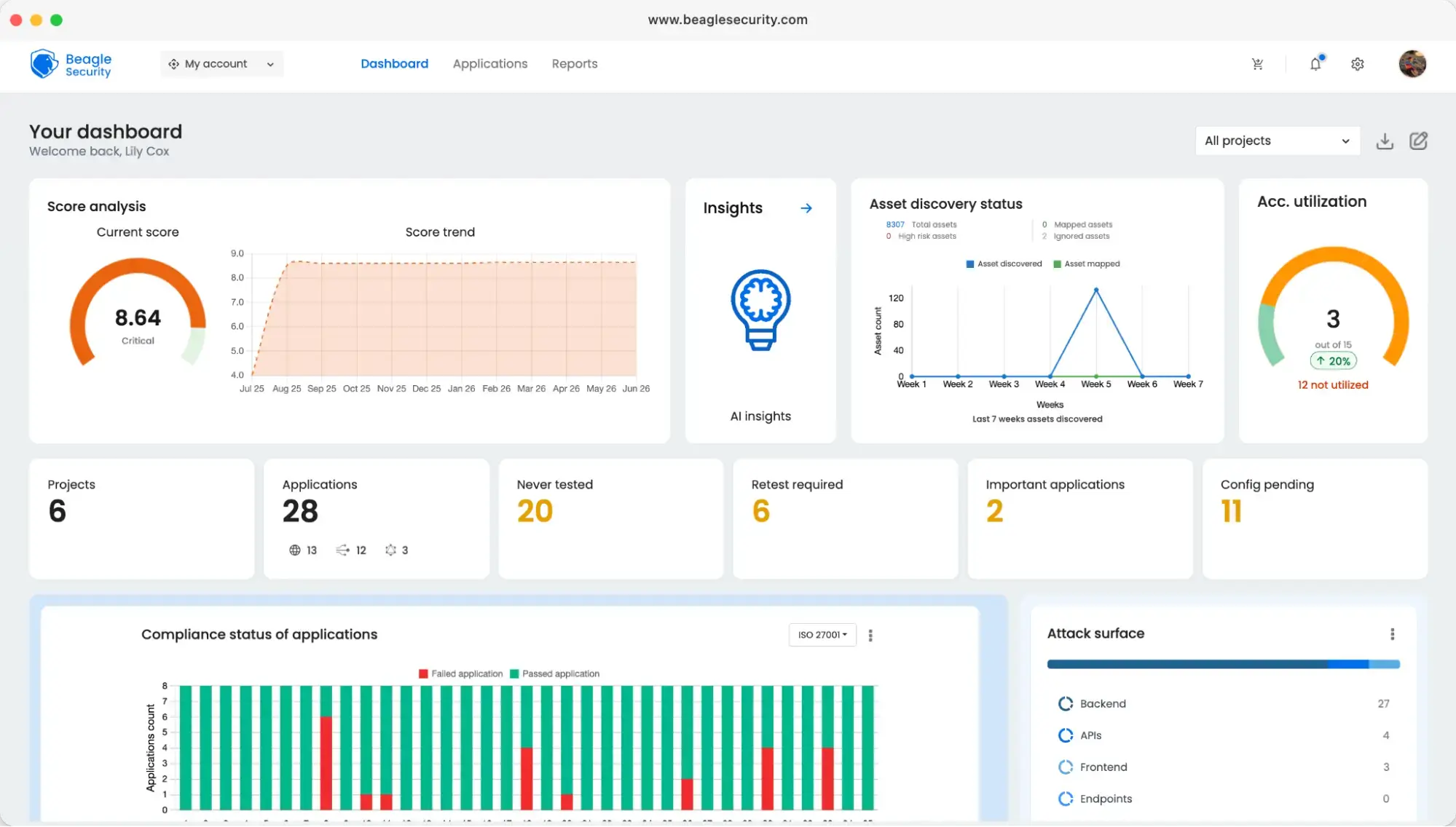
Beagle Security provides a fast, objective, third-party view of an acquisition target’s application and API security posture, critical for cybersecurity due diligence processes. Through agentic AI penetration testing, Beagle Security helps M&A teams validate vulnerabilities, identify real-world risk exposure, and assess how mature the target’s security practices truly are. This independent analysis strengthens negotiation positions and helps quantify remediation effort without requiring internal system access.
Final thoughts
Cybersecurity due diligence is undeniably inseparable from financial, operational, and legal diligence. Security lapses directly influence valuation, integration complexity, and long-term business resilience. For private equity partners, investment analysts, CFOs, and corporate development teams, the ability to identify unacceptable risk can determine whether a deal becomes a strategic win or a costly liability.
A structured approach to M&A cybersecurity due diligence allows deal teams to distinguish between manageable gaps and fundamental weaknesses. Combined with independent assessment tools like Beagle Security, investors can verify claims, uncover hidden risks, and make data-driven decisions even under compressed transaction timelines. Ultimately, cybersecurity due diligence protects not just the deal, but the future value of the combined organization.
With Beagle Security, teams gain an objective, third-party view of an acquisition target’s true application and API security posture. This helps them validate risk early, strengthen negotiation positions, and accelerate confident decision-making. Check out our 14 day advanced trial or the interactive demo to see if we’re the right fit for you.
FAQs
What should a cybersecurity due diligence checklist include?
A cybersecurity due diligence checklist should cover key areas such as application security, cloud infrastructure, identity and access management, data protection, third-party vendors, compliance, incident response, and disaster recovery. Reviewing these areas helps identify security gaps before making business decisions.
How does cybersecurity due diligence help reduce business risk?
Cybersecurity due diligence helps uncover vulnerabilities, security misconfigurations, and compliance gaps that could lead to financial losses, operational disruptions, or legal issues. Addressing these risks early enables organizations to make informed decisions and plan remediation before completing a transaction.
How often should organizations perform cybersecurity due diligence?
Cybersecurity due diligence isn’t limited to mergers and acquisitions. Organizations should also perform security assessments before onboarding critical vendors, adopting new technologies, entering strategic partnerships, or making significant infrastructure changes.
What happens if cybersecurity due diligence is overlooked?
Skipping cybersecurity due diligence can leave organizations unaware of hidden security risks, outdated systems, compliance issues, or unresolved vulnerabilities. These problems may result in unexpected remediation costs, reputational damage, or security incidents after the deal is completed.


![Top ZAP alternatives and competitors [October 2026]](/blog/images/top-zap-alternatives-cover.webp "Top ZAP alternatives and competitors [October 2026]")




![Top 10 penetration testing companies [2026]](/blog/images/top-penetration-testing-companies-cover.webp "Top 10 penetration testing companies [2026]")




![Top vendor application security tools [2026]](/blog/images/top-vendor-application-security-testing-tools-2026-cover.webp "Top vendor application security tools [2026]")




![Top Snyk alternatives & competitors [2026]](/blog/images/top-snyk-alternatives-cover.webp "Top Snyk alternatives & competitors [2026]")