Cybersecurity compromise assessment

In cybersecurity, silence is not always a sign of safety. Many organizations operating under the illusion of normalcy are, in reality, already compromised.
According to multiple industry reports, attackers now dwell inside enterprise networks for an average of over 200 days before detection. During that time, they quietly escalate privileges, move laterally, and exfiltrate critical data while bypassing traditional monitoring tools.
A cybersecurity compromise assessment bridges that gap between assumption and evidence. It is not a theoretical exercise or a compliance checkbox; it is a forensic reality check. By systematically examining endpoints, logs, and network activity, this assessment exposes signs of undetected intrusion, persistence mechanisms, and attacker footprints that traditional defenses miss.
In 2025, as organizations expand across hybrid clouds, SaaS ecosystems, and remote endpoints, compromise assessment services are becoming integral to modern security programs.
They answer the most critical question every CISO must ask: “Are we already breached, and if so, where?”
What is a cybersecurity compromise assessment?
A cybersecurity compromise assessment is a forensic investigation designed to determine whether an organization has experienced unauthorized access or hidden malicious activity that evaded existing defenses.
It analyzes endpoint telemetry, system logs, and network data to identify Indicators of Compromise (IoCs), malicious persistence, and attacker movement within the environment.
The primary purpose is to detect active or historical breaches, reduce attacker dwell time, and restore operational assurance across critical systems.
What are the key objectives of a cybersecurity compromise assessment?
A compromise assessment provides verifiable insight into an organization’s current threat exposure. Its objectives include:
Confirm or dismiss a breach: Determine whether attackers are present, active, or have previously infiltrated the network.
Reduce attacker dwell time: Detect and eliminate persistence mechanisms that extend intruder presence.
Identify Indicators of Compromise (IoCs): Locate artifacts such as malicious executables, unauthorized scripts, or suspicious registry changes.
Map Tactics, Techniques, and Procedures (TTPs): Align findings with frameworks such as MITRE ATT&CK to understand attacker behavior.
Validate security control performance: Evaluate how well existing EDR, SIEM, and firewall systems detected or missed the threat.
Support governance and compliance: Generate verifiable evidence for regulators, audits, and board reporting.
Enable proactive defense: Use forensic insights to improve SOC detection logic and incident response readiness.
When should organizations conduct a cybersecurity compromise assessment?
A cybersecurity compromise assessment should not be limited to crisis response. Leading enterprises schedule them as a continuous validation exercise within their cyber resilience framework. Key scenarios include:
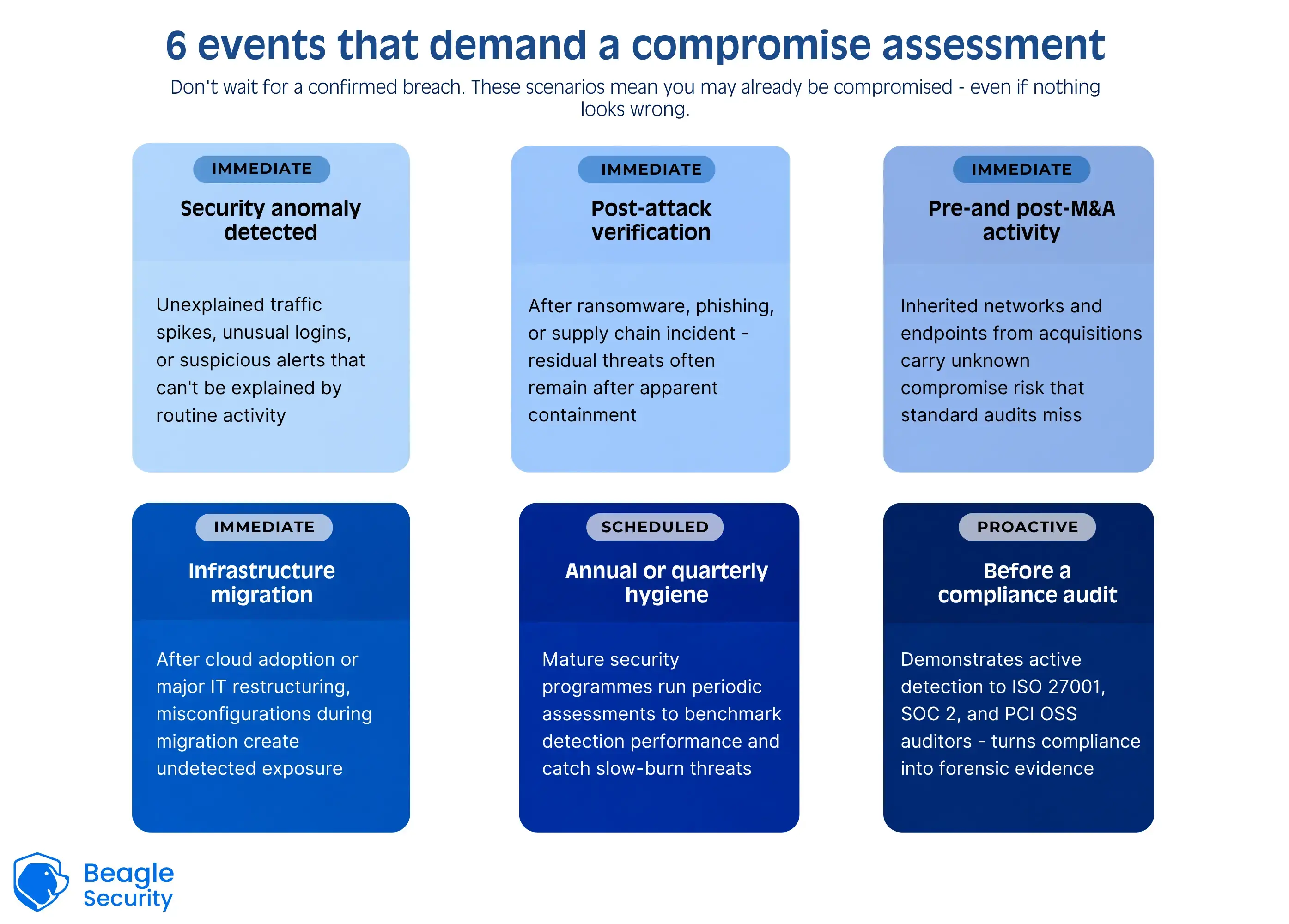
After a suspected security anomaly: When there are unexplained spikes in outbound traffic, irregular logins, or suspicious alerts.
Post-attack verification: After a ransomware attempt, phishing campaign, or supply chain incident to ensure no residual threat remains.
Pre- and post-M&A activities: To ensure no hidden compromise exists in the networks or endpoints of target organizations.
After infrastructure migration: Following cloud adoption or major IT restructuring to validate configurations and ensure no exposure.
As part of annual or quarterly security hygiene: Mature programs conduct periodic compromise assessments to benchmark detection performance.
Before compliance audits: Demonstrates active detection measures to meet frameworks like ISO 27001, SOC 2, and PCI DSS.
What are the steps involved in a compromise assessment?
The compromise assessment steps follow a forensic methodology that combines planning, evidence collection, deep analysis, and reporting.
Step 1: Planning & scoping: Define the scope, objectives, and key systems under review. Identify critical business assets, network boundaries, and compliance requirements.
Step 2: Data collection: Deploy forensic and endpoint agents, gather system logs, and capture memory images and network telemetry. Maintain a clear chain of custody to preserve data integrity.
** Step 3: Analysis & detection:** Correlate anomalies with IoCs and TTPs. Use DFIR (Digital Forensics and Incident Response) tools to uncover lateral movement, privilege escalation, and command-and-control channels.
Step 4: Reporting & remediation: Compile findings into a detailed compromise assessment report, including technical evidence, executive summaries, and prioritized remediation guidance.
Step 5: Post-assessment validation: Re-scan after remediation to verify complete threat removal and update detection logic for future prevention.
What is included in a compromise assessment report?
A compromise assessment report provides clear, evidence-backed insights to both technical and executive stakeholders. It typically includes:
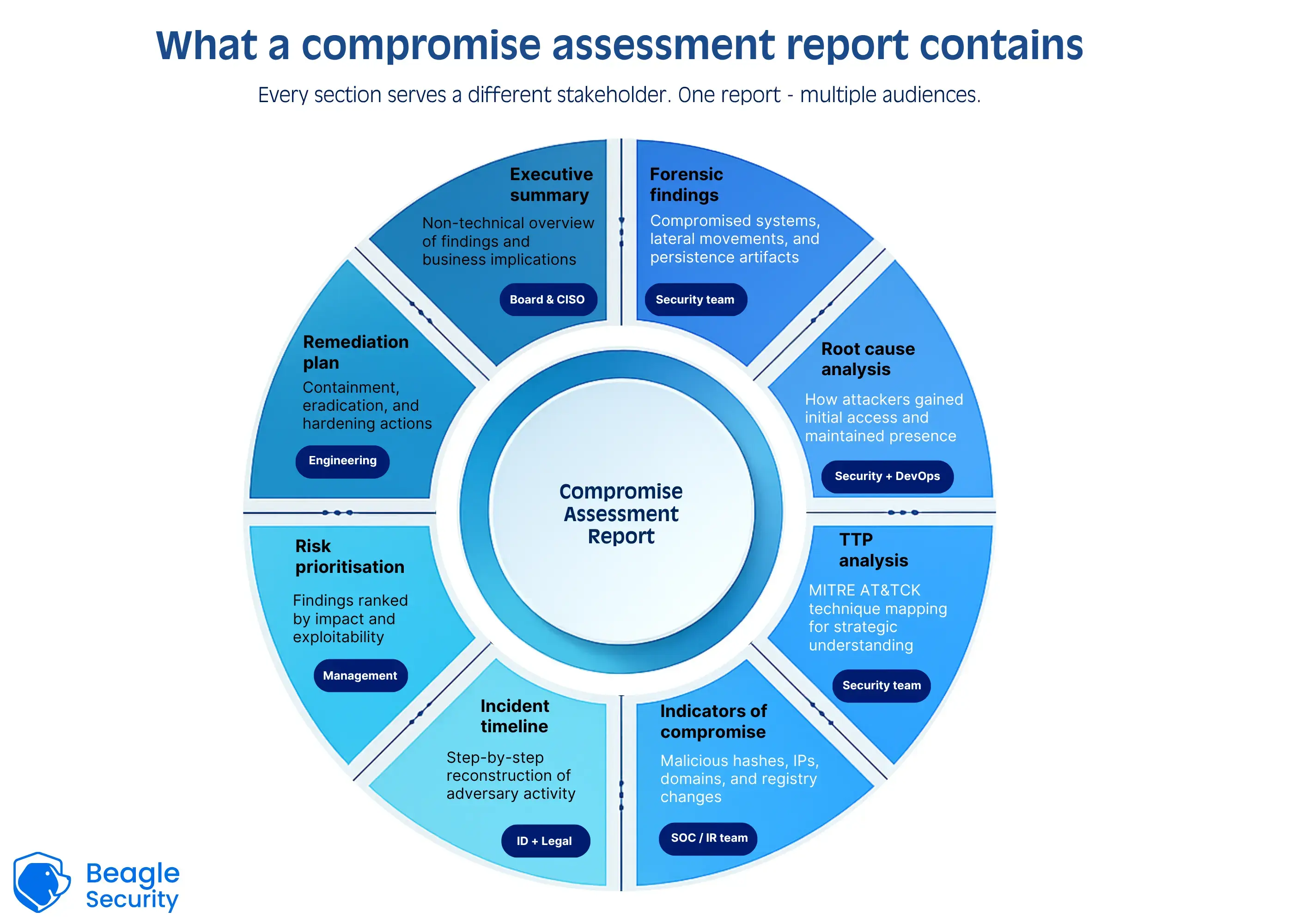
Executive summary: Non-technical overview of the findings and their business implications.
Forensic findings: Detailed records of compromised systems, lateral movements, and persistence artifacts.
Root cause analysis: Clarifies how attackers gained initial access and maintained presence.
Indicators of compromise (IoCs): Comprehensive lists of malicious file hashes, IPs, domains, and registry changes.
TTP analysis: Correlation with MITRE ATT&CK techniques for strategic understanding.
Incident timeline: Step-by-step reconstruction of adversary activity.
Risk prioritization: Categorization of findings based on impact and exploitability.
Remediation plan: Actionable guidance for containment, eradication, and hardening.
Appendices: Supporting forensic data, screenshots, and intelligence references.
Compromise assessment vs threat hunting
While both activities aim to detect malicious presence, their operational philosophies differ significantly.
| Aspect | Compromise assessment | Threat hunting |
|---|---|---|
| Initiation | Reactive, triggered by suspicion or routine validation | Proactive, continuous, and hypothesis-driven |
| Objective | Confirm existing or past compromise | Predict and prevent future intrusions |
| Methodology | Evidence-based forensic validation | Analytical exploration using threat hypotheses |
| Scope | Enterprise-wide, across endpoints and networks | Focused on specific attack patterns or threat vectors |
| Outcome | Detection and confirmation of compromise | Early behavioral detection before exploitation |
In essence, compromise assessments are forensic confirmations, while threat hunting is anticipatory defense. Many security teams integrate both to create a feedback loop: threat hunting identifies potential risks, and compromise assessments confirm exploitation with forensic evidence.
Compromise assessment vs vulnerability assessment
These two assessments serve distinct but complementary functions in a security strategy.
| Aspect | Compromise assessment | Vulnerability assessment |
|---|---|---|
| Purpose | Detect evidence of exploitation or intrusion | Identify unpatched vulnerabilities or misconfigurations |
| Timing | Post-incident or periodic validation | Routine preventive exercise |
| Focus | Active attacker presence and dwell time | Potential entry points and weaknesses |
| Approach | Manual forensic analysis using EDR, SIEM, and DFIR data | Automated scanning tools and configuration reviews |
| Output | Compromise assessment report with forensic evidence | Vulnerability scan report with remediation priorities |
The core difference lies in intent: vulnerability assessments are preventive, while cybersecurity compromise assessments are detective, uncovering tangible proof of exploitation.
Compromise assessment checklist
Before initiating or selecting a compromise assessment service, organizations should use the following compromise assessment checklist to ensure readiness:
Preparation phase
Define assessment scope (network, endpoint, cloud).
Identify stakeholders (SOC, IT, legal, compliance).
Gather architectural diagrams, access logs, and incident history.
Establish secure communication and data handling policies.
Execution phase
Deploy forensic agents or sensors across endpoints.
Collect logs from SIEM, firewalls, and EDR platforms.
Capture network traffic and memory dumps for deep analysis.
Maintain chain-of-custody documentation for collected evidence.
Analysis phase
Correlate IoCs and TTPs using threat intelligence feeds.
Analyze lateral movement, privilege escalation, and persistence.
Reconstruct incident timelines and attacker paths.
Validate findings against MITRE ATT&CK.
Reporting & remediation
Deliver executive and technical reports.
Prioritize containment and eradication steps.
Conduct validation scans post-remediation.
Present board-level summary of risk reduction and assurance.
Final thoughts
In an age where detection failure can destroy trust overnight, a cybersecurity compromise assessment represents more than just a diagnostic tool; it is the ultimate validation of resilience.
Modern attackers move quietly, leveraging legitimate credentials and cloud-native tools to blend in. Traditional alert-driven monitoring often misses these signs until it is too late.
By engaging compromise assessment services, organizations can independently verify whether hidden intrusions exist, assess the maturity of their detection systems, and strengthen response capabilities.
The financial argument is clear: the average global data breach now exceeds $4.8 million, while the cost of a professional compromise assessment ranges from $15,000 to $80,000, a fraction of the potential loss.
For security leaders, the assessment is no longer optional; it is a forensic necessity for maintaining operational integrity and executive confidence. In 2025 and beyond, the most resilient organizations will not only defend against threats but validate that those defenses are working.
FAQ
How much does a typical cybersecurity compromise assessment cost?
Pricing ranges from $15000 to $80000, depending on scope, organization size, and forensic depth. Larger enterprises may require multi-week assessments involving thousands of endpoints.
When should a business choose a compromise assessment over penetration testing?
Opt for a cybersecurity compromise assessment when verifying potential or existing breaches. Choose penetration testing when simulating external attacks to assess preventive defense capabilities.


![Top ZAP alternatives and competitors [October 2026]](/blog/images/top-zap-alternatives-cover.webp "Top ZAP alternatives and competitors [October 2026]")




![Top 10 penetration testing companies [2026]](/blog/images/top-penetration-testing-companies-cover.webp "Top 10 penetration testing companies [2026]")




![Top vendor application security tools [2026]](/blog/images/top-vendor-application-security-testing-tools-2026-cover.webp "Top vendor application security tools [2026]")



![Top Snyk alternatives & competitors [2026]](/blog/images/top-snyk-alternatives-cover.webp "Top Snyk alternatives & competitors [2026]")