Veracode review: Everything you need to know before choosing it

Veracode is a cloud- native application security platform that integrates SAST, DAST, and SCA into the software development lifecycle. It helps organizations identify, manage and fix vulnerabilities from development through production.
Founded in 2006, Veracode is widely recognized as an enterprise-grade application security platform. It is built around a “shift-left” philosophy, enabling developers to catch security issues early in the development process rather than after deployment
This guide walks through Veracode’s key features, pros and cons, pricing and what you should know before committing to it, so you can make an informed decision about whether it fits your security workflow.
TL;DR: Veracode review
Veracode is a comprehensive enterprise application security platform that combines SAST, DAST, and SCA under one roof. It is best suited for large organizations with strict compliance requirements and centralized security governance needs.
Its limitations show up in cost, speed, and developer experience. The platform is expensive at every tier, feedback cycles are slower than modern developer-focused tools, and setup complexity can slow down adoption across engineering teams.
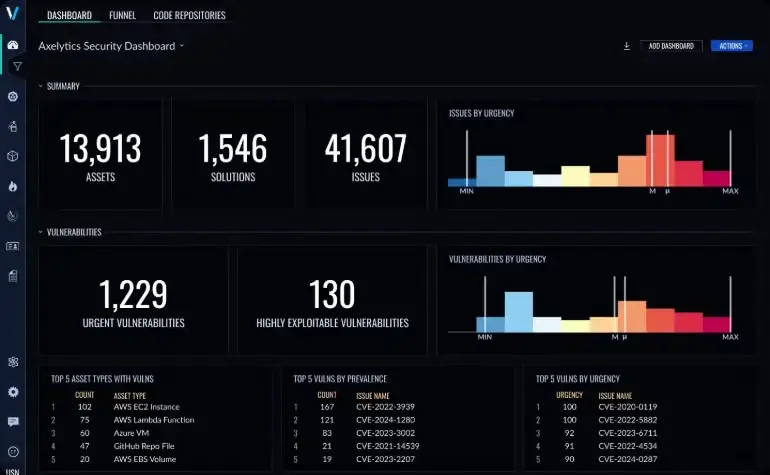
Source: veracode
Comprehensive AST coverage: Combines SAST, DAST, and SCA for broad vulnerability coverage across the software lifecycle.
Binary-based SAST: Scans compiled code without requiring source code access, appealing to regulated industries.
Compliance and governance focus: Built-in policy management and compliance dashboards for enterprises with regulatory requirements.
AI-powered remediation: Veracode Fix uses AI to generate code patches for identified security flaws.
High cost at every tier: SAST starts at $10,000 per year, DAST at $20,000, full enterprise deployments can exceed $100,000 annually (source: underdefence).
Slower feedback cycles: In-depth analysis can delay vulnerability detection, impacting agile workflows.
Limited modern stack support: DAST capabilities are limited for SPAs, GraphQL APIs, and complex authentication flows.
G2 rating & review:
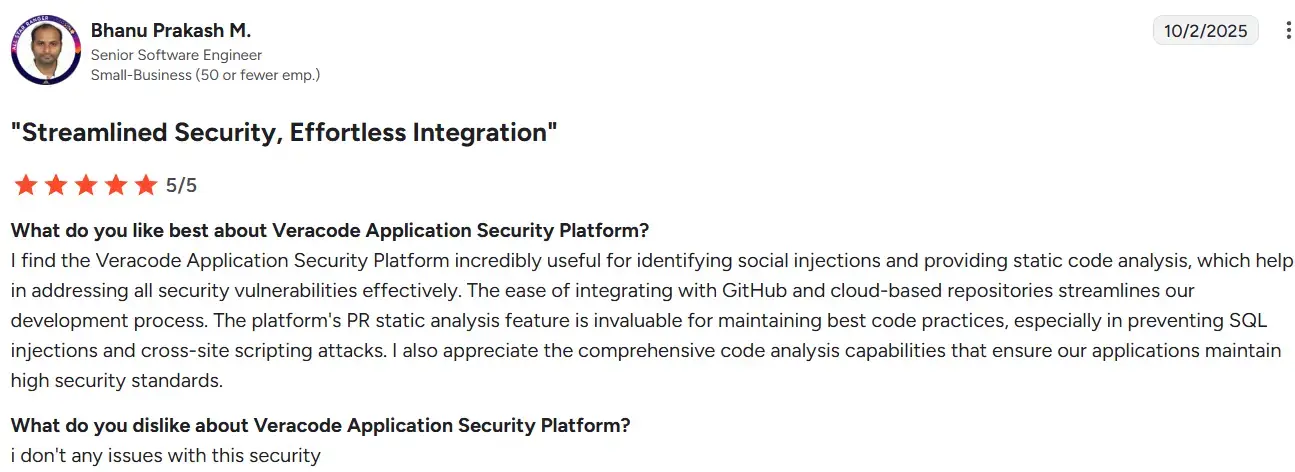
Generally ranks around 3.8 to 4.5 stars in the Application Security category.Users frequently praise its easy integration with IDEs and CI/CD build tools, along with strong vulnerability reporting.
Key features of Veracode
- Static application security testing (SAST)
Veracode’s SAST uses binary analysis to scan compiled code rather than source code. This makes it appealing to regulated industries like finance and government that are reluctant to share source code. It includes enterprise features like policy management, compliance dashboards, and CI/CD pipeline integration.
- Dynamic application security testing (DAST)
Veracode DAST tests live web applications and APIs for runtime vulnerabilities by simulating real-world attacks. It supports traditional web applications and offers compliance-ready reporting. Coverage for modern use cases like SPAs, GraphQL APIs, and complex authentication flows is limited.
- Software composition analysis (SCA)
Veracode SCA identifies vulnerabilities and license risks in open-source libraries and third-party dependencies. It generates SBOMs for regulatory needs and provides centralized visibility into all open-source components in use across the application portfolio.
- Veracode Fix
Veracode Fix uses AI to generate code patches for identified security flaws directly within the development workflow. This reduces the time developers spend on remediation and provides actionable guidance tied to specific findings.
- Pipeline scan
Veracode’s Pipeline Scan integrates directly into developer workflows through GitHub, GitLab, and Jenkins to provide immediate security feedback while coding. This supports a shift-left approach by surfacing issues earlier in the development cycle.
- Compliance-focused reporting
Veracode includes robust compliance dashboards and policy enforcement capabilities mapped to regulatory frameworks. For enterprises with strict governance requirements, this centralized visibility across teams and applications is a meaningful operational advantage.
Pros of Veracode
- Comprehensive AST tool coverage
Veracode provides SAST, DAST, and SCA under one platform, ensuring broad vulnerability coverage across the software lifecycle. Users value the ability to manage application risk from a single interface rather than stitching together multiple tools.
- Accurate vulnerability detection
Users consistently praise Veracode’s accuracy in identifying security vulnerabilities through its code analysis capabilities. The binary-based SAST approach reduces noise from source code artifacts and improves result reliability.
- Strong governance and compliance focus
The platform includes robust compliance features, policy management, and detailed analytics that make it well suited for enterprises operating under strict regulatory requirements such as PCI DSS, HIPAA, and SOC 2.
- Scalable for complex enterprise environments
Veracode’s architecture supports large-scale environments with multiple applications and teams. Organizations with extensive application portfolios find it capable of handling the volume and complexity that smaller tools cannot.
- Automated scanning with developer-centric guidance
Veracode supports automated scanning across the development lifecycle and provides actionable remediation guidance that helps developers understand and fix vulnerabilities without requiring deep security expertise.
Cons of Veracode
- Expensive
Veracode is consistently reported as one of the most expensive application security platforms on the market. Licensing is per application, and costs rise quickly as portfolios grow.
- Slower feedback cycles
Veracode’s in-depth analysis takes longer than modern developer-focused tools. This can delay vulnerability detection and create friction in agile workflows where fast feedback is expected. For teams running frequent releases, the scan turnaround time is a meaningful constraint.
- Steep learning curve
The platform’s advanced features require significant time and expertise to implement effectively. New users and teams without dedicated security functions find the setup and configuration process demanding, which slows time to value.
- Limited modern stack support in DAST
Veracode DAST relies heavily on signature-based scanning and has limited capability for modern use cases including SPAs, GraphQL APIs, and complex authentication flows. Teams building on modern architectures will encounter coverage gaps.
- Limited extensibility
Gaps in Veracode’s portfolio and limited integrations with third-party scanners require additional tools to achieve full vulnerability detection coverage.
Veracode pricing
Veracode does not publish pricing on its website. All pricing is quote-based and obtained directly through their sales team. The following data is sourced from Underdefense’s 2026 Veracode pricing guide and community reports.
Veracode Static Analysis (SAST): Starts at $10,000 per year for 100,000 lines of code. Full deployments for up to 100 applications start around $15,000 per year.
Veracode Software Composition Analysis (SCA): Starts at $12,000 per year depending on the number of repositories and scans required.
Veracode Dynamic Analysis (DAST): Starts at $20,000 per year for basic coverage, scaling to $25,000 or more for medium-sized application portfolios.
Full enterprise suite: Frequently exceeds $100,000 annually for organizations with extensive application security needs and compliance requirements. Large enterprise deployments have been reported at over $500,000 per year.
| Product | Starting price | Key features | Best for: |
|---|---|---|---|
| SAST | From $10,000/ year | Deep code scanning, CI/CD integration, automated reporting, security guidance | Developers and SMBs needing code-level vulnerability management |
| SCA | From $12,000/year | Open-source security, license management, centralized visibility of third-party components | Businesses with large open-source or third-party component usage |
| DAST | From $20,000/year | Real-time threat simulation, comprehensive reporting, CI/CD integration, runtime vulnerability testing | Enterprises needing real-time web application security testing |
| Full enterprise | Around $100,000/ year | Full SAST, DAST, SCA, compliance dashboards, policy enforcement, EASM | Large enterprises with extensive application security and compliance requirements |
Per-application licensing compounds costs significantly for organizations managing large portfolios. Factor in the cost of AI features like Veracode Fix, which are charged at a premium on top of base licensing.
Summing up: Veracode review
Veracode is a mature enterprise application security platform with genuine strengths in compliance governance, broad AST coverage, and centralized visibility across large application portfolios. Organizations with strict regulatory requirements and dedicated security teams will find it well suited to their needs.
Where it becomes a harder conversation is around cost, speed, and developer experience. Per-application licensing scales quickly, feedback cycles are slower than modern tools, and the setup investment is significant. These are not dealbreakers for every organization, but they are worth weighing carefully against what your team actually needs today.
Application security is not one-size-fits-all. Veracode is a strong fit for enterprises prioritizing governance and compliance at scale. Teams that need faster feedback loops, modern API coverage, and security that integrates naturally into development workflows may find that a more focused tool serves them better. Beagle Security is built for that layer, combining agentic AI-powered testing with native GraphQL support, CI/CD integration, and developer-friendly reporting that surfaces findings where developers already work.
Start your 14-day advanced free trial or explore the interactive demo to see if it is the right fit for you.
FAQs
What is the use of Veracode?
Veracode is used for application security testing across the software development lifecycle. It combines SAST, DAST, and SCA to identify vulnerabilities in source code, running applications, and open-source dependencies, helping teams remediate security issues quickly and efficiently.
Is Veracode used for SAST or DAST?
Veracode is an AST suite designed for enterprises. It offers SAST through binary-based static analysis, DAST for runtime testing of live applications, and SCA for open-source dependency scanning. Together these are bundled under the Veracode One platform for enterprises that need full lifecycle coverage.
What is Veracode Fix?
Veracode Fix is an AI-powered remediation feature that generates code patches for identified security vulnerabilities. It is designed to reduce the time developers spend on fixing issues by providing actionable, context-aware suggestions directly within the development workflow. It is charged as a premium add-on.


![Top ZAP alternatives and competitors [October 2026]](/blog/images/top-zap-alternatives-cover.webp "Top ZAP alternatives and competitors [October 2026]")




![Top 10 penetration testing companies [2026]](/blog/images/top-penetration-testing-companies-cover.webp "Top 10 penetration testing companies [2026]")




![Top vendor application security tools [2026]](/blog/images/top-vendor-application-security-testing-tools-2026-cover.webp "Top vendor application security tools [2026]")



![Top Snyk alternatives & competitors [2026]](/blog/images/top-snyk-alternatives-cover.webp "Top Snyk alternatives & competitors [2026]")