Burp Suite review: Is it worth the investment?

PortSwigger’s Burp Suite is one of the most widely used tools in web application security testing, especially among penetration testers, bug bounty hunters, and security researchers. For a lot of people working in AppSec, Burp is usually one of the first tools they learn and one they continue using for years.
At its core, Burp Suite is a web security testing toolkit built around intercepting, analyzing, and manipulating web traffic. Instead of functioning only as an automated scanner, the platform gives testers direct control over requests, responses, sessions, APIs, and application behavior during testing.
Burp Suite’s biggest identity is probably its flexibility. It’s less of a ‘push button and scan everything’ platform, and more of a toolkit designed for testers who want deeper visibility into how applications actually behave.
In this review, we’ll look at Burp Suite’s features, strengths, limitations, pricing, and how it compares to what modern security teams expect from application security testing platforms today.
TL; DR: Burp Suite review
| G2 rating | Gartner rating |
|---|---|
| 4.8/5 (based on 128 reviews) | 4.6/5 (based on 310 reviews) |
As of the latest data on May 2026
Users often highlight the user friendly interface and its powerful features for security testing as major wins for the platform.
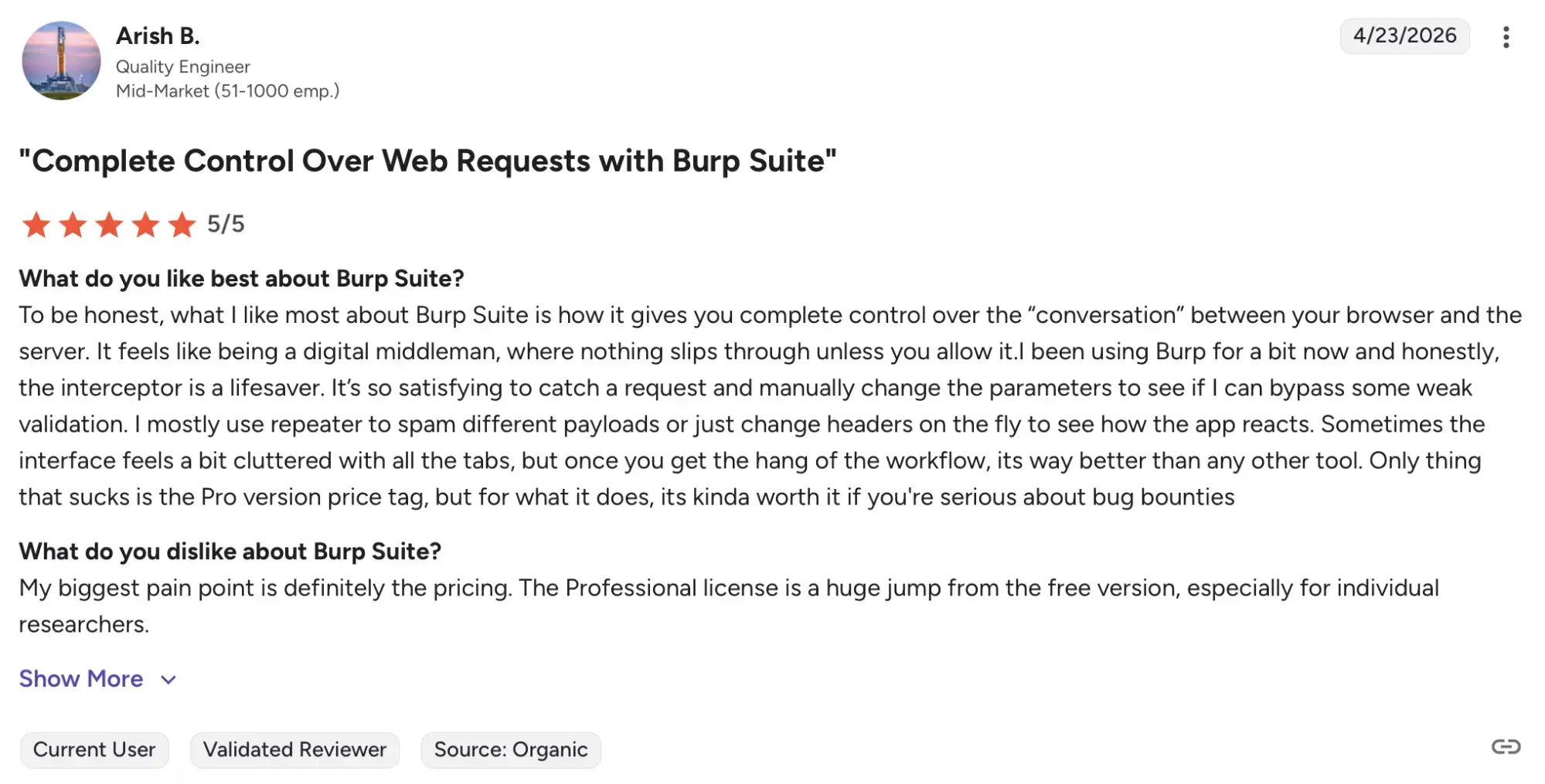
Source: G2
Key features of Burp Suite
PortSwigger has built Burp Suite around both manual penetration testing and automated DAST scanning, which is why the platform is widely used across different types of security teams.
Some of Burp Suite’s main features include:
Burp Scanner, which is one of the platform’s core DAST engines and is designed to identify common web vulnerabilities including OWASP Top 10 issues.
Browser-powered scanning using an embedded Chromium browser, allowing Burp Suite to handle JavaScript heavy applications and modern SPAs more effectively.
API security testing support for JSON, YAML, and OpenAPI definitions, along with automated endpoint discovery during testing.
Burp Proxy, which allows testers to intercept, inspect, and modify HTTP/HTTPS traffic in real time while interacting with applications.
Manual testing tools like Burp Repeater and Burp Intruder that help testers resend requests, modify payloads, fuzz inputs, and validate vulnerabilities manually.
Additional utilities like Sequencer, Decoder, and Comparer that support deeper manual analysis during testing.
Automated scanning and scheduling features available in enterprise editions, helping teams run recurring scans across applications.
CI/CD integrations through REST APIs and support for platforms like Jenkins and TeamCity, allowing Burp Suite to fit into DevSecOps workflows.
Compliance-ready reporting aligned with frameworks like PCI DSS and OWASP Top 10, along with remediation guidance from PortSwigger’s research team.
Enterprise focused features such as role-based access control (RBAC), SSO support, centralized dashboards, and multi-user management.
Pros of Burp Suite
Burp Suite gives testers a lot of control during security assessments. Instead of only running automated scans, the platform allows users to manually inspect, modify, replay, and fuzz requests in detail.
The combination of automated scanning and manual testing tools is one of Burp Suite’s biggest strengths. Many testers like the fact that they can switch between automation and hands-on testing depending on the situation.
Users generally find the interface easy to navigate once they get familiar with the workflow.
Burp Proxy and Repeater are still widely considered some of the most useful tools for manual web application testing because of the visibility they provide into HTTP and HTTPS traffic.
Burp Suite also has a large community around it, along with the BApp Store ecosystem, which gives testers access to additional extensions and plugins for different use cases.
Cons of Burp Suite
Burp Suite can feel expensive for smaller teams or individual testers, especially once you move beyond the Community edition and start looking at the Professional or Enterprise versions.
The platform has a fairly steep learning curve in the beginning. New users often struggle with the proxy setup, workflow, and understanding how the different modules work together during testing.
Performance can slow down during larger scans or when multiple extensions and plugins are loaded, particularly on lower-end systems.
For organizations looking for lightweight onboarding or quick setup, Burp Suite can sometimes feel more like a toolkit for experienced testers rather than an out of the box security platform.
Burp Suite pricing
Burp Suite Community Edition is free of charge.
Burp Suite Professional starts at $499 per user per year.
Burp Suite DAST offers a custom quote based pricing. Contact the vendor directly for more details.
Summing up
PortSwigger’s Burp Suite has earned its reputation over the years for a reason. When it comes to manual web application testing, request manipulation, traffic analysis, and hands-on penetration testing, it’s still one of the most widely used tools in the AppSec space.
Its biggest strength is flexibility. Testers get deep visibility into how applications behave, along with a large collection of tools for both automated and manual testing workflows. For experienced penetration testers and security researchers, that level of control is hard to ignore.
At the same time, modern application environments are changing quickly. APIs, authenticated user flows, GraphQL, SPAs, and continuous deployment pipelines have pushed security testing beyond purely manual workflows and periodic assessments.
That’s where Beagle Security approaches things differently. Instead of relying mainly on manual interaction, Beagle Security’s agentic AI-driven pentesting platform is designed to actively explore applications, adapt to responses, and simulate attacker behavior across web applications and APIs.
If that’s the direction your team is moving, schedule a demowith Beagle Security and see how it handles what manual testing alone can’t cover.
FAQs
What is Burp Suite used for?
PortSwigger’s Burp Suite is mainly used for web application security testing and penetration testing. It allows testers to intercept, inspect, modify, and analyze web traffic while identifying vulnerabilities in web applications and APIs.
Why is Burp Suite so popular among penetration testers?
Burp Suite gives testers deep visibility and control over HTTP/HTTPS traffic, requests, sessions, and application behavior. Its flexibility and large set of manual testing tools make it widely used in penetration testing and bug bounty workflows.
Is Burp Suite a DAST tool?
Yes, Burp Suite includes DAST capabilities but the platform is also known for its manual penetration testing and traffic analysis tools.


![Top ZAP alternatives and competitors [October 2026]](/blog/images/top-zap-alternatives-cover.webp "Top ZAP alternatives and competitors [October 2026]")




![Top 10 penetration testing companies [2026]](/blog/images/top-penetration-testing-companies-cover.webp "Top 10 penetration testing companies [2026]")


![Top vendor application security tools [2026]](/blog/images/top-vendor-application-security-testing-tools-2026-cover.webp "Top vendor application security tools [2026]")



![Top Snyk alternatives & competitors [2026]](/blog/images/top-snyk-alternatives-cover.webp "Top Snyk alternatives & competitors [2026]")