Detectify review: Is it the best web scanner out there?

If you’re trying to get a handle on your web application security, chances are Detectify has come up in your research. It’s one of those tools that keeps getting mentioned in AppSec circles and for good reason.
Detectify is a cloud-based platform that combines automated web application scanning with external attack surface monitoring. But what actually makes it stand out isn’t just the scanning, it’s the way it approaches vulnerability research. Instead of relying on a static library of known issues, Detectify pulls in continuous research from a community of ethical hackers and turns that into automated tests. So the platform is always catching up with what’s actually being exploited in the wild, not just what was documented six months ago.
It’s also built with modern applications in mind - think authenticated scanning, API support, cloud integrations, and continuous monitoring. Not the kind of tool that was designed a decade ago and patched to keep up with the times.
In this review, we’ll break down what Detectify actually offers, what it’s good at, where it has room to improve, and whether it fits what modern security teams are actually looking for today.
TL;DR: Detectify review
| G2 rating | Gartner rating |
|---|---|
| 4.5/5 (based on 51 reviews) | 4.4/5 (based on 11 reviews) |
As of the data on September 2026
Users consistently highlight ease of use and the crowdsourced vulnerability research model as what sets Detectify apart.
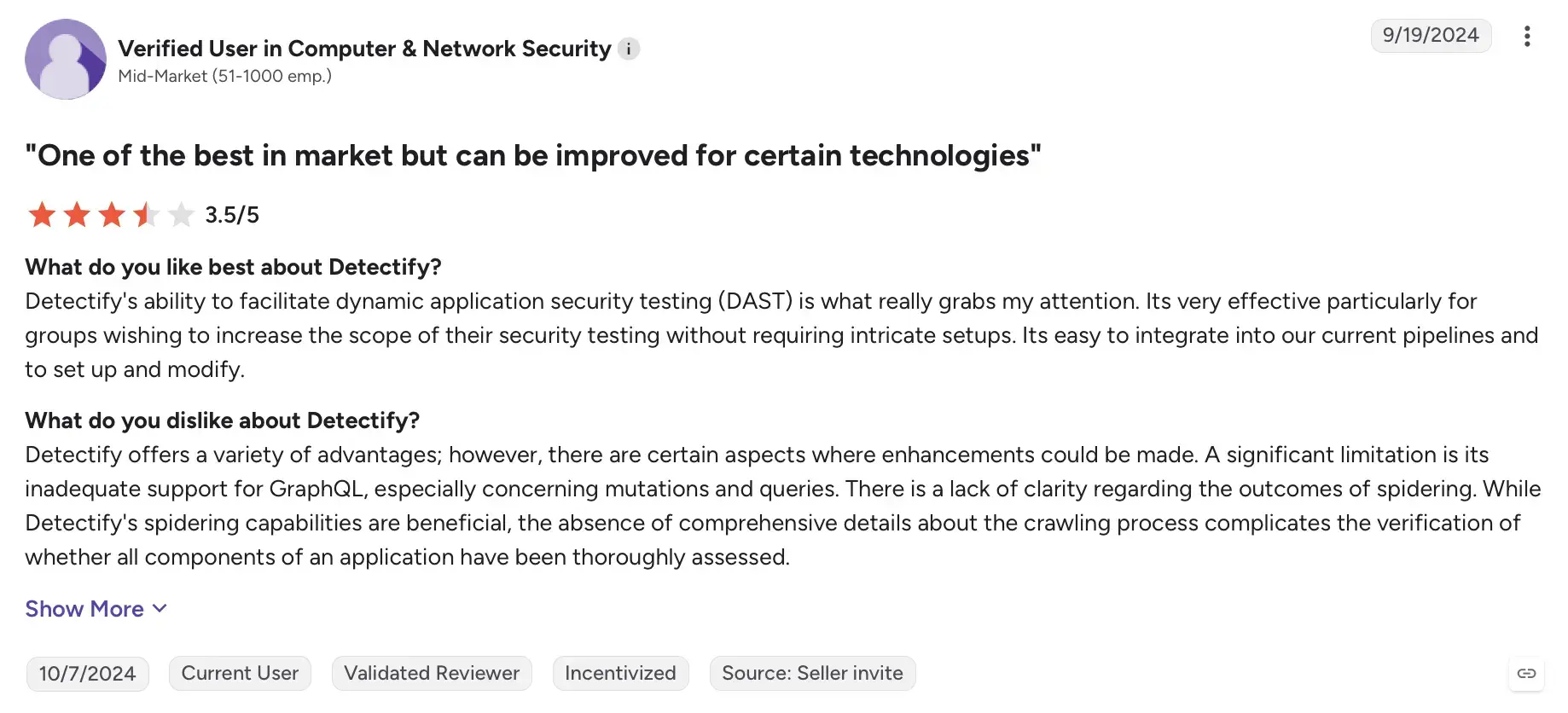
Source: G2
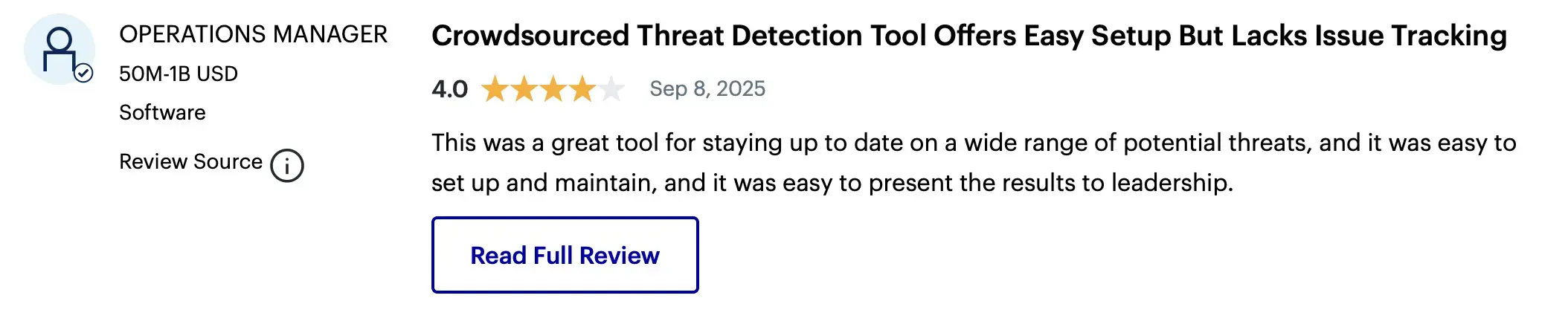
Source: Gartner
Key features of Detectify
Detectify is mainly positioned around crowdsourced DAST and external attack surface monitoring. A big part of the platform’s identity comes from its ethical hacker-driven vulnerability research model rather than relying only on traditional scanner signatures.
Some of Detectify’s main features include:
Web application scanning with payload-based testing designed to validate vulnerabilities by actively testing exploitability, including common issues like SQL injection, XSS, and other known web vulnerabilities.
External attack surface monitoring that continuously discovers exposed assets, subdomains, DNS records, and SSL/TLS issues across an organization’s environment.
Crowdsourced vulnerability research where new security tests are contributed and updated by a global community of ethical hackers, helping the platform detect both CVE-based and newer emerging vulnerabilities.
Compliance reporting support for standards such as SOC 2 and ISO 27001, making it easier for organizations to document security testing and audit-related requirements.
Integrations with tools and platforms like Slack, Jira, Splunk, AWS, Azure, and GCP to fit into existing security and DevSecOps workflows.
Support for authenticated scanning and session handling for applications, though mainly geared toward simpler authentication workflows.
Pros of Detectify
Detectify is relatively easy to integrate into existing workflows. Teams using tools like Jira, Slack, Splunk, AWS, or Azure can connect things without too much setup effort.
One of its stronger areas is external attack surface monitoring. The platform helps identify exposed assets, forgotten subdomains, SSL/TLS issues, and other internet facing risks that organizations sometimes overlook.
The platform itself is fairly straightforward to use. Compared to some larger enterprise security tools, Detectify feels less heavy and easier to manage day to day.
Detectify also updates its security tests continuously through contributions from ethical hackers, which helps the platform keep up with newer vulnerabilities and attack techniques. (Crowdsource)
Cons of Detectify
Some users feel the setup and scan configuration process has a learning curve, particularly when dealing with more advanced scan behavior or authenticated testing.
The platform still has limitations around modern APIs, GraphQL environments, and more complex authentication workflows compared to newer application security testing platforms.
Pricing can become expensive as the number of monitored assets grows, which may be a concern for scaling organizations.
Users have also reported situations where scan visibility and results were not always very clear, making it harder to fully understand scan coverage.
While Detectify performs well for external monitoring and web scanning, organizations looking for deeper business logic testing or more attacker like testing approaches may find the platform somewhat limited.
Detectify pricing
Detectify offers a subscription model with different tiers designed for small teams, expanding businesses, and big corporations. The plans adjust according to the quantity of applications and assets under observation, as well as the necessary features.
Starter: This is a free plan for up to 5 users in 1 team.
Standard: Starts from €2,500 annually for up to 10 users in 1 team. This plan is for growing teams needing advanced access controls and full API scanning.
Professional: Starts from €5,000 annually for unlimited users across 2 teams, this plan is designed for scaling operations requiring internal network visibility and automated workflows.
Enterprise: Starts from €15,000 annually for unlimited users across unlimited teams, this plan is aimed at large corporations for complete organizational protection and custom built requirements.
Summing up
Detectify works well for organizations that mainly care about external exposure monitoring and automated web application scanning without getting pulled into overly complicated security tooling. The platform is relatively straightforward, continuously updated, and easier to work with than some larger enterprise-focused solutions.
Its crowdsourced vulnerability research model is probably one of the more interesting parts of the platform. Having ethical hackers contribute new checks gives Detectify a different feel compared to scanners that mostly rely on fixed vulnerability databases and periodic updates.
Still, modern applications have changed quite a bit. Between APIs, authenticated areas, cloud-native deployments, and fast release cycles, security testing today often needs to go beyond traditional scanning and predefined checks.
That’s one area where Beagle Security takes a different direction. Instead of only scanning for known patterns, the platform is designed to actively interact with applications and adapt its testing based on how the application responds during the assessment.
For teams exploring newer approaches to application security testing, especially around APIs and modern web apps, Beagle Security is worth checking out. If that’s the direction your team is moving, schedule a demo with Beagle Security and see how it handles what your current tools don’t.
FAQs
What is Detectify used for?
Detectify is used for automated web application security testing and external attack surface monitoring. It helps organizations identify exposed assets, vulnerabilities, misconfigurations, and internet-facing security risks.
Is Detectify a DAST tool?
Yes, Detectify is primarily a cloud-based DAST platform focused on automated web application scanning and continuous external exposure monitoring.
Does Detectify support compliance reporting?
Yes, Detectify includes reporting features aligned with standards such as SOC 2 and ISO 27001 to help organizations with security documentation and audit preparation.




![Top 10 penetration testing companies [2026]](/blog/images/top-penetration-testing-companies-cover.webp "Top 10 penetration testing companies [2026]")





![Top vendor application security tools [2026]](/blog/images/top-vendor-application-security-testing-tools-2026-cover.webp "Top vendor application security tools [2026]")




![Top Snyk alternatives & competitors [2026]](/blog/images/top-snyk-alternatives-cover.webp "Top Snyk alternatives & competitors [2026]")
![BurpSuite vs Acunetix: Which is the best choice for you? [2026]](/blog/images/burpsuite-vs-acunetix-cover.webp "BurpSuite vs Acunetix: Which is the best choice for you? [2026]")