Tenable review: Is it the right tool for you?
Tenable is one of the bigger names in the vulnerability management and exposure management space. Over the years, the company has expanded beyond traditional infrastructure scanning and now offers products across web application security, cloud security, identity exposure, and broader cyber exposure management.
For our case, we’ll mainly focus on three of Tenable’s products:
Tenable WAS (Web Application Scanning)
Tenable Vulnerability Management
Tenable Cloud Security
Together, these products are aimed at helping organizations identify vulnerabilities across applications, cloud infrastructure, internet-facing assets, and internal systems from a centralized platform approach.
Tenable’s overall positioning leans heavily toward visibility and exposure management at scale. Instead of focusing only on isolated security testing, the platform is built around helping organizations continuously track, prioritize, and reduce security exposure across larger environments.
At the same time, modern applications and cloud environments are changing quickly, which raises questions around how well traditional vulnerability management approaches keep up with APIs, authenticated applications, dynamic cloud workloads, and continuously evolving attack surfaces.
In this review, we’ll look at where Tenable performs well, where it struggles, and how its products compare to what modern security teams expect from security testing platforms today.
TL;DR: Tenable review
| Product | Rating |
|---|---|
| Tenable WAS | 4.5/5 (based on 21 reviews on Gartner) |
| Tenable Vulnerability Management | 4.5/5 (based on 122 reviews on G2) |
| Tenable Cloud Security | 4.6/5 (based on 37 reviews on G2) |
As of the latest data on May 2026
Users consistently highlight ease of integration and visibility across large environments as Tenable’s strongest points
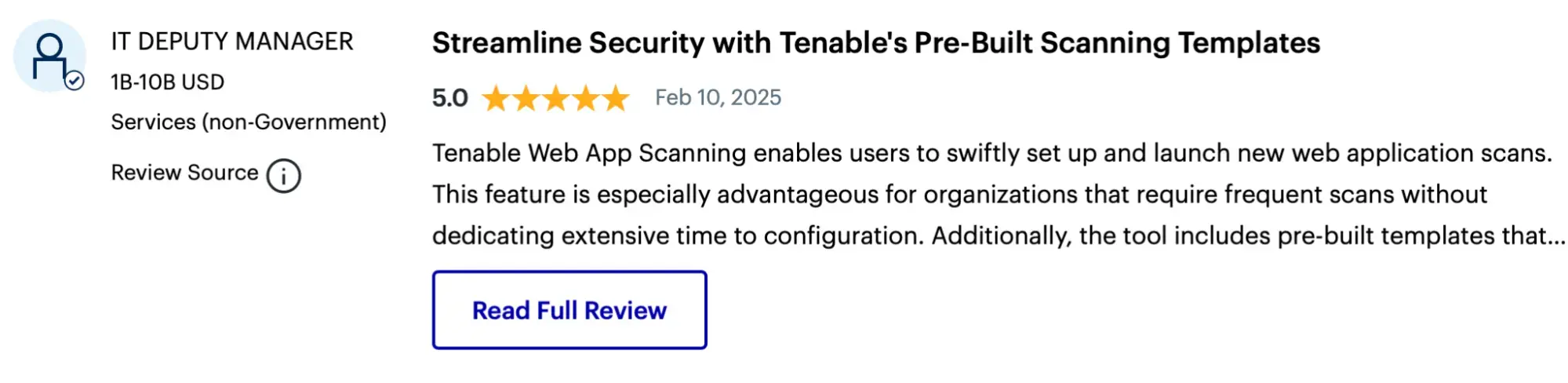
Tenable WAS review, source: Gartner
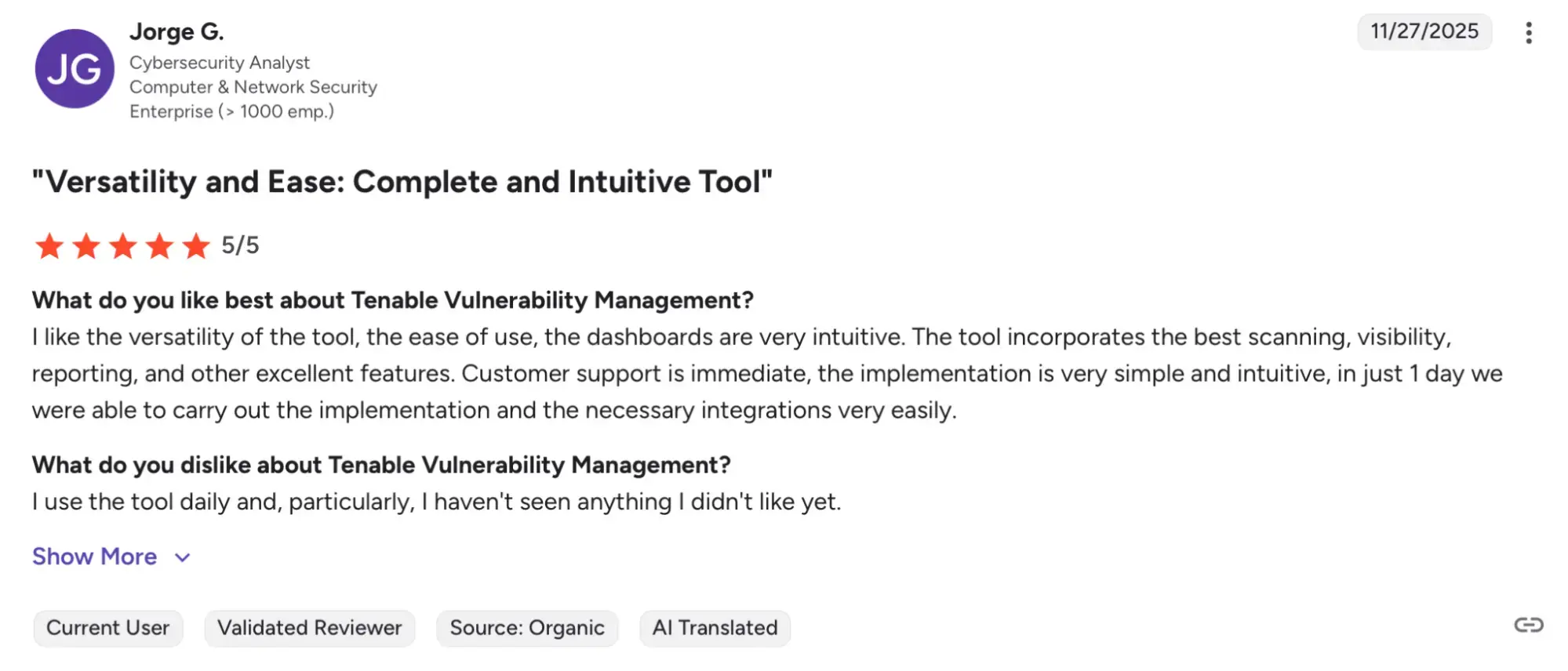
Tenable Vulnerability Management review, source: G2
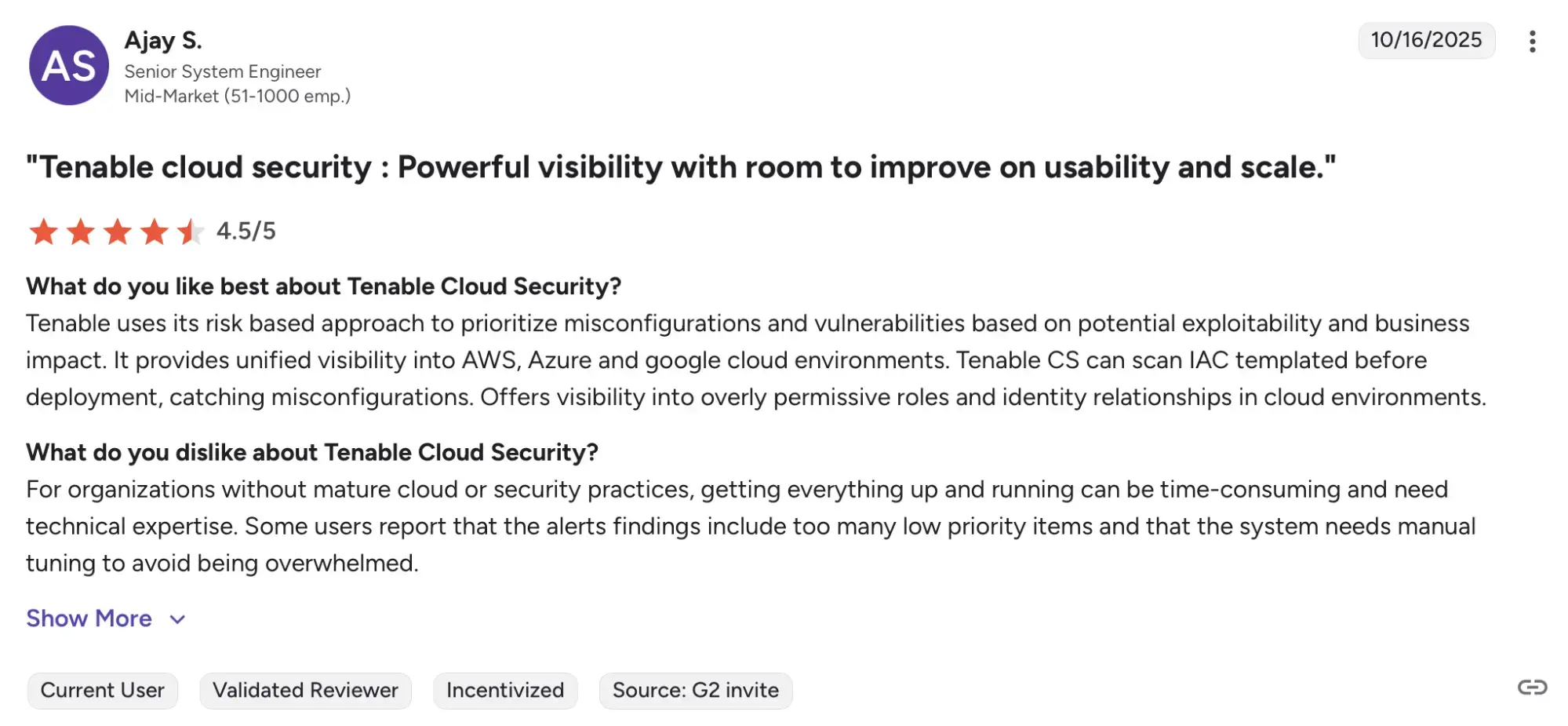
Tenable Cloud Security review, source: G2
Key features of Tenable WAS
Tenable’s Tenable WAS (Web Application Scanning) is Tenable’s DAST focused product built around automated web application and API security testing.
Some of Tenable WAS’s main features include:
Automated DAST scanning for identifying common web application vulnerabilities.
API security testing support that allows teams to scan and assess API driven applications.
DevSecOps and CI/CD integrations that help security testing fit into development and deployment workflows instead of running as a separate process.
Vulnerability intelligence and prioritization features that combine scan findings with Tenable’s broader exposure management and threat intelligence ecosystem.
Advanced reporting features designed for security teams.
Key features of Tenable Vulnerability Management
Tenable’s Tenable Vulnerability Management platform is mainly focused on continuous vulnerability detection and exposure visibility across cloud, hybrid, and on-premise environments.
Some of its main features include:
Cloud-based vulnerability detection that continuously scans systems, endpoints, and assets for known vulnerabilities and security weaknesses.
Asset discovery and inventory capabilities that help organizations maintain visibility into devices, applications, cloud workloads, and internet facing assets across larger environments.
Integrations with DevOps and operational tools, allowing vulnerability data and remediation workflows to fit into broader security and infrastructure processes.
Reporting aligned with compliance frameworks and regulatory requirements, helping teams track vulnerabilities, remediation progress, and audit-related security visibility more efficiently.
Key features of Tenable Cloud Security
Tenable’s cloud security offering is designed to help organizations monitor and manage risks across multi-cloud environments and cloud-native infrastructure.
Some of its main features include:
Visibility across AWS, Azure, and Google Cloud environments, helping organizations track assets, workloads, and cloud exposures from a centralized platform.
Cloud misconfiguration detection for identifying risky settings, exposed services, weak permissions, and other security gaps across cloud infrastructure.
Compliance monitoring aligned with common cloud security and regulatory frameworks, helping teams maintain visibility into cloud security posture and audit readiness.
API-level integrations with CI/CD and DevOps pipelines, allowing cloud security monitoring and remediation workflows to fit into modern cloud deployment processes.
Pros of Tenable
Tenable does a good job when it comes to visibility. If an organization has a large mix of cloud systems, endpoints, servers, and applications spread across different environments, the platform helps bring all of that into one place.
The platform feels more mature on the infrastructure and exposure management side than a lot of smaller security tools. Asset discovery, vulnerability tracking, and cloud visibility are areas where Tenable is generally pretty strong.
For larger enterprises, having products like Tenable Vulnerability Management, Tenable WAS, and Tenable Cloud Security connected together can make operations easier compared to managing several completely separate tools.
Tenable also integrates well into existing enterprise workflows. Things like CI/CD integrations, compliance reporting, and cloud integrations are already built into the ecosystem, which helps security teams fit it into day-to-day operations more easily.
Another thing many teams like is the amount of reporting and visibility available. The platform gives security teams, operations teams, and management different levels of visibility into vulnerabilities and overall exposure.
Cons of Tenable
One thing that becomes obvious fairly quickly is that Tenable still feels heavily centered around traditional vulnerability management. It’s very good at identifying and tracking exposures, but not always as strong when it comes to deeper attacker-like application testing.
The platform can also feel heavy, especially for smaller teams. There’s a lot happening across the ecosystem, and managing scans, assets, workflows, and findings can become operationally tiring without dedicated security resources.
Pricing can become difficult as more Tenable products get added into the environment. Using vulnerability management, cloud security, and web application scanning together can increase costs pretty quickly.
Tenable WAS, specifically, still feels closer to a traditional DAST scanner than some of the newer application security platforms entering the market today.
For teams mainly looking for lightweight application security testing or faster onboarding, Tenable’s enterprise-first approach may feel more complicated than necessary.
Pricing
Tenable WAS: Pricing starts at $7,434 per year for 5 FQDNs.
Tenable Vulnerability Management: Pricing starts at $6,112.4 per year for 100 assets.
Tenable Cloud Security: Custom pricing, so contact the vendor directly for more details.
Summing up
Tenable has been around long enough to earn its place in a lot of enterprise security stacks, and for good reason. If you’re trying to maintain visibility across a large mix of cloud assets, endpoints, and infrastructure, it handles that side of things well. The vulnerability management and exposure tracking capabilities are mature and the ecosystem holds together better than most platforms at this scale.
Where it gets more complicated is when application security becomes the priority. Tenable WAS does the job for standard DAST scanning, but it still feels like a traditional scanner at its core. For environments with complex APIs, authenticated flows, or business logic that needs to be actively tested rather than just crawled, that gap starts to matter.
That’s where the conversation around newer testing approaches comes in. Beagle Security’s agentic AI platform is built to actually interact with applications - following real user flows, adapting to responses, and testing the way an attacker would rather than the way a scheduled scan would.
If your team is at the point where traditional scanning isn’t covering enough ground, it’s worth seeing what a different approach looks like in practice. Schedule a demo with Beagle Security and see it for yourself.
FAQs
What are the main Tenable products?
Some of Tenable’s major products include Tenable Vulnerability Management, Tenable WAS (Web Application Scanning), and Tenable Cloud Security, along with other exposure management and identity-focused solutions.
Is Tenable good for enterprise environments?
Yes, Tenable is heavily enterprise focused and works well in large environments where organizations need centralized visibility into infrastructure, vulnerabilities, cloud workloads, and security exposure.
Is Tenable a vulnerability scanner or a security platform?
Tenable is more than just a vulnerability scanner. It positions itself as a broader exposure management platform that combines vulnerability management, cloud security, asset visibility, and risk prioritization.


![Top ZAP alternatives and competitors [October 2026]](/blog/images/top-zap-alternatives-cover.webp "Top ZAP alternatives and competitors [October 2026]")




![Top 10 penetration testing companies [2026]](/blog/images/top-penetration-testing-companies-cover.webp "Top 10 penetration testing companies [2026]")


![Top vendor application security tools [2026]](/blog/images/top-vendor-application-security-testing-tools-2026-cover.webp "Top vendor application security tools [2026]")



![Top Snyk alternatives & competitors [2026]](/blog/images/top-snyk-alternatives-cover.webp "Top Snyk alternatives & competitors [2026]")