Checkmarx review: Is it the right Appsec platform for your team?
Checkmarx is an application security company, and Checkmarx One is the platform it sells: a cloud native suite that brings SAST, DAST, SCA, secrets detection, IaC scanning, container security, and API security under one roof, correlated through what Checkmarx calls a fusion or ASPM layer. Individual engines like Checkmarx SAST or Checkmarx SCA can be licensed as part of that platform, but which capabilities you actually get depends on which tier and add ons you buy, not on the Checkmarx name alone.
This review evaluates Checkmarx One as it stands in September 2026, after a year in which Checkmarx has pushed hard into AI assisted and agentic capabilities: an MCP server that puts the platform inside tools like Claude Code and Cursor, autonomous remediation agents, and a new module for inventorying AI components in your own applications. Whether any of that changes the calculus for your team depends heavily on organization size, compliance requirements, and how much internal AppSec engineering time you have to invest.
This guide walks through what Checkmarx actually does, what changed recently, where it’s strong, where it asks more of a team than a lighter tool would, and how its pricing model works.
TL;DR: Checkmarx review
Checkmarx One is a mature, enterprise oriented application security platform. Its strength is breadth: SAST, DAST, SCA, secrets detection, IaC, container, and API security scanning, correlated into one risk view rather than six separate dashboards. It’s built for organizations that need governance and compliance reporting across a large, multi language codebase, and that have the internal capacity to run it.
Where it asks more of a team is setup and cost predictability. Advanced configuration takes real AppSec engineering time, and because pricing is quote based and modular, the total cost of a deployment isn’t something you can estimate from a public price list.
| G2 rating | 4.2 out of 5, based on 49 reviews |
| Best suited for | Large enterprises and regulated industries with complex, multi language codebases and a dedicated AppSec team |
| Coverage | SAST, DAST, SCA, secrets detection, IaC scanning, container security, API security, AI supply chain security |
| Pricing model | Quote based, structured around named platform tiers (Start with SAST NG, Essential, Professional, Enterprise) plus per module add ons |
| Key strengths | Correlated findings across multiple scan types in one platform, reachability based prioritization for SCA and code findings, AI assisted remediation agents, strong compliance and governance reporting |
| Key trade offs | Cost isn't predictable without a sales conversation, initial setup and tuning take real expertise, full first scans on large codebases take real time even with incremental scanning on subsequent runs |
Source: G2
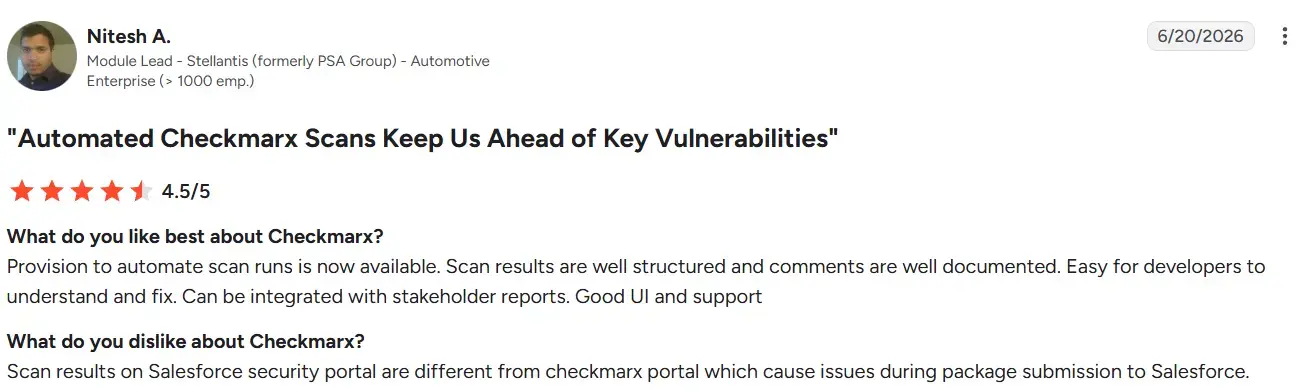
Reviewers on G2 consistently point to CI/CD integration and the depth of reporting as strengths. False positives come up often enough in reviews to be a real consideration, not just an outlier complaint, and several reviewers note that getting full value out of the platform takes dedicated AppSec expertise rather than a quick self-serve setup.
Key features of Checkmarx
Checkmarx SAST
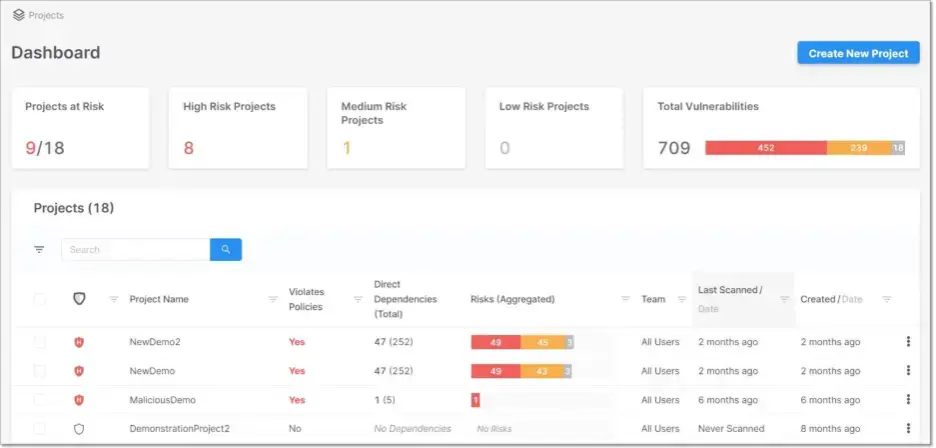
Checkmarx SAST scans source code before it’s built or deployed, tracing how untrusted input flows through an application to flag issues like SQL injection or XSSbefore they reach a running system. It covers a broad range of mainstream languages and frameworks, Java, C#, Python, JavaScript and TypeScript, Go, and others, though Checkmarx doesn’t publish a single headline count of supported languages, so treat any specific number you see elsewhere with some skepticism.
What actually affects a team’s day to day experience:
Incremental scanning analyzes only changed code on subsequent scans, which matters more for CI/CD scan times than for the slower first full scan of a large codebase.
AI assisted query customization helps security teams write and adjust custom detection rules without deep familiarity with Checkmarx’s query language, though writing genuinely custom rules for an unusual framework still takes some expertise.
Best Fix Location points developers at the single place in the data flow where a fix will resolve the most related findings, which cuts down on chasing the same root cause across multiple flagged lines.
IDE and CI/CD integration surfaces findings where developers already work, but getting authentication, scan scope, and policy tuned correctly for a specific pipeline is still a configuration task, not a toggle.
Checkmarx DAST
Checkmarx DAST is built on the ZAP engine (the same open source project Checkmarx now funds and employs the core maintainers of), wrapped with enterprise features aimed at getting a scan running against a real application without a lot of manual setup: guided onboarding, built in tunneling for internal applications behind a firewall, and ready to use scan templates.
Authentication is the part that determines whether a DAST scan actually reaches anything worth testing. Checkmarx DAST supports browser recorded logins, TOTP and other 2FA methods, and a Business Flow Recorder for capturing multi step, sequenced workflows, which matters for testing things like a checkout process or an admin console that requires more than a single login form. It scans REST, SOAP, and gRPC APIs, and findings correlate with SAST results in the platform so a vulnerability confirmed at both the code and runtime level gets flagged with more confidence than either finding alone.
None of this removes the need for scope planning. Pointing DAST at a large, complex application without narrowing scope and tuning the scan policy will still produce a long scan and a noisy result set, the same trade off that applies to any DAST tool.
Checkmarx SCA
Checkmarx SCA looks at your open source dependencies, not just for known CVEs but for licensing risk and malicious packages slipped into the ecosystem. Checkmarx states it analyzes roughly one million open source packages monthly and maintains a proprietary database of more than 420,000 identified malicious packages, figures that come from Checkmarx’s own published materials rather than independent verification.
The capability that matters most in practice is reachability analysis, what Checkmarx calls exploitable path analysis: instead of flagging every vulnerable dependency in your dependency tree, it checks whether your application’s code actually calls the vulnerable function. That’s the difference between a backlog of a few thousand SCA findings and one you can realistically work through, since a lot of dependency vulnerabilities exist in code paths an application never executes. SBOM generation is supported in CycloneDX and SPDX formats, which covers most current regulatory and customer requirements for supply chain documentation.
Checkmarx One
Checkmarx One is the platform these engines sit inside, and its value isn’t really about adding another scan type. It’s about what happens once SAST, DAST, SCA, and the rest are all reporting into the same place.
Findings from different engines get correlated rather than triaged separately, so a vulnerability that shows up in both a SAST scan and a DAST scan against the same endpoint gets treated with more confidence than either finding alone would carry. Policy and governance controls apply consistently across every project and application in the portfolio rather than per tool. Compliance reporting maps findings to frameworks organizations are already being audited against, which matters more to a CISO than to an individual developer.
What a unified platform does not automatically deliver is less work. Consolidating six types of scanning into one governance layer is a genuine advantage for a large AppSec team managing many applications. It doesn’t by itself reduce the number of findings a team has to act on, and coordinating policy across a large application portfolio is its own ongoing task.
Checkmarx in 2026: What’s changed?
Checkmarx has spent 2026 pushing Checkmarx One toward something closer to an AI native security operations layer than a set of scanners. The Checkmarx MCP Server, released as an initial phase this year, connects Checkmarx One directly to MCP compatible AI tools like Claude Code, Cursor, and Windsurf, so a developer or AppSec engineer can query findings, trigger scans, and pull remediation guidance through natural language instead of logging into a dashboard.
The bigger shift is in the Assist agent family. Developer Assist moved from suggesting fixes in the IDE to running an autonomous find fix verify loop before code is even committed, and Triage Assist and Remediation Assist now handle prioritization and merge ready pull requests for what’s already in the backlog, using a reachability based scoring approach Checkmarx calls attackability. Developers still review and merge each fix; AppSec retains policy control.
Checkmarx also launched AI Inventory, a module that catalogs the AI models, agents, and MCP servers running inside your own applications and produces an audit ready AI-BOM, aimed at the shadow AI governance gap many security teams currently have no visibility into. Together, these developments say less about any single new feature and more about where Checkmarx is positioning the platform: as a unified, AI assisted infrastructure for AppSec teams, not a bundle of independent scanners.
Pros of Checkmarx
- Findings correlated across scan types, not siloed by tool
A vulnerability flagged by both SAST and DAST against the same code path carries more confidence than either finding alone, and Checkmarx One’s fusion layer surfaces that correlation automatically rather than leaving a team to cross reference dashboards manually.
- Reachability based prioritization for SCA and code findings
Exploitable path analysis for SCA, and the newer attackability scoring for Triage Assist, both aim at the same real problem: most vulnerability backlogs are dominated by findings that aren’t actually reachable in a given application. Cutting that noise is a genuine, specific improvement over flagging every match against a CVE database.
- Autonomous remediation that keeps a human in the loop
Developer Assist’s pre commit fix loop and Remediation Assist’s merge ready pull requests reduce manual remediation effort without removing developer review or AppSec policy control, which is a meaningful design choice compared with either fully manual triage or a fully automated merge.
- Compliance and governance reporting built for audits, not just dashboards
Policy enforcement and reporting map to the frameworks large, regulated organizations are already being audited against, which is specifically valuable to a CISO or compliance team managing a large application portfolio, less so to a five person startup.
- Codebashing for developer security training
Checkmarx offers Codebashing, hands on secure coding training, as a standalone product or an add on, which some organizations use to reduce the volume of recurring vulnerability classes at the source rather than catching the same mistake in every scan.
Cons of Checkmarx
- Cost isn’t predictable without a sales conversation
Checkmarx doesn’t publish list pricing, and the tier plus add-on structure means the difference between a base license and a fully featured deployment (IaC, containers, secrets, AI protection) can be substantial. Budgeting for Checkmarx realistically means going through a quote process rather than estimating from a price sheet.
- Setup and tuning take dedicated AppSec expertise
Getting scan policies, authentication flows, and correlation rules configured well enough to avoid a noisy first few months of results is a real project, not a same day setup. Organizations without existing AppSec engineering capacity will feel this more than ones that already have a mature program.
- First scans on large codebases still take time
Incremental scanning helps once a baseline exists, but the initial full scan of a large, complex codebase, and any scan that follows a significant refactor, still takes meaningfully longer than a lightweight scanner. Teams needing fast feedback on every commit should factor this into their CI/CD design.
- A meaningful share of reviewers report false positives
This shows up often enough in G2 reviews to be worth planning for, not dismissing as a one off. How much triage overhead this actually adds depends heavily on how well scan policies and correlation rules are tuned for a specific codebase.
- Module based pricing can mean paying for more platform than you use
Because Checkmarx One’s value comes from breadth, a team that only needs one or two of its scan types may end up paying platform overhead for capabilities it doesn’t use, compared with a tool built around a single testing layer.
Checkmarx pricing
Checkmarx does not publish list pricing on its website. Quotes are generated through Checkmarx’s sales team or its self-serve packaging tool, where you select the scan modules relevant to your application portfolio and get a custom quote.
Checkmarx One is sold through named tiers, each with its own available add ons:
Start with SAST NG , with API Security, IaC (KICS), and AI add ons available
Essential , with Container, Malicious Package, IaC, and AI Protection add ons available
Professional , with IaC, Enterprise Secrets, and AI Protection add ons available
Enterprise , Checkmarx’s full platform tier
Codebashing, the developer training product, is available standalone or as an add on to any of the above tiers. A Premium Service Package, covering enhanced support and services, is available at 20% of the SaaS subscription fee.
Checkmarx also sells through AWS Marketplace, which lists these same tiers for procurement purposes. Specific per license dollar figures vary enough across third party sources and marketplace listings that publishing a single number here would create false precision. Independent pricing analyses of 2026 Checkmarx deals commonly describe total costs starting in the tens of thousands of dollars annually for smaller deployments and scaling into six figures for mid market and enterprise coverage across multiple modules, but these are third party estimates, not confirmed list prices, and actual contracts are negotiated individually.
Summing up: Checkmarx review
Checkmarx One earns its position among the more capable enterprise AppSec platforms available. The breadth across SAST, DAST, SCA, secrets, IaC, and API security, correlated into one risk view rather than six separate tool dashboards, is a genuine advantage for an organization managing a large, complex application portfolio under real compliance pressure. The 2026 additions, the MCP server, the autonomous Assist agents, AI Inventory, show a platform investing seriously in where AI assisted development is heading rather than treating it as a bolt on.
The honest trade off is that all of this asks something of the team running it. Pricing requires a sales conversation to understand, initial setup takes real AppSec engineering time, and the platform’s depth is wasted on a team that only needs one layer of testing.
For a large enterprise with a dedicated AppSec function and multi language codebase, that investment tends to pay off. For a smaller team, or one that primarily needs fast, accurate testing of a specific layer like APIs or web applications without the platform overhead, a more focused tool may fit better day to day. Beagle Security, for instance, is built around agentic AI driven web and API testing with native GraphQL support and CI/CD integration that’s configured out of the box, aimed at teams that want exploit focused testing without standing up a full enterprise AppSec platform. Start your 14 day free trial or explore the interactive demo to see whether that fits your team better than a platform like Checkmarx.
FAQs
What is Checkmarx used for?
Checkmarx is used for application security testing across the software development lifecycle: finding vulnerabilities in source code (SAST), in running applications (DAST), and in open source dependencies (SCA), along with secrets detection, infrastructure as code scanning, and API security, unified under the Checkmarx One platform.
What is Checkmarx One?
Checkmarx One is the company’s unified application security platform. It’s the product that brings SAST, DAST, SCA, and the other individual scanning engines together with shared governance, policy, and correlated reporting, rather than a separate name for any single scan type.
Is Checkmarx SAST or DAST?
Both, among other things. Checkmarx SAST and Checkmarx DAST are separate engines within the Checkmarx One platform, covering static source code analysis and dynamic runtime testing respectively. The platform also includes SCA, IaC, container, secrets, and API security scanning.
Does Checkmarx provide SCA?
Yes. Checkmarx SCA identifies vulnerable, outdated, and malicious open source dependencies, checks license compliance, and generates SBOMs in CycloneDX and SPDX formats, with reachability analysis to prioritize which findings are actually exploitable in your application.