![Acunetix vs Rapid7: Complete DAST comparison [2026]](/blog/images/acunetix-vs-rapid7.webp "Acunetix vs Rapid7: Complete DAST comparison [2026]")
Your application security strategy depends on choosing a DAST solution that fits how your team builds and ships software. Acunetix and Rapid7 InsightAppSec represent two distinctly different philosophies.
Acunetix doubles down on web application scanning depth, offering granular control over crawling behavior and vulnerability detection that appeals to security teams who want fine-tuned testing. Rapid7 takes the platform approach, embedding application security within a broader ecosystem that spans vulnerability management, cloud-native application protection, SIEM, and more.
The choice between them often comes down to whether you need a specialist tool that excels at one thing, or a generalist platform that connects security testing to your wider operational picture.
This comparison breaks down the practical trade-offs between Acunetix and Rapid7, and covers how Beagle Security’s agentic AI-first architecture addresses the workflow friction that even the best traditional DAST tools cannot quite solve.
Acunetix and Rapid7 at a glance
| Features | Acunetix | Rapid7 (InsightAppSec) |
|---|---|---|
| Scanning technology | DAST with some IAST features | DAST + IAST (via Insight agents) |
| AI features | Limited | Limited |
| Ease of use | Moderate learning curve | Moderate learning curve |
| Free trial | Not available | 30-day free trial |
| Pricing | Starts at ~ $7,000/year | Custom quote (typically $20k+) |
| G2 rating | 4.1/5 | 4.3/5 |
The alternative to Acunetix and Rapid7: Beagle Security
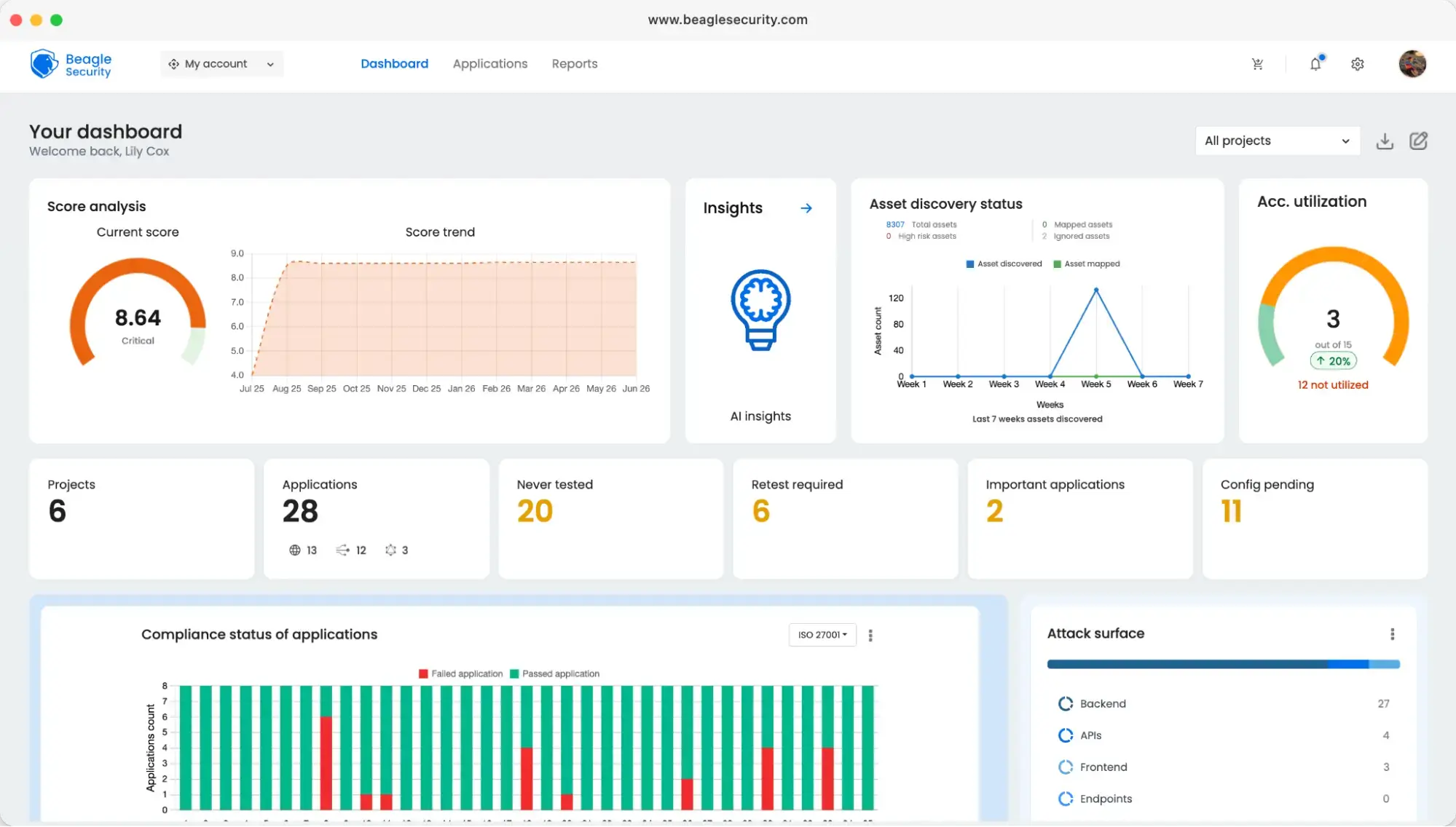
Acunetix and Rapid7 have established themselves as reliable tools in the DAST space, but both carry the architectural DNA of an earlier era in application security. Their scanning engines were designed when applications were simpler, development cycles were longer, and security teams had weeks to analyze and remediate findings.
Today’s development reality looks different. Teams ship multiple releases per day, applications span complex microservice architectures, and APIs outnumber traditional web interfaces by significant margins. The traditional DAST approach often creates more friction than value in that environment.
Beagle Security is built natively for cloud-first applications and API-heavy architectures. Its agentic AI engine automatically adapts testing techniques based on the specific technology stack and attack surface it encounters, rather than requiring security teams to configure complex scan policies.
The practical difference shows up in three areas: penetration testing depth that goes beyond surface-level vulnerability detection, intelligent vulnerability prioritization that reduces noise for development teams, and integration patterns that work with modern development toolchains rather than against them.
Why teams choose Beagle Security over Acunetix and Rapid7
No configuration overhead: Start testing immediately without weeks of setup or deep security expertise requirements.
Real penetration testing depth: Attack-path simulation covers business logicflaws and authentication bypasses that traditional DAST tools miss.
Contextual reporting: Developers get specific remediation steps. Leadership gets business impact summaries. Neither gets a generic vulnerability list.
No target lock-in: Test any number of web apps or APIs within your allotted test credits, without per-domain restrictions that inflate cost.
Agentic AI built in: Automatically adapts to your application stack, handles complex authentication flows, and filters false positive noise without manual tuning.
Transparent pricing: Comprehensive penetration testing starting at $119/month, accessible to teams of any size.
Acunetix vs Rapid7 vs Beagle Security: Feature comparison
| Features | Rapid7 | Acunetix | Beagle Security |
|---|---|---|---|
| Configuration complexity | High | Medium-high | Low |
| AI-based login authentication | No | No | Yes |
| Real attack simulation | No | No | Yes |
| Advanced API security testing | No | No | Yes |
| AI-based false positive filtering | No | No | Yes |
| Reporting | Extensive | Extensive | Contextual & developer-friendly |
| Target limitations | Application-based pricing | Target-based pricing | Test-based pricing |
Acunetix features
Dynamic Application Security Testing (DAST)
Authenticated scanning with support for cookies and custom headers
Compliance-focused reporting (PCI DSS, HIPAA, OWASP Top 10, etc.)
AcuSensor integration for enhanced IAST-style insights
CI/CD pipeline integration
Acunetix has carved out its niche as the approachable gateway into professional DAST scanning.
Built for mid-market teams who need enterprise-quality vulnerability detection without the complexity overhead, it delivers reliable results for traditional web application architectures.
The platform’s strength lies in its proof-based validation approach that cuts through false positive noise and comprehensive coverage of established vulnerability classes. For security teams running compliance-driven programs, Acunetix handles the fundamentals exceptionally well.
But dig into the day-to-day operational reality, and some interesting limitations emerge. Multi-domain applications require separate target configurations for each subdomain, turning what should be a single scan into a configuration management exercise. Power users often find themselves editing XML configuration files directly when the interface doesn’t expose the granular controls they need.
The platform also operates on traditional rule-based scanning logic rather than AI-powered adaptive testing. This means authentication flows, business logic testing, and attack pattern selection still lack depth and configuration simplicity.
For teams building API-heavy applications or managing rapid deployment cycles, these workflow constraints can overshadow Acunetix’s solid technical foundation.
Rapid7 features
InsightAppSec with DAST scanning
Scheduled scanning and scan blackouts
Risk scoring and vulnerability tracking
Visual dashboards and customizable reporting
CI/CD integrations
Compliance focused reports
Rapid7 has built InsightAppSec as part of its broader security ecosystem, emphasizing integration across vulnerability management, incident response, and application security.
The platform’s attack replay feature stands out, allowing developers to validate vulnerabilities and test patches directly from vulnerability reports without requiring additional security team involvement.
The connection to Rapid7’s Metasploit framework provides access to real-world attack simulation capabilities, though this integration requires security expertise to leverage effectively.
However, the platform reveals some operational limitations in practice.
Users report that the number of web applications they can scan faces licensing restrictions, and the solution needs improvement in detecting complex attack patterns.
Authentication and session management support has gaps for custom schemes, requiring manual code development. The platform operates on traditional signature-based detection rather than AI-powered adaptive testing, meaning teams still need to manually configure scan policies for optimal coverage.
For organizations already invested in Rapid7’s security platform, InsightAppSec provides solid integration value, but teams seeking standalone DAST solutions may find the workflow friction outweighs the ecosystem benefits.
Beagle Security features
Agentic AI-driven penetration testing engine with adaptive attack logic
Comprehensive REST API and GraphQL security testing
Contextual, compliance-ready reports
CI/CD integration for shift-left security
Easy onboarding and intuitive interface
Advanced business logic testing and complex authentication handling
Beagle Security takes a fundamentally different approach to application security testing.
Rather than relying on traditional rule-based scanning, its AI engine learns application behavior patterns and adapts attack strategies based on the specific technology stack it encounters.
This means authentication workflows, attack simulation, and vulnerability prioritization happen automatically without requiring extensive manual configuration. The platform excels in areas where conventional DAST tools typically struggle.
Beagle Security’s agentic AI understands application context well enough to navigate multi-step authentication flows, and business logic without the policy tuning that traditional scanners demand.
What sets it apart operationally is the elimination of security expertise barriers.
Teams can launch comprehensive penetration tests immediately without spending weeks learning scanner configuration or managing false positive noise. The contextual reporting provides remediation steps tailored to specific frameworks and technologies, bridging the gap between security findings and actionable developer tasks.
For modern development environments where applications span microservices, APIs, and dynamic frontend frameworks, Beagle Security addresses the workflow friction that often makes traditional DAST tools more hindrance than help in rapid deployment cycles.
Acunetix vs Rapid7 vs Beagle Security: Pricing comparison
| Platform | Starting price | Free trial |
|---|---|---|
| Rapid7 | $175/month for 1 app | 30 day free trial |
| Acunetix | $7000/year for 5 FQDNs | No |
| Beagle Security | Self-serve plans start at $1188/year Enterprise plans start at $8500/year for 5 concurrent tests | 14 day free trial |
Acunetix pricing
Targeting mid-market businesses, Acunetix pricing starts from $7000/year.
The target-based pricing creates particular challenges for complex applications. Multi-domain applications require separate targets for each subdomain, multiplying licensing costs beyond initial estimates.
One user noted that “pricing is good for a small number of targets, but quickly becomes expensive for multiple target locations”.
Acunetix offers proof-of-concept licenses for evaluation but the lack of a traditional free trial means teams must engage sales before properly assessing platform fit for their specific environment and workflow needs.
Rapid7 pricing
Rapid7’s InsightAppSec pricing starts at $175 per month for a single application, but costs can escalate quickly for organizations managing multiple applications. For businesses with a high volume of assets, this makes it one of the more expensive options on the market.
While it may be overkill for teams focused solely on application and API security, it can be a practical choice for companies already invested in the Rapid7 ecosystem, where integration with other tools adds value.
Beagle Security pricing
Beagle Security provides clear, usage-based pricing that adapts to your requirements without placing arbitrary restrictions on domains or targets. The platform provides complete flexibility to “add or remove applications at any time, with no restrictions or penalties” and allows teams to “split your monthly test quota across multiple applications”.
A 14-day free trial includes access to all Advanced plan features with one complete penetration test, allowing teams to evaluate AI-powered testing capabilities before commitment.
This model particularly benefits organizations with fluctuating testing needs or diverse application portfolios, eliminating the target-based restrictions that traditional DAST solutions impose.
Acunetix vs Rapid7 vs Beagle Security: Customer reviews comparison
| Criteria | Rapid7 | Acunetix | Beagle Security |
|---|---|---|---|
| Ease of use | 88% | 85% | 95% |
| Ease of setup | 88% | 86% | 96% |
| Ease of admin | 90% | 92% | 93% |
| Quality of support | 80% | 87% | 97% |
| G2 ratings | 4.3/5 | 4.1/5 | 4.7/5 |
As of latest G2 comparison in June 2026
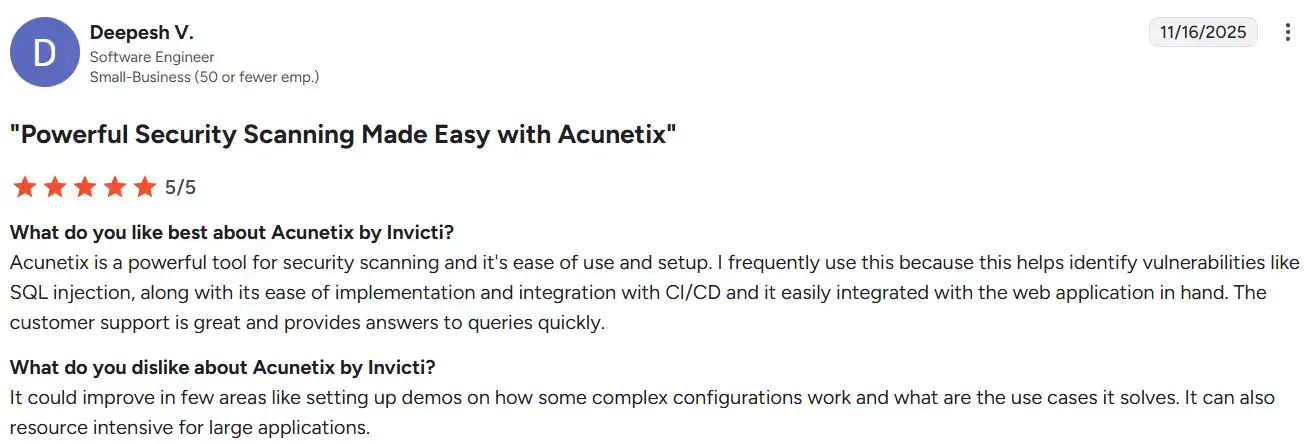
Acunetix reviews
Source: G2
User comments raise doubts about Acunetix’s dependability, especially when verified scans are being performed.
Even when credentials were properly checked, up to 90% of scans had problems, particularly around login sequences, according to a confirmed enterprise user, despite the fact that reporting tools are valued.
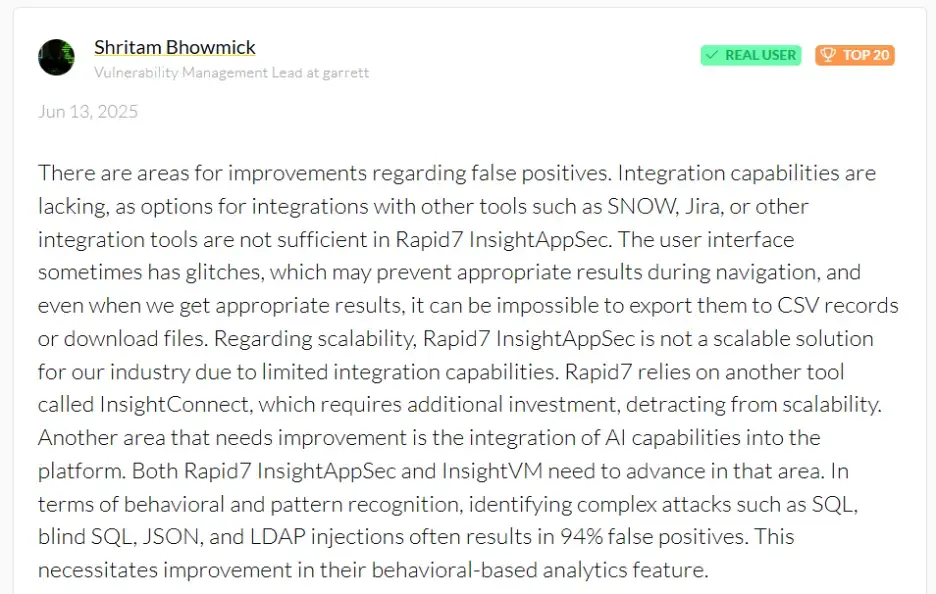
Rapid7 reviews
Source: PeerSpot
Source: G2
Users appreciate the platform’s integration with other Rapid7 tools and its visualization features. However, some cite a steep learning curve, performance issues during scans, and a lack of context-aware remediation guidance as major drawbacks.
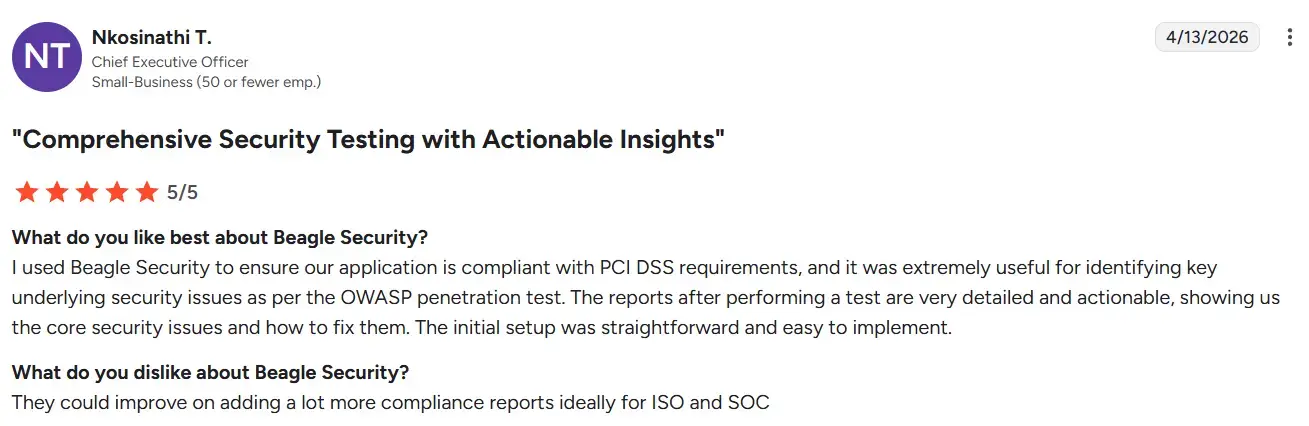
Beagle Security reviews
Source: G2
Beagle Security is consistently praised for realistic attack simulations, developer-friendly reports, and a clear interface. Users highlight the balance between ease of use and testing depth, and the agentic AI-driven testing that feels tailored rather than generic. Onboarding is straightforward even for teams without deep security expertise, and reports are formatted to give technical clarity to developers and business context to leadership.
Acunetix vs Rapid7 vs Beagle Security: Which is best for you?
Choose Rapid7 if:
- Your organization already uses Rapid7’s security ecosystem and values unified platform integration across vulnerability management, incident response, and application security. Your security team is comfortable with traditional DAST workflows and manual policy configuration, and Metasploit integration or attack replay capabilities align with your existing methodology.
Choose Acunetix if:
- You are a mid-market organization looking for proven vulnerability detection for traditional web applications. You are comfortable with a moderate learning curve, do not mind manual customization, and your application portfolio does not rely heavily on GraphQL or complex API architectures.
Choose Beagle Security if:
- You want agentic AI penetration testing with actionable remediation and CI/CD integration. You need real-world attack simulations without complicated setup or constant tuning. You are done with target lock-ins and FQDN-based pricing that scales against you. You need comprehensive API testing for REST, GraphQL, and complex authentication workflows without deep security expertise requirements.
Try Beagle Security for free to see how it compares to Acunetix and Rapid7
Choosing between Acunetix and Rapid7 can feel like weighing two capable yet legacy-heavy platforms each bringing complexity that modern teams often struggle to justify.
Beagle Security emerges as the smarter, more agile alternative, purpose-built for today’s web and API security landscape.
With agentic AI penetration testing, developer-centric reports and seamless CI/CD integration, Beagle Security delivers everything you need, without the steep learning curves or enterprise bloat.
You can get started with a 14-day free trial or schedule a demo to see how Beagle Security fits into your workflow.
FAQ
What is the difference between Acunetix and Rapid7 InsightAppSec?
Acunetix is a focused DAST scanner built for mid-market security teams who want depth and control over web application testing. Rapid7 InsightAppSec is part of a broader security platform that connects application testing to vulnerability management, incident response, and SIEM. The right choice depends on whether you need a specialist tool or an integrated platform.
Is Acunetix or Rapid7 better for API security testing?
Neither platform was built primarily for API-heavy or GraphQL architectures. Both handle basic REST API scanning, but coverage gaps emerge on complex authentication flows, business logic, and GraphQL endpoints.
Does Rapid7 InsightAppSec offer a free trial?
Yes. Rapid7 offers a 30-day free trial for InsightAppSec.


![Top ZAP alternatives and competitors [October 2026]](/blog/images/top-zap-alternatives-cover.webp "Top ZAP alternatives and competitors [October 2026]")




![Top 10 penetration testing companies [2026]](/blog/images/top-penetration-testing-companies-cover.webp "Top 10 penetration testing companies [2026]")



![Top vendor application security tools [2026]](/blog/images/top-vendor-application-security-testing-tools-2026-cover.webp "Top vendor application security tools [2026]")



![Top Snyk alternatives & competitors [2026]](/blog/images/top-snyk-alternatives-cover.webp "Top Snyk alternatives & competitors [2026]")