OpenVAS vs Nessus: Which is the best choice for you? [2026]
Vulnerability scanning is still a baseline control in most security programs. Your attack surface spans cloud workloads, on premises systems, APIs and internet facing applications, and regular assessments help you find weaknesses before attackers do.
Two scanners come up often in OpenVAS vs Nessus discussions. Both are mature tools, but they are built on different models and suit different teams.
OpenVAS is known for its open source roots and configurability. Nessus is a commercial product from Tenable, known for packaged deployment, frequent plugin updates and built-in compliance auditing.
This OpenVAS vs Nessus comparison covers features, pricing, accuracy and fit for vulnerability management.
Overview of OpenVAS and Nessus
OpenVAS is the open source vulnerability scanning technology behind the Greenbone vulnerability management software stack. It runs network vulnerability tests (NVTs) that are maintained by Greenbone and the community.
The name now covers more than one thing. Greenbone AG uses the OpenVAS brand for its products, so you will see OpenVAS community edition, OpenVAS free, OpenVAS basic and OpenVAS scan. These are not interchangeable:
OpenVAS community edition is open source and community oriented software. You can install it with Docker containers, Linux distribution packages or from source, and it uses the OpenVAS community feed.
OpenVAS free is a cross platform virtual appliance for Windows, Linux and macOS. Greenbone positions it as an entry point for first time users, with the community feed and fewer features than the commercial products.
OpenVAS basic is a paid, entry level commercial product for small businesses.
OpenVAS scan is Greenbone’s commercial vulnerability management product, sold as hardware or virtual appliances and used with the OpenVAS enterprise feed and Greenbone support.
Nessus, developed by Tenable, is a commercial vulnerability scanner used across enterprise environments. It also has more than one edition: Nessus Essentials, Nessus Essentials Plus, Nessus Professional and Nessus Expert.
Both tools find known vulnerabilities, but they differ in usability, maintenance effort, scalability and the problems they are suited to solve.
OpenVAS vs Nessus at a glance
| Area | OpenVAS (Greenbone) | Nessus (Tenable) |
|---|---|---|
| Ownership model | Open source community software plus commercial products | Commercial, with limited free options |
| Vendor | Greenbone AG | Tenable |
| Primary focus | Network and host vulnerability scanning | Vulnerability assessment and compliance auditing |
| Deployment | Docker, Linux packages or source (community), virtual appliance (OpenVAS free), appliances (OpenVAS scan) | Packaged software deployed on premises or in your own environment |
| Setup effort | Varies by edition, from moderate to high for community installs | Typically lower, as a packaged product |
| Updates | OpenVAS community feed, or OpenVAS enterprise feed with commercial products | Tenable plugin updates, frequency depends on edition |
| Free option | OpenVAS community edition and OpenVAS free | Nessus Essentials (limited, 30 days) |
| Paid options | OpenVAS basic, OpenVAS scan | Nessus Professional, Nessus Expert |
| Web application scanning | Not a core focus | Nessus Expert |
| Support | Community support, or Greenbone support with commercial products | Community support, with optional paid Advanced Support |
| Suited to | Technical teams that want control over deployment | Teams that want a packaged commercial scanner |
An alternative web and API penetration testing platform for comparison: Beagle Security
OpenVAS and Nessus are infrastructure focused vulnerability assessment tools. Many modern risks sit in the application layer, such as authentication flows, business logic flaws, broken authorization and API misuse.
Beagle Security is an agentic AI penetration testing platform that simulates real world attacks against web applications and APIs. Rather than looking for missing patches or insecure services, it tests how an attacker could exploit a running application.
It is a different use case from network vulnerability assessment. It can sit alongside OpenVAS or Nessus, but it does not replace them for infrastructure vulnerability management.
Where Beagle Security fits for modern development teams
Development teams ship often. Applications change weekly, APIs evolve and authentication is rarely simple. Network scanners are not designed to follow application workflows or API logic.
Beagle Security focuses on that gap. It:
Runs automated penetration tests against web applications and APIs
Handles authenticated tests and complex login flows
Produces findings with context that developers can act on
Integrates with CI/CD pipelines for continuous testing
If application security is a priority, it covers areas that OpenVAS and Nessus are not primarily designed for.
OpenVAS vs Nessus vs Beagle Security: Feature comparison
| Feature | Beagle Security | OpenVAS | Nessus |
|---|---|---|---|
| Network vulnerability scanning | Not the focus | Yes | Yes |
| Web application scanning | Yes, core focus | Not a core focus | Nessus Expert |
| API security testing | Yes | Not a core focus | Not a core focus |
| Authenticated testing | Authenticated web and API flows | Credentialed host scans | Credentialed host scans |
| Compliance and configuration audits | Compliance reports on higher plans | Depends on edition and feed | Yes |
| Business logic testing | Yes | Not designed for it | Not designed for it |
| CI/CD integration | Yes | Depends on edition and setup | Depends on setup |
| Reporting | Developer focused | Depends on edition | Configurable reports |
| Proof of exploitability | Yes | Not the aim | Not the aim |
Capabilities differ by edition for both OpenVAS and Nessus. Check the edition you plan to buy or deploy before relying on a feature.
OpenVAS vulnerability scanning features
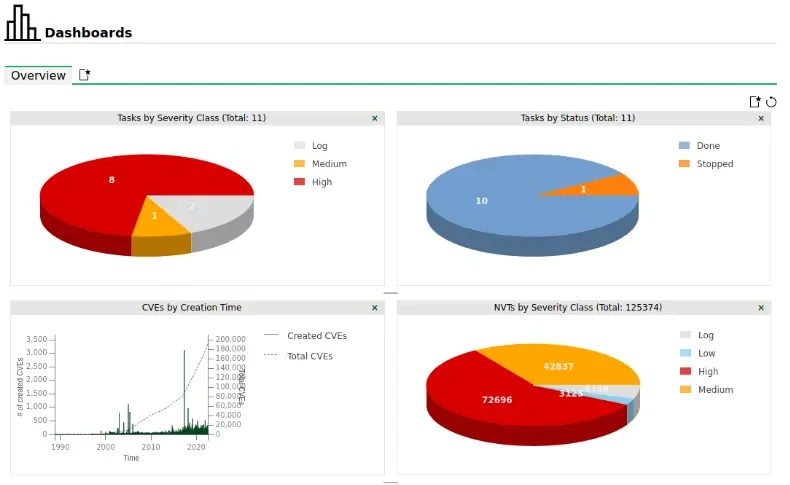
OpenVAS detects known CVEs across hosts and services, and supports credentialed and unauthenticated scans. Core capabilities include:
Detection of known CVEs across hosts and services
Custom scan configurations
Open and inspectable vulnerability tests in the community software
Integration with the wider Greenbone ecosystem
The tradeoff depends on how you deploy it. With OpenVAS community edition you manage updates, tuning and scaling yourself, and reporting may need extra work for nontechnical stakeholders.
Commercial products shift some of that work to the vendor. For example, OpenVAS free lacks features that OpenVAS scan includes, such as schedules and notifications, TLS certificate management, integrated backups and master sensor support, according to Greenbone.
OpenVAS scan lists open APIs and connectors for integration with tools such as Splunk and ServiceNow. Container image scanning arrived in OpenVAS scan 25.0 for selected appliance models.
Nessus vulnerability scanning features
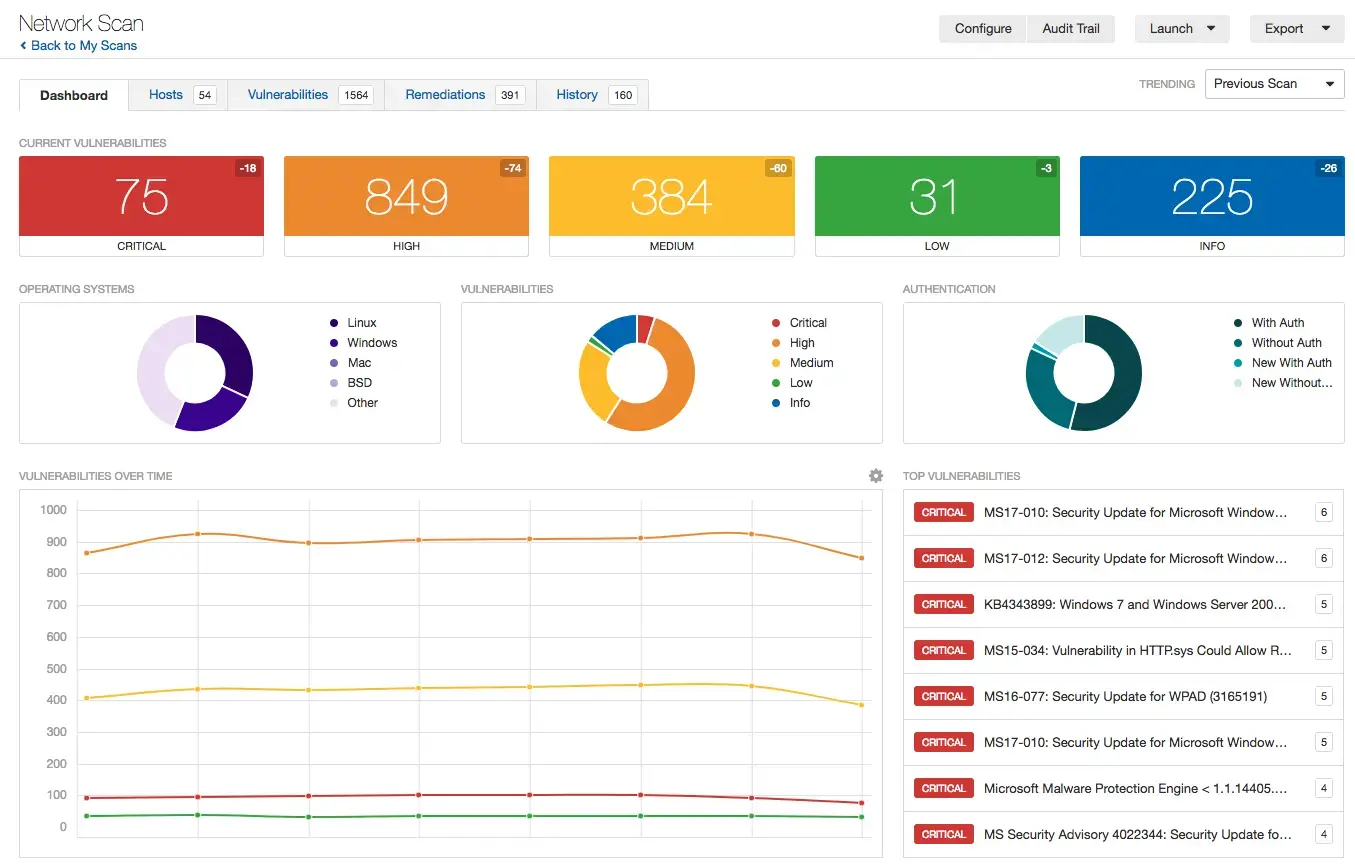
Tenable maintains a large plugin library and updates it frequently. Core capabilities in Nessus Professional include:
Unlimited IT vulnerability assessments
Configuration, compliance and security audits
Credentialed scanning for deeper visibility
Vulnerability scoring with CVSS v4, EPSS and VPR
Configurable reports
Nessus Expert includes the Professional capabilities and adds web application scanning and external attack surface scanning. Tenable describes Expert as covering the modern attack surface.
Nessus focuses on identifying known weaknesses. It does not simulate real world exploitation at the application layer.
Beagle Security features
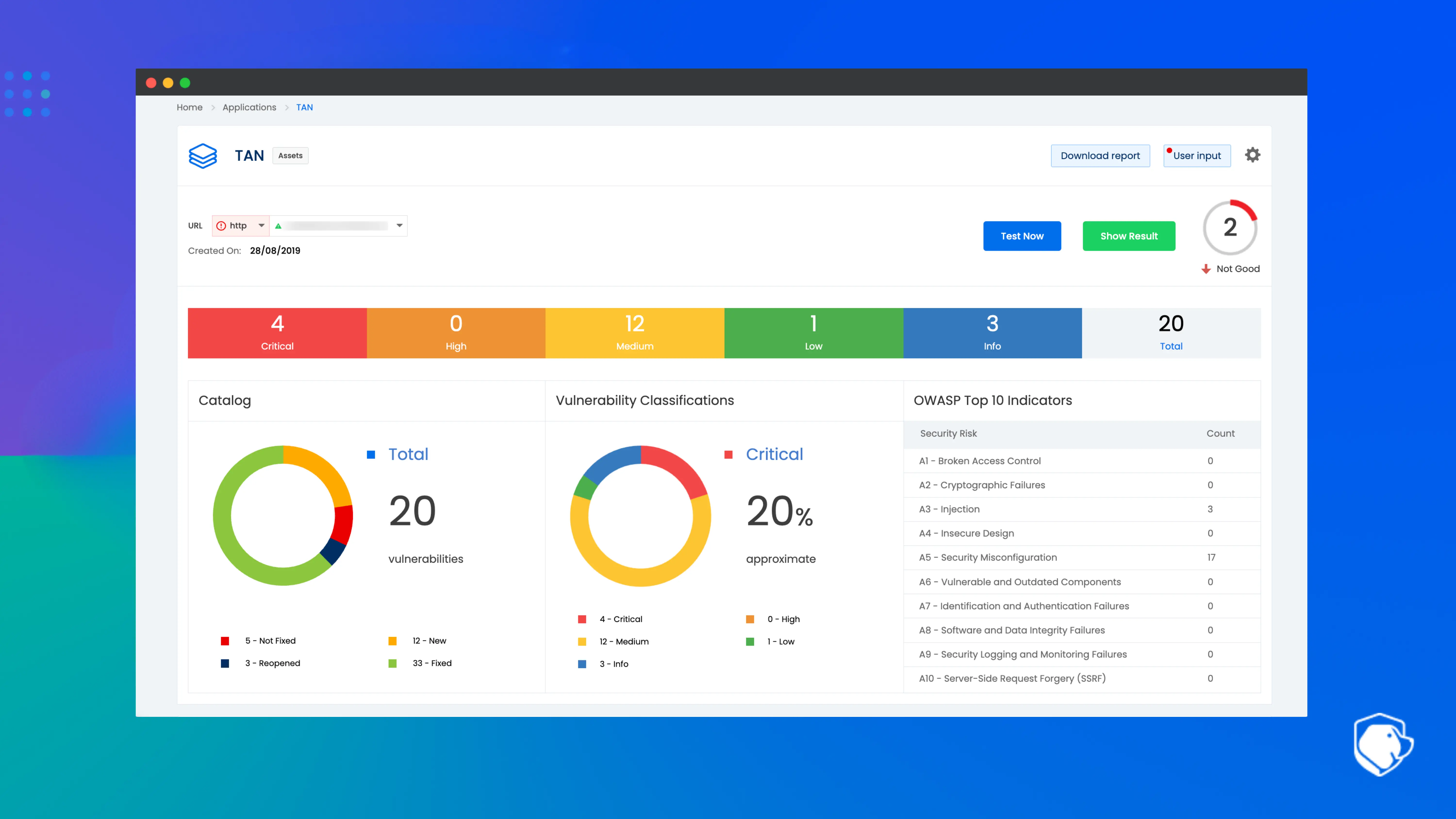
Beagle Security tests live applications and APIs the way an attacker would. Key capabilities include:
Automated web and API penetration testing
REST and GraphQL API testing (GraphQL is on the Advanced plan)
Handling of authentication and sessions
Reports with context and proof of exploitability
Retesting workflows and CI/CD integration
It is built for application security teams that need fast, actionable feedback on real security risks.
OpenVAS vs Nessus vs Beagle Security: Pricing comparison
| Tool | Pricing model | What you pay for | Published cost |
|---|---|---|---|
| OpenVAS | Community software, free appliance and commercial products | Feed, support and product tier | OpenVAS community edition and OpenVAS free edition are free. OpenVAS basic is €2,524 per year. OpenVAS scan is quoted by Greenbone |
| Nessus | Commercial annual license | Edition and license term | Nessus Professional is $4,790 for one year. Nessus Expert is $6,790 for one year |
| Beagle Security | Subscription | Web application and API penetration tests | Essential from $99/ month billed annually (119 billed monthly) |
Prices were checked on the vendors’ pages in October 2026. Check them again before you buy.
OpenVAS pricing
OpenVAS is not simply free or paid. Greenbone offers several models:
OpenVAS community edition: open source software for community use. You pay no license fee, but you cover the infrastructure, maintenance and expertise to run it.
OpenVAS free: a free virtual appliance for entry level use. Greenbone describes it as suited to private use and nonprofessional environments, and it uses the community feed.
OpenVAS basic: a paid entry level product listed at €2,524 per year, with a free 14 day trial. Greenbone’s page does not list API access or Greenbone professional support for it.
OpenVAS scan: commercial appliances with the OpenVAS enterprise feed and Greenbone support.
On the feed, Greenbone states that the community feed focuses on consumer products and standards such as IT Grundschutz. It says the enterprise feed adds enterprise products, compliance policies such as CIS Benchmarks, EPSS data, multiple daily updates and access to Greenbone support.
Teams that need faster updates, enterprise support or compliance content usually look at the commercial products. Factor in infrastructure, maintenance time and internal expertise either way.
Nessus pricing
Nessus Professional costs $4,790 for a one year license, according to Tenable. Nessus Expert is $6,790 for one year. Multi year terms and optional add ons such as Advanced Support are priced separately.
Professional covers IT vulnerability assessment, compliance audits and reporting. Expert includes everything in Professional and adds web application scanning and external attack surface scanning.
Nessus also has free limited options. Nessus Essentials is a free 30 day license for noncommercial use, limited to 5 IPs. Nessus Essentials Plus covers up to 20 IPs, and Tenable lists it as free for verified students and educators. Neither is a free version of Nessus Professional.
You cannot compare €2,524 for OPENVAS BASIC with $4,790 for Nessus Professional directly. The currencies, editions, licensing models and included support all differ.
A commercial scanner can still reduce operational overhead through packaged deployment and regular plugin updates. Whether that justifies the cost depends on your team’s capacity and requirements.
Beagle Security pricing
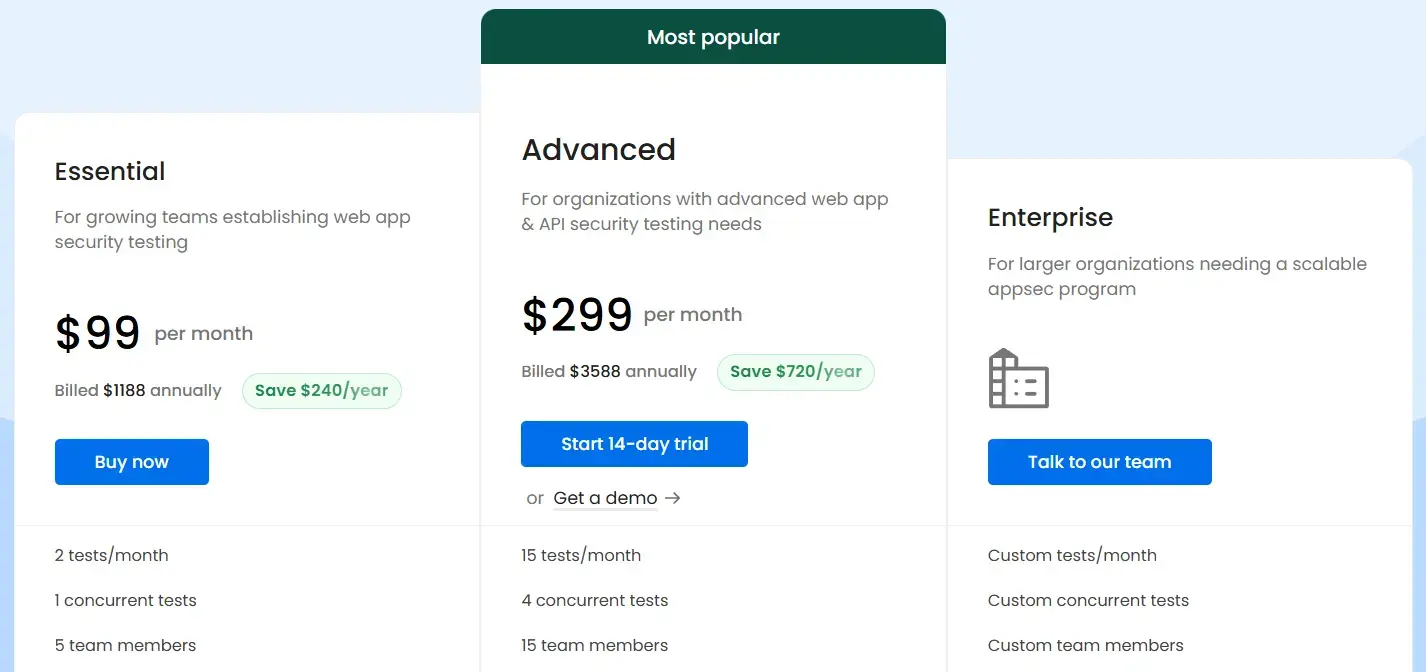
Beagle Security offers tiered plans for web and API penetration testing. The Essential plan starts at $99 per month billed annually, or $119 per month billed monthly, with higher tiers for advanced features and enterprise use. A free trial is available.
Instead of paying to scan every host, teams pay for automated penetration testing of their web applications and APIs. That model suits product teams and SaaS companies that release often.
OpenVAS vs Nessus vs Beagle Security: Customer reviews comparison
| Aspect | OpenVAS | Nessus | Beagle Security |
|---|---|---|---|
| Ease of use | Depends on deployment | Packaged setup | Quick setup |
| Setup experience | Manual for community installs | Quicker for most teams | Quick |
| False positives | Depends on tuning and scan configuration | Depends on tuning and scan configuration | Reduced by contextual validation |
| Reporting | Depends on edition | Configurable reports | Developer focused |
| Common praise | Free and customizable | Reliable and scalable | Actionable reports |
| Common criticism | Maintenance overhead | Licensing cost | Focused on apps and APIs |
OpenVAS reviews
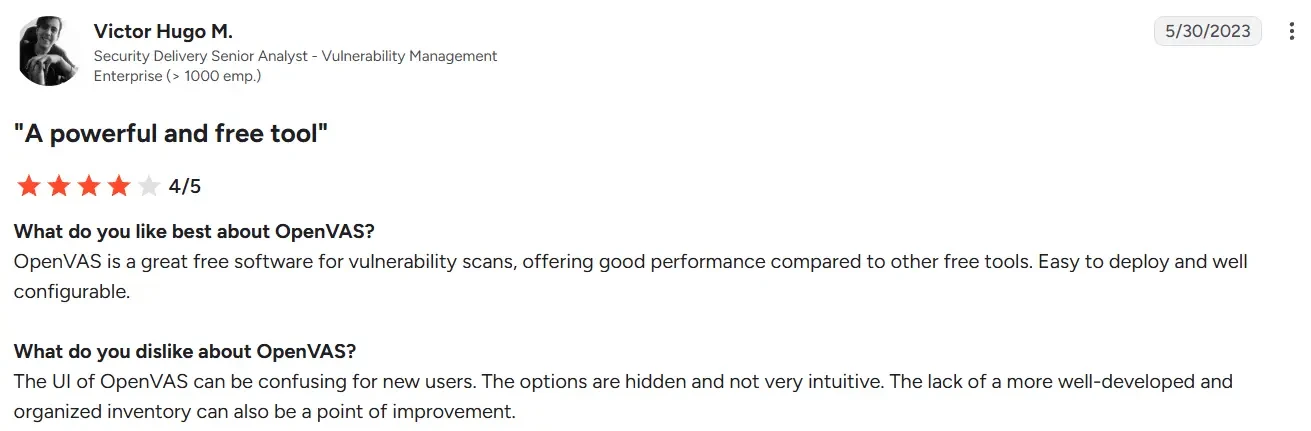
G2 rating: 4.4 / 5 from 32 reviews.
OpenVAS is frequently praised for being free, transparent and flexible. Security professionals value its open source nature and the ability to customize scans, especially where control over vulnerability logic matters.
Common feedback themes include:
Technical depth and coverage
A learning curve for new users
Manual effort for setup, tuning and maintenance
Limited reporting for nontechnical stakeholders
Experienced security engineers and researchers tend to rate it well. Smaller teams without dedicated security resources can find it harder, especially when scaling scans or reporting to management.
Nessus reviews
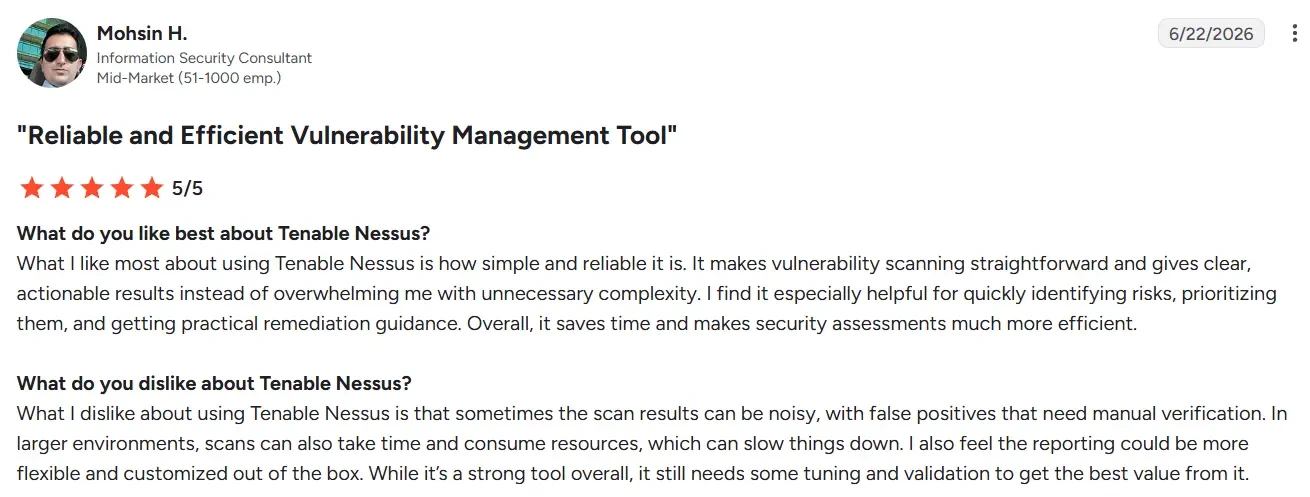
G2 rating: 4.5 / 5 from 313 reviews.
Nessus reviews often mention reliability, scan coverage and ease of deployment. Users describe getting started quickly across larger environments with limited configuration.
Common feedback themes include:
Scan speed and scalability
Frequently updated vulnerability coverage
Compliance and audit oriented reporting
Licensing costs that rise with scale
It is widely used in enterprise and regulated environments, particularly where compliance and consistency matter.
Beagle Security reviews
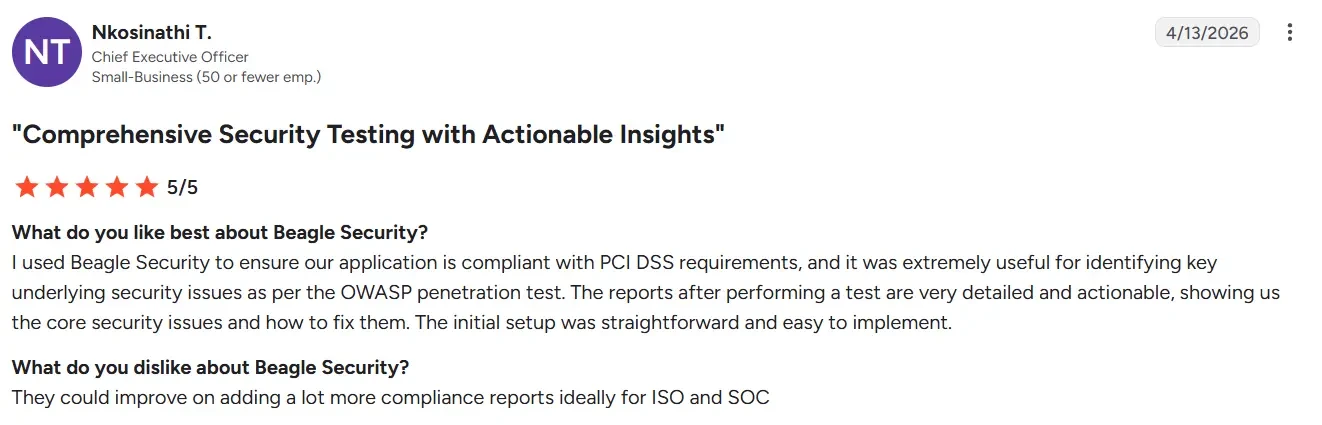
G2 rating: 4.7 / 5 from 88 reviews.
Reviews often emphasize ease of use, report clarity and findings that developers can act on. Users describe it as helping security and development teams work from the same findings, with a focus on exploitability over raw vulnerability volume.
Common feedback themes include:
Actionable, contextual vulnerability reports
Web and API penetration testing capabilities
CI/CD integration for continuous testing
Less noise than traditional vulnerability scanners
It tends to resonate with SaaS teams, startups and product driven organizations.
OpenVAS vs Nessus vs Beagle Security: Which fits your use case?
There is no universal winner. The right tool depends on your security goals, team maturity and the assets you protect.
Choose OpenVAS (Greenbone) if:
Open source control and self hosting matter to you
Your team is comfortable managing and tuning the platform
You want the option of commercial Greenbone support when you need it
Choose Nessus if:
You prefer a packaged commercial vulnerability assessment product
Commercial support and Tenable’s plugin ecosystem matter to you
You need compliance and configuration audits out of the box
Web application or external attack surface scanning in Nessus Expert is relevant
Choose Beagle Security if:
Your primary risk is in web applications and APIs
You want automated penetration testing, not only a list of vulnerabilities
You need developer focused reports and continuous testing
Many mature programs combine tools. Infrastructure scanners handle baseline hygiene, and an application focused platform validates real world exploitability.
Final thoughts
OpenVAS and Nessus are both established vulnerability scanners, built for different working models. OpenVAS gives technical teams control and transparency, with commercial Greenbone products for those who want support. Nessus gives teams a packaged commercial product, with Expert adding web application and external attack surface scanning.
Neither fully covers application and API risk. For teams building API driven products, Beagle Security tests real attack paths in web applications and APIs, and returns findings developers can fix.
In practice, you can pair OpenVAS or Nessus for infrastructure vulnerability management with an application focused penetration testing platform like Beagle Security.
FAQs
What is the difference between OpenVAS and Nessus?
OpenVAS is open source scanning technology from Greenbone, also sold in commercial products. Nessus is a commercial scanner from Tenable with free, limited and paid editions. Both detect known vulnerabilities, but they differ in deployment, support and licensing.
Is Nessus free?
Partly. Nessus Essentials is a free 30 day license for noncommercial use, limited to 5 IPs. Nessus Professional and Nessus Expert are paid products.
How much does Nessus Professional cost in 2026?
Tenable lists Nessus Professional at $4,790 for a one year license. Multi year terms and add ons such as Advanced Support are priced separately.
Does Nessus have web application scanning?
Yes, in Nessus Expert. Tenable lists web application scanning as an Expert capability, not a Nessus Professional one. It is not a replacement for a dedicated application penetration testing platform.
Does OpenVAS scan web applications?
OpenVAS is built mainly for network and host vulnerability scanning, and web application testing is not its core focus. Teams that need deep application and API testing usually add a dedicated tool.
Metadata
| Title | OpenVAS vs Nessus: Which is the best choice for you? [2026] |
|---|---|
| Slug | https://beaglesecurity.com/blog/article/openvas-vs-nessus-which-is-the-best-choice-for-you-2025.html |
| Date | 2026-10-06 |
| Author | Jijith |
| Contributor | Pooja |
| Description | Compare OpenVAS and Nessus, two leading vulnerability scanners, for features, pricing, and suitability, and find out why Beagle Security is the best choice for comprehensive web and API security testing, as neither OpenVAS nor Nessus fully addresses application risk. |
| Tags | |
| Categories |