HIPAA API security testing: Best practices for healthcare applications

Think about everything a healthcare application can do through an API. A patient checks their lab results, a doctor updates a prescription, a hospital system shares records with a third-party service.
Behind each of these actions, APIs move sensitive information between systems. And if an API gets its security controls wrong, that information could end up in the wrong hands.
For healthcare organizations, this isn’t just another application security issue. APIs that handle electronic protected health information (ePHI) need safeguards that protect patient data and support HIPAA security requirements.
That’s where HIPAA API security testing comes in. It helps teams find weaknesses in how their APIs authenticate users, enforce permissions, handle sensitive data, and respond to unexpected requests.
In this guide, we’ll break down what HIPAA API security testing involves, the vulnerabilities healthcare teams should look for, and the best practices for building a testing process that keeps up with their applications.
What is HIPAA security testing?
HIPAA API security testing is the process of checking healthcare APIs for vulnerabilities that could expose, alter, or disrupt access to electronic protected health information (ePHI).
HIPAA, or the Health Insurance Portability and Accountability Act, includes the Security Rule, which requires covered entities and business associates to implement appropriate safeguards for protecting ePHI. These include technical safeguards related to access control, authentication, audit controls, integrity, and transmission security.
API security testing puts those safeguards into practice by examining how an application behaves when someone interacts with its endpoints.
For example, imagine a patient portal that retrieves medical records through an API. A patient should be able to view their own records, but not someone else’s. If changing a patient ID in a request gives them access to another person’s medical history, the API has an authorization flaw that could expose ePHI.
Testing helps uncover issues like this before someone exploits them.
Depending on the application, testing may involve automated security assessments, manual penetration testing, authenticated testing, and reviews of API configurations. The goal is to understand where the weaknesses are, how they could be exploited, and what needs to change.
One important distinction to remember: HIPAA API security testing supports a broader compliance and security program; passing a penetration test does not automatically make an organization HIPAA compliant.
How does HIPAA apply to API security?
HIPAA doesn’t prescribe one specific method for testing APIs. Instead, its Security Rule establishes safeguards that regulated organizations must implement based on their circumstances and risks.
For healthcare teams, the practical question is this: do the APIs handling ePHI enforce the controls needed to protect that information?
Here are four areas worth paying close attention to.
Access control
Not everyone who can access a healthcare application should be able to access every record or perform every action.
A doctor, a patient, and a hospital administrator may use the same application, but their permissions should look very different. Access control ensures that users can reach only the information and functionality they’re authorized to use.
Testing should check whether these restrictions hold up when someone interacts directly with an API. Can a patient retrieve another patient’s records by changing an identifier? Can a user access a restricted endpoint by calling it outside the normal application interface?
These checks help uncover authorization weaknesses that might not be obvious during ordinary use.
Authentication & authorization
Authentication and authorization work together, but they solve different problems.
Authentication verifies who a user or system is. Authorization determines what that identity is allowed to do.
A successful login doesn’t mean a user should have unrestricted access to the API. A patient might be allowed to view their medical history, for instance, but not update another patient’s prescription or change their account permissions.
Testing should examine how APIs validate credentials and tokens, manage sessions, handle expired or revoked credentials, and enforce permissions across endpoints.
The key is to check more than whether login works. The real question is whether the API continues to enforce the right restrictions after authentication succeeds.
Audit control & integrity protection
When sensitive health information is involved, organizations need to understand what’s happening to that data and protect it against improper changes.
HIPAA’s Security Rule addresses audit controls and measures to protect ePHI from improper alteration or destruction. APIs play a part in both.
Testing should check whether relevant activities, such as viewing records, updating prescriptions, and attempting unauthorized actions, are recorded appropriately. It should also examine whether users can modify information they shouldn’t be able to change.
Logs need to be useful without becoming another source of sensitive data exposure. Storing patient information, access tokens, or other secrets unnecessarily in logs can create risks of its own.
Transmission security
Healthcare APIs often exchange sensitive information between patient portals, electronic health record systems, mobile applications, and external services. That information needs protection while it moves between systems.
Testing should verify that APIs use appropriately configured HTTPS/TLS and don’t expose sensitive information through insecure connections, URLs, or error messages. Teams should also review how credentials and authentication tokens are transmitted.
But encryption isn’t the whole story. An API can encrypt every request and response correctly and still expose patient records if its authorization controls are broken.
Good API security needs both protected data transmission and proper control over who can access the data.
Common API security vulnerabilities in healthcare applications
Healthcare APIs face many of the same security risks as other applications. The difference is what an attacker might gain from exploiting them.
A flaw in a healthcare API could expose medical histories, reveal prescription information, allow unauthorized changes to records, or disrupt services that patients and healthcare professionals depend on.
The OWASP API Security Top 10 highlights several risks that are especially relevant here. Let’s look at what they can mean in practice.
Broken object level authorization (BOLA)
Imagine a patient opens their lab results and the application sends a request containing their patient ID. What happens if they replace that ID with someone else’s?
If the API returns the other person’s results, it has a broken object-level authorization (BOLA) vulnerability.
BOLA occurs when an API doesn’t properly check whether the requesting user is allowed to access a particular record or object. It’s particularly concerning in healthcare because APIs frequently retrieve records using identifiers.
The same weakness could expose medical histories, prescriptions, appointment details, or billing information.
To test for BOLA, teams should use authorized test accounts with different permissions and attempt to access records outside each account’s permitted scope. The API must verify access to each requested object on the server side, rather than assuming that a valid login or an unpredictable identifier is enough.
Broken function level authorization (BFLA)
BOLA is about accessing the wrong record. BFLA is about performing an action the user shouldn’t be allowed to perform.
For example, a patient might be able to call an administrative endpoint that changes user roles or updates sensitive records. The API may confirm that the patient is logged in but fail to check whether they have permission to perform that operation. This can give ordinary users access to privileged functionality.
Testing should cover sensitive operations such as managing accounts, changing permissions, updating medical information, and performing administrative actions. Teams should verify that access restrictions are enforced on the server side, even when a user calls an endpoint directly instead of going through the application’s interface.
Broken authentication
Authentication is supposed to keep unauthorized users out. When its implementation has weaknesses, attackers may find ways around it.
Common issues include improper token validation, weak session management, incorrect handling of expired credentials, and authentication flows that can be bypassed.
In a healthcare application, a compromised session or poorly validated token could provide access to patient portals or other systems containing ePHI.
Testing should examine how the API handles missing, invalid, expired, and revoked credentials. It should also check session expiration and invalidation, along with the security of relevant login and recovery flows.
The goal is to make sure that access depends on valid authentication. It should not rely on assumptions about where a request came from or whether the user previously logged in.
Sensitive data exposure
An API doesn’t have to hand over an entire medical record to create a security problem. Sometimes, the issue is simply that it returns more information than the user needs.
Consider a patient-facing endpoint that displays an appointment date but also returns internal notes, unnecessary identifiers, or details about other patients. Even if the interface hides those fields, anyone who can inspect the API response may still see them.
Sensitive information can also leak through verbose error messages, debugging output, insecure caching, or application logs.
Testing should examine actual API responses rather than relying on what the frontend displays. Check whether sensitive fields are exposed unnecessarily and whether errors reveal information that could help an attacker. The principle is straightforward: return only the data the requesting user is authorized to receive and the operation actually requires.
Injection vulnerabilities
APIs receive all kinds of input: search terms, record identifiers, filters, form data, and more. Problems arise when an application treats untrusted input as part of a database query, operating system command, or other instruction.
SQL injection is one example. If a healthcare API builds database queries unsafely, an attacker may be able to manipulate those queries to access or modify information they shouldn’t reach.
Other injection vulnerabilities can affect connected services or disrupt application operations.
Testing should examine how endpoints handle unexpected and malformed input, especially in parameters that influence database queries or backend operations. Appropriate parameterization, input validation, and context-specific handling help prevent user input from being interpreted as executable instructions. Simply blocking a few suspicious characters isn’t a reliable substitute for secure input handling.
Security misconfiguration
Sometimes, the problem isn’t a vulnerability in the application’s logic. It’s the way the application or its supporting infrastructure has been configured.
Examples include overly permissive cross-origin resource sharing (CORS), unnecessary HTTP methods, exposed debugging endpoints, verbose error responses, and unsafe server settings.
In healthcare applications, these mistakes can expose endpoints or technical details that should remain protected.
Testing should review API gateway rules, server responses, permitted methods, error handling, and exposed documentation or debugging interfaces. Teams should also check that development and testing settings haven’t accidentally made their way into production.
Misconfigurations can be easy to overlook, especially as applications grow and teams add new services or integrations. Regular reviews help catch them before they become a bigger problem.
Unrestricted resource consumption
APIs rely on resources such as CPU, memory, storage, bandwidth, and database capacity. If an API doesn’t limit how much work a request can trigger, an attacker may be able to overwhelm it with repeated requests or expensive operations.
For a healthcare application, this isn’t just a performance issue. An overloaded API could interrupt access to patient portals, appointment services, or other important workflows.
Testing should examine rate limits, request-size restrictions, pagination, query complexity, and controls on resource-intensive operations. Teams should check that the application handles excessive requests safely without unnecessarily blocking legitimate users.
The aim is to prevent a single user, or an automated attack from consuming resources to the point where the service becomes unreliable or unavailable.
Shadow & deprecated APIs
Healthcare applications don’t always have just one clean, up-to-date API. Older versions may remain active, new endpoints may be introduced without proper documentation, and third-party integrations may continue using interfaces that the main team has stopped monitoring.
These are the kinds of gaps that create shadow and deprecated API risks.
An older endpoint, for example, might still accept requests but lack the authorization checks introduced in a newer version. An undocumented API might expose data without the security team realizing that the endpoint exists.
Testing should start with a current API inventory covering endpoints, versions, environments, authentication requirements, and the data each API handles. Teams should identify undocumented or outdated interfaces, check whether they are still needed, and restrict or retire those that aren’t.
You can’t properly secure an API that nobody knows is there.
HIPAA API security checklist
Before getting into a full testing cycle, use this quick checklist to cover the essentials.
Discovery & inventory APIs
Identify APIs that handle or transfer ePHI.
Record endpoints, versions, environments, and authentication methods.
Find undocumented, shadow, and deprecated APIs.
Test authentication
Check how APIs handle invalid, expired and revoked credentials.
Review token management and session management.
Confirm that protected endpoints require valid authentications.
Validate authorization
Test access restrictions across users, roles, and patient records.
Check for BOLA and BFLA vulnerabilities.
Verify permissions for sensitive and administrative operations.
Check data protection
Inspect responses for unnecessary or unauthorized sensitive data.
Check encryption in transit and the handling of tokens and secrets.
Review error messages, logging, and integrity protections.
Validate findings & prioritize remediation
Confirm vulnerabilities and assess their potential impact on ePHI.
Prioritize findings by risk and exploitability.
Assign remediation owners and track progress.
Retest & document
Retest fixes to confirm vulnerabilities are resolved.
Record evidence, remediation details, and remaining risks.
Maintain relevant reports and testing records.
How to build an effective HIPAA API security testing process
Finding vulnerabilities is only half the job. Teams also need a repeatable way to test APIs, act on the results, and check that fixes actually work. A useful testing process should fit into how the application is built and maintained. It should not exist as a separate activity that everyone remembers just before an audit.
Combine authenticated & unauthenticated testing
Unauthenticated testing looks at what someone can access without valid credentials. Authenticated testing goes further, examining the functionality and data available after login.
Both matter for healthcare APIs.
Unauthenticated testing can uncover publicly exposed endpoints, weak authentication controls, and configuration issues. Authenticated testing can reveal flaws in patient records, staff workflows, and privileged functionality that aren’t visible from the outside.
Where relevant, test with different roles, such as patients, clinicians, and administrators. Each role should have its own permitted actions and data access boundaries. This is especially important for authorization testing. A user may be able to log in successfully and still have access to records or operations they shouldn’t.
Integrate testing into CI/CD workflows
APIs change whenever teams add features, update integrations, or modify how data is handled. Testing only before a major release can leave a gap between when a vulnerability is introduced and when it’s discovered.
Integrating API security testing into continuous integration and continuous delivery (CI/CD) workflows helps teams identify problems earlier and repeat checks as the application evolves.
For example, a team adding a new endpoint for retrieving lab results could include security checks before deploying the change. If the endpoint allows one patient to access another patient’s results, the team can investigate and fix the issue before the feature reaches production.
Automation makes repeated testing easier, while manual review remains valuable for complex business logic and issues that need human judgment.
Teams should also define appropriate test environments, credentials, and safety boundaries, particularly when testing systems that handle sensitive health information.
Establish a risk based testing schedule
Not every API needs the same testing frequency. An endpoint that returns public clinic information presents a different level of risk from one that retrieves medical records or updates prescriptions. The sensitivity of the data, the privileges exposed by the endpoint, and the potential impact of an attack should all influence testing priorities.
Build a schedule around these factors, and reassess APIs after significant changes to authentication, authorization, data handling, or application functionality.
HIPAA’s Security Rule calls for risk analysis and periodic evaluation of security measures, but it doesn’t prescribe one universal testing frequency for every API. The schedule should reflect the organization’s risk analysis and the systems it needs to protect.
The important thing is to avoid treating a single successful test as proof that an API will remain secure indefinitely.
Document findings and verify remediation
A vulnerability report shouldn’t leave developers wondering what went wrong or what they need to fix.
For each confirmed finding, document the affected endpoint, the conditions needed to reproduce the issue, the potential impact, and the recommended remediation. Where relevant, explain how the issue could affect ePHI or disrupt an important healthcare workflow.
Assign each finding to an owner and track it through remediation. Then test the affected endpoint again.
That final step matters. A developer might fix the specific request that exposed a vulnerability without addressing the underlying authorization logic. Retesting helps confirm that the issue is resolved rather than simply harder to reproduce.
Keep appropriate records of the findings, fixes, and retest results. These records can support ongoing security reviews and help teams demonstrate how identified risks were addressed.
How Beagle Security can help secure healthcare APIs
Healthcare teams need more than a list of potential vulnerabilities. They need a practical way to test the APIs their applications depend on, understand what the findings mean, and work out what to fix first.
Beagle Security provides agentic AI penetration testing for web applications and APIs, including REST and GraphQL APIs. Its testing capabilities can help teams identify vulnerabilities that put sensitive data or application functionality at risk.
Here’s how it can fit into a healthcare API security testing process:
API penetration testing: Test REST and GraphQL APIs for security weaknesses that could expose sensitive information or allow unauthorized actions.
Authenticated testing: Assess protected application areas using supported authentication configurations, helping teams examine functionality that isn’t available to unauthenticated users.
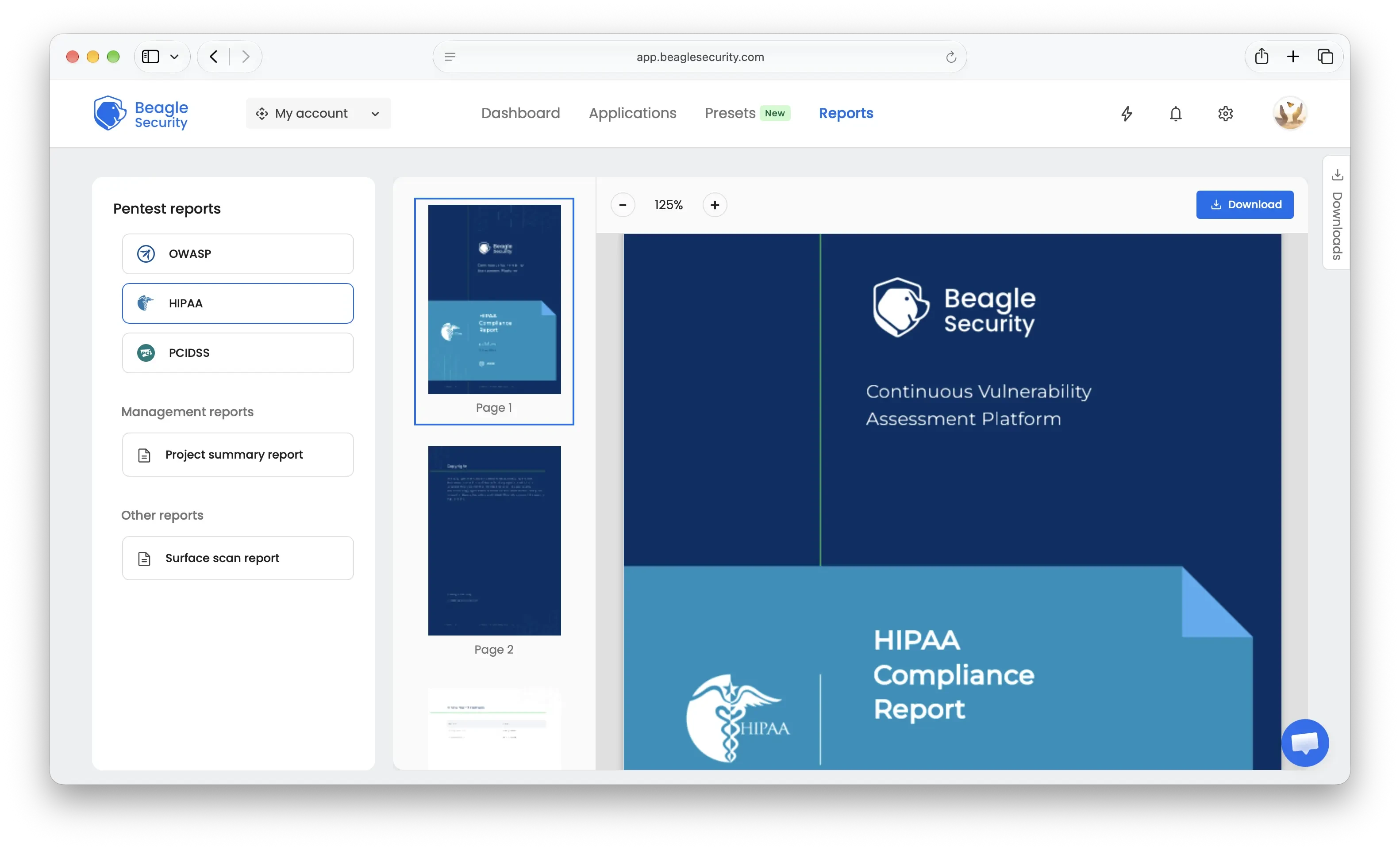
HIPAA mapped reports: Review findings in the context of relevant HIPAA Security Rule requirements and use the reports to support compliance and security reviews.
Remediation guidance: Give development teams actionable information to investigate vulnerabilities and work towards a fix.
Recurring testing: Schedule assessments to help identify weaknesses as applications and their APIs evolve.
Workflow integrations: Connect testing results with supported tools and compliance workflows to make findings easier to track.
These capabilities can help make API security testing a more consistent part of the development process. They don’t replace the broader administrative, physical, and technical safeguards required under HIPAA, but they can support the work of identifying and addressing application-level risks.
If your healthcare application relies on APIs to handle ePHI, explore Beagle Security’s HIPAA penetration testing capabilities to learn how automated testing and HIPAA-mapped reporting can support your security efforts.
Conclusion
Healthcare APIs do a lot of important work behind the scenes. They help patients access records, allow providers to exchange information, and connect the systems healthcare services depend on. But every endpoint that handles sensitive information also needs the right security controls.
A missed authorization check, an exposed response field, or an outdated endpoint can create a real risk for patient data. HIPAA API security testing helps teams uncover these weaknesses and understand what needs attention.
The best approach goes beyond a one-time scan. Combine authenticated and unauthenticated testing, prioritize APIs based on risk, integrate checks into development workflows where appropriate, and retest fixes to make sure they hold up.
Most importantly, treat testing as an ongoing part of protecting healthcare applications and not as a task to tick off when an audit is approaching.
FAQs
What is HIPAA API security testing?
HIPAA API security testing evaluates healthcare APIs for weaknesses that could expose, alter, or disrupt access to electronic protected health information (ePHI). It examines areas such as authentication, authorization, data protection, input handling, and security configuration to help organizations assess their application security controls.
Does HIPAA require API security testing?
HIPAA doesn’t prescribe a specific API security testing methodology. Its Security Rule requires regulated organizations to implement appropriate safeguards, conduct risk analysis, and evaluate security measures. API security testing can help assess whether relevant controls are working, but it doesn’t guarantee HIPAA compliance on its own.
How often should healthcare APIs be tested?
Testing frequency should depend on the organization’s risk analysis, the sensitivity of the data handled, the API’s exposure, and how often the application changes. Higher-risk APIs may need more frequent assessments, especially after significant changes to authentication, authorization, or data handling. HIPAA doesn’t set one universal testing schedule for every API.
What should a HIPAA API security testing report include?
A useful report should identify affected endpoints, describe each vulnerability, provide supporting evidence, explain potential impact, and recommend remediation. It should also track severity, remediation status, and retest results. HIPAA-mapped reporting can help organize findings for compliance reviews, but a report alone isn’t proof of compliance.