As applications grow more complex and attack surfaces expand, security testing is evolving to match the pace. Development teams today need security coverage that scales alongside their release cycles, catches vulnerabilities early, and integrates into how they already work. Agentic pentesting is emerging as the approach that makes all of that possible.
Agentic pentesting is an AI-driven approach where autonomous agents handle the full penetration testing workflow from reconnaissance and planning to execution, adaptation, and reporting. Unlike conventional scanners, agentic pen testing systems reason about what they find, chain attack steps together, and adjust their strategy in real time, much like a skilled human tester would. The difference is they do it continuously, at a scale no human team can match.
In this blog, you’ll learn how agentic pentesting differs from traditional approaches, what an agentic system actually does during a test, what it can cover today from web apps and APIs to complex business logic and how Beagle Security’s agentic pentesting helps development teams ship securely.
How agentic pentesting differs from what came before
Traditional pentesting: Depth without scale
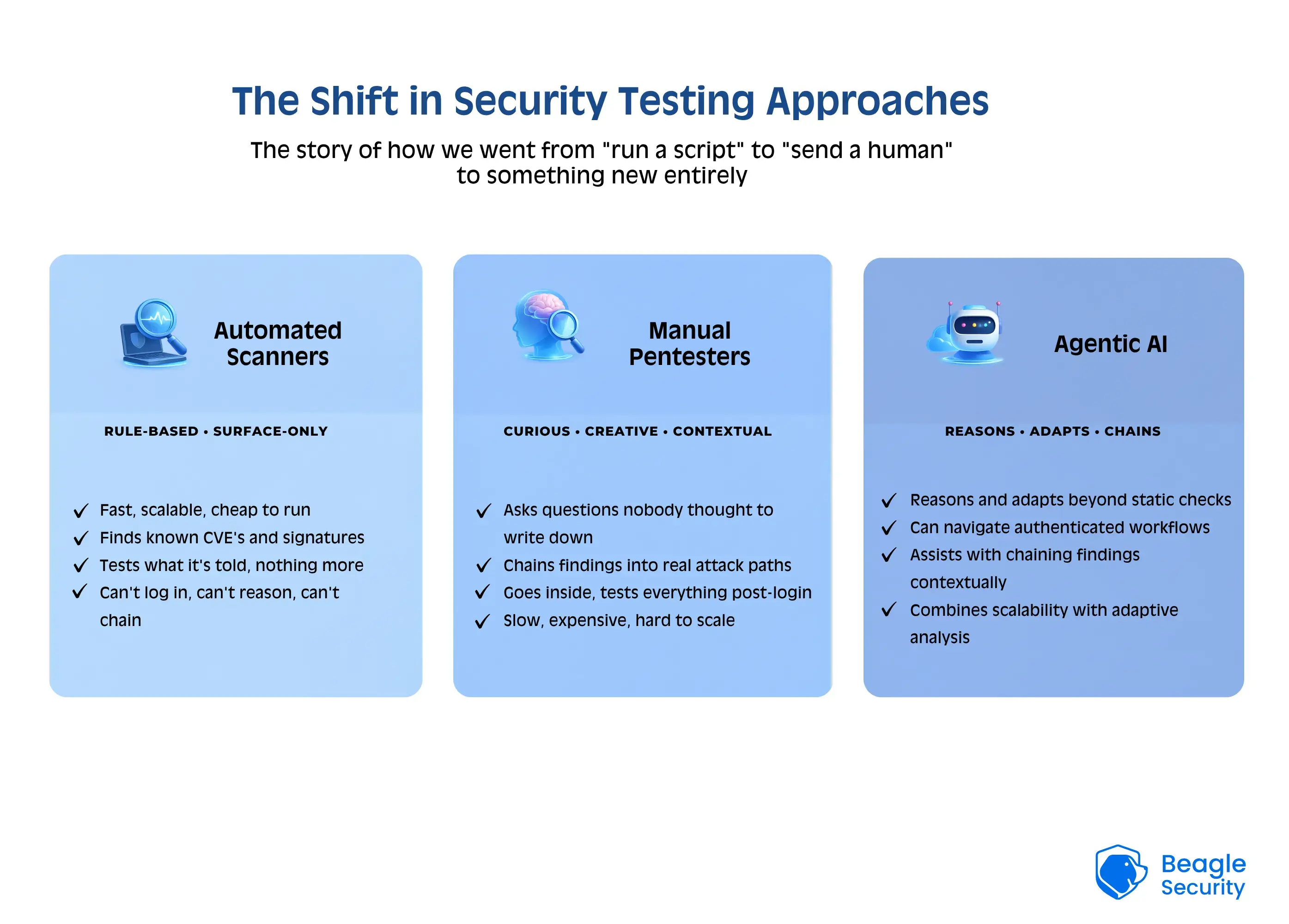
Traditional penetration testing is scenario-based and context-aware, relying on the creativity and intuition of skilled security professionals. Human testers think like adversaries chaining seemingly minor flaws into significant exploits, uncovering business logic vulnerabilities like manipulating pricing or workflow approvals that automated tools consistently miss. That adversarial creativity is hard to replicate and remains one of the most valuable things a skilled tester brings to an engagement.
The challenge is scale. Because this work is inherently creative and context-driven, it’s difficult to perform continuously across a modern attack surface. A proper engagement takes days to weeks, and it’s not feasible to manually test every web app, API, and newly shipped feature every time the codebase changes. Testing naturally gets prioritized toward high-value systems, which means coverage gaps grow as applications do.
Agentic pentesting: Autonomous reasoning across the full attack cycle
Agentic pentesting takes a fundamentally different approach. Instead of manual testers working through a checklist, an agentic system reasons about your application the way an attacker would form hypotheses, running tests, interpreting results, and adapting its strategy based on what it finds, all without human direction at each step.
The word “agentic” is key here. An agent is an AI system that pursues a goal autonomously across multiple steps using tools, evaluating outcomes, and adjusting course. Applied to security testing, this means the system can:
Explore an application’s full attack surface continuously, across every endpoint and flow
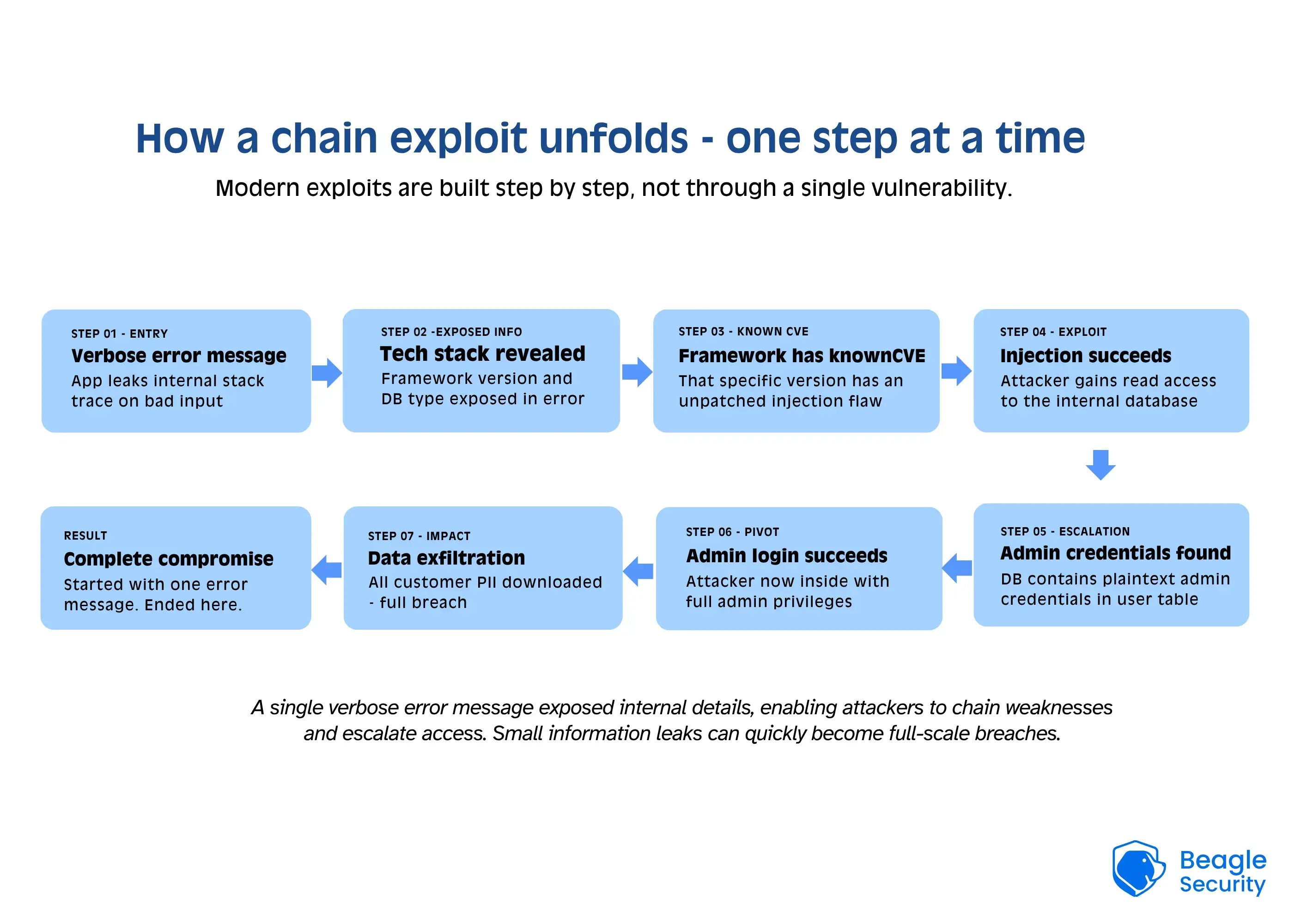
Chain findings across multiple requests to simulate realistic, multi-step attack scenarios
Reason about business logic, not just technical vulnerability patterns
Validate exploitability rather than flagging potential issues producing findings teams can actually act on
Integrate into CI/CD pipelines, running on-demand or with every significant change
What an agentic pentesting system actually does
When an agentic pentesting system begins a test, it doesn’t start from a fixed checklist. It starts by understanding the target mapping the application’s structure, endpoints, authentication model, and data flows. From there, it forms hypotheses about where vulnerabilities are likely to exist and begins testing, much like a human attacker would approach a new target.
Here’s what that looks like in practice:
Reconnaissance and mapping: The system automatically discovers the full attack surface endpoints, parameters, authentication flows, and technology stack without being told where to look.
Hypothesis-driven testing: Rather than firing random payloads, the agent reasons about what vulnerabilities are likely given the application’s structure and targets them deliberately.
Real-time adaptation: If one approach is blocked, the system pivots. If a vulnerability is found in one endpoint, it checks whether the same pattern exists elsewhere. It continuously adjusts strategy based on what it finds.
Authenticated and multi-step testing: The agent can log in, navigate complex user flows, perform actions as one user type, and verify whether another user can access the same result, the kind of testing that previously required a human tester.
Validated, actionable reporting: Rather than flagging potential issues, the system documents findings with proof-of-concept evidence, severity ratings, and remediation guidance so developers know exactly what’s exploitable and how to fix it.
What agentic pentesting can test today
Web applications and authenticated flows
Modern web applications are complex systems, not static pages. They have session management, role-based access controls, user state, and flows that only make sense once you’re logged in. Agentic systems can authenticate, navigate these flows, and test them the way a real user or a real attacker would.
This includes testing for broken access control, insecure direct object references, session fixation and hijacking vulnerabilities, and privilege escalation paths that only appear after authentication. Coverage that previously required a manual tester sitting in front of a browser is now something an agent can handle continuously.
REST and GraphQL APIs
APIs are increasingly the primary attack surface for modern applications, and agentic pentesting is well suited to testing them at scale. It can enumerate endpoints systematically, test parameter handling across a wide range of inputs, and identify issues like broken object-level authorization(BOLA), excessive data exposure, and improper rate limiting.
GraphQL introduces its own complexity, introspection queries, nested resolvers, batched requests and agentic systems can reason through these structures rather than applying generic checks that weren’t designed for them.
Business logic and multi-step attack chains
Business logic vulnerabilities, the kind that emerge from how an application is supposed to work, not just how it’s built, are consistently missed by scripted tools.
An agentic system can model a multi-step flow, reason about what should and shouldn’t be possible at each stage, and probe the gaps between expected and actual behavior. It can also chain findings together using a low-severity information disclosure to inform a more targeted attack on a sensitive operation the way a skilled human attacker would.
Why Beagle Security’s agentic pentesting changes how development teams ship
Beagle Security’s agentic pentesting fundamentally changes how teams ship by turning security from a periodic bottleneck into a continuous part of the SDLC. Instead of waiting for manual assessments, testing runs automatically within CI/CD pipelines as code is pushed. This ensures security validation happens alongside development, not after it. The result is faster feedback and fewer last-minute delays.
It also aligns with how modern teams work. What once took weeks of manual effort now fits within sprint cycles, with AI systems running tests continuously and at scale. Teams can identify and fix vulnerabilities during development instead of reacting to issues just before release. This shift reduces disruption and keeps delivery timelines predictable.
At the same time, it improves both coverage and clarity. Applications across web, APIs, and complex workflows are tested continuously without increasing security overhead. Findings come with proof and clear remediation steps, often integrated directly into developer tools. This allows teams to move quickly while staying confident that every release is secure.
If you want to see how it works firsthand, explore Beagle Security’s 14-day advanced trial or try the interactive demo.
FAQs
Is agentic pentesting the same as automated scanning?
No. Traditional automated scanners are static, they fire predefined payloads and pattern-match responses. Agentic pentesting systems reason about what they find, adapt their approach in real time, and can chain multiple steps together into complex attack sequences.
What is the difference between agentic AI and generative AI?
Agentic AI acts independently to achieve complex goals by planning, reasoning, and using tools. While generative AI is reactive (waiting for prompts), agentic AI is proactive (taking steps to finish tasks), often using generative models internally to fulfill its objectives.
How does agentic pentesting handle authentication?
Agentic systems like Beagle Security’s platform are designed to navigate real authentication flows. You provide credentials for the roles you want tested, and the system handles authentication as part of its testing process giving it access to the authenticated functionality where the most sensitive features live.